Current Events

  • Kansas Legislator Proposes Bill to Outlaw Sustainability Education
    A bill has been introduced in the Kansas legislature this week that would prohibit the promotion of ...Read more

    x

    Kansas Legislator Proposes Bill to Outlaw Sustainability Education

    A bill has been introduced in the Kansas legislature this week that would prohibit the promotion of sustainability. Here is a link to the one-page bill: http://www.kslegislature.org/li/b2013_14/measures/documents/hb2366_00_0000.pdf. See report on Bloomberg News.
  • Earth's Center Is 1,000 Degrees Hotter Than Previously Thought, Synchrotron X-Ray Experiment Shows
    Scientists have determined the temperature near the Earth’s center to be 6000 degrees Celsius, 1000 ...Read more

    x

    Earth's Center Is 1,000 Degrees Hotter Than Previously Thought, Synchrotron X-Ray Experiment Shows

    Scientists have determined the temperature near the Earth’s center to be 6000 degrees Celsius, 1000 degrees hotter than in a previous experiment run 20 years ago. These measurements confirm geophysical models that the temperature difference between the solid core and the mantle above, must be at least 1500 degrees to explain why the Earth has a magnetic field. For more information about this study, see the press release from the European Synchrotron Radiation Facility.
  • Ocean Volcanic Rocks Contain Samples of Recycled Crust
    Scientists have long believed that lava erupted from certain oceanic volcanoes contains materials fr...Read more

    x

    Ocean Volcanic Rocks Contain Samples of Recycled Crust

    Scientists have long believed that lava erupted from certain oceanic volcanoes contains materials from the early Earth’s crust. But decisive evidence for this phenomenon has proven elusive. New research from a team including Carnegie’s Erik Hauri demonstrates that oceanic volcanic rocks contain samples of recycled crust dating back to the Archean era 2.5 billion years ago. Their work is published in Nature. Oceanic crust sinks into the Earth’s mantle at so-called subduction zones, where two plates come together. Much of what happens to the crust during this journey is unknown. Model-dependent studies for how long subducted material can exist in the mantle are uncertain and evidence of very old crust returning to Earth’s surface via upwellings of magma has not been found until now. For more information about these results, see the press release from the Carnegie Institution.
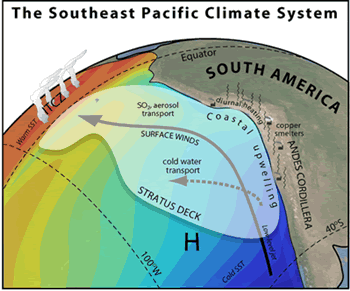
What’s in a global climate model? The Community Climate System Model (CCSM version 3) that is run with the supercomputer at the National Center for Atmospheric Research incorporates data about all of the natural processes shown in this diagram to simulate Earth’s complex climate system.
Click on image for full size
UCAR

Global Climate Models and the Southeast Pacific

Global Climate Models (GCMs) are run on fast supercomputers as a way to better understand Earth's climate. Scientists are always trying to make these models better so that the results are more accurate. We know that climate is not the same everywhere in the world. There are some places where it is relatively easy to model the climate. There are other places where it is tricky to get realistic results from climate models. The Southeast Pacific, near the west coast of South America, turns out to be one of those tricky places!

Why is it so difficult to model the climate of the Southeast Pacific? There are lots of reasons. There are a lot of connections between the land, ocean, and atmosphere in that area. Climate models have many different parts: the ocean, the clouds, chemicals in the atmosphere, and so on. In some places, these different systems influence each other a lot. That means the overall GCM only works well if the connections between parts of the model are good. It is challenging to get all of those relationships right in the Southeast Pacific.

There are other things happening in the Southeast Pacific that make it difficult to model. El Nino and La Nina are influenced by the climate of the Southeast Pacific. These events are also connected, however, to places in the Western Pacific thousands of kilometers away and even to phenomena that occur in the Atlantic Ocean! Climate model connections that have to cover that much area are especially difficult for scientists to accurately describe and predict.

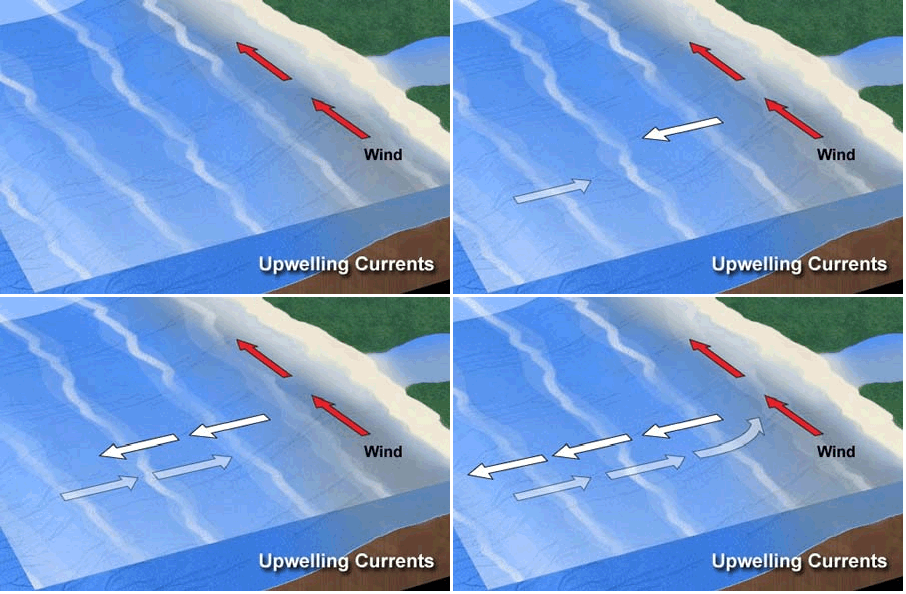
VOCALS scientists intend to improve modeling of the Southeast Pacific region. They want to make better models of cloud formation. They want to better understand how upwelling of cold ocean waters in coastal regions influences climate. They hope to get a better picture of the roles of aerosols in cloud formation, and they want to understand the extent to which different aerosols and low-level cumulus clouds reflect away incoming sunlight.

Last modified September 19, 2008 by Sandra Henderson.

Shop Windows to the Universe Science Store!

Learn about Earth and space science, and have fun while doing it! The games section of our online store includes a climate change card game and the Traveling Nitrogen game!

Windows to the Universe Community

News

Opportunities

You might also be interested in:

Traveling Nitrogen Classroom Activity Kit

Check out our online store - minerals, fossils, books, activities, jewelry, and household items!...more

What Is Climate?

The climate where you live is called regional climate. It is the average weather in a place over more than thirty years. To describe the regional climate of a place, people often tell what the temperatures...more

Southeast Pacific Climate

The Southeast Pacific Ocean region off the coastal areas of Peru and Chile is one part of the world where stratus and stratocumulus clouds are frequently present. Other areas include the subtropical climate...more

Ocean-Atmosphere Coupling in the Southeast Pacific

There are many connections between the ocean and the atmosphere in the Southeast Pacific Ocean. Strong winds blow north along the coast of South America. These winds stir up the ocean. That brings cold...more

How Clouds Form

A cloud is composed of tiny water droplets or ice crystals that are suspended in the air. A series of processes have to happen in order for these water droplets or ice crystals to form into clouds in the...more

Ocean Upwelling

There are places in the ocean where water from the deep sea travels up to the surface. These are called areas of upwelling. The deep waters can have a large influence upon life in the ocean and the climate...more

Aerosols: Tiny Particulates in the Air

When you look up at the sky, you are looking at more than just air. There are also billions of tiny bits of solid and liquid floating in the atmosphere. Those tiny floating particles are called aerosols...more

Low Clouds

The low cloud group consists of Stratus, Stratocumulus, and Nimbostratus clouds. Low clouds consist of water droplets. The base of a low cloud is from the ground surface to 2000m....more

Shop Windows to the Universe

We now offer the Cool It! card game in our Science Store. Cool It! is the new card game from UCS that teaches kids about the choices we have when it comes to climate change.

Windows to the Universe, a project of the National Earth Science Teachers Association, is sponsored in part by the National Science Foundation and NASA, our Founding Partners (the American Geophysical Union and American Geosciences Institute) as well as through Institutional, Contributing, and Affiliate Partners, individual memberships and generous donors. Thank you for your support! NASA AGU AGI NSF