Current Events

  • Atmospheric CO2 Level Tops 400 ppm
    During the week of May 13th, the CO2 level at the Mauna Loa Observatory in Hawaii topped 400 ppm rep...Read more

    x

    Atmospheric CO2 Level Tops 400 ppm

    During the week of May 13th, the CO2 level at the Mauna Loa Observatory in Hawaii topped 400 ppm repeatedly. Daily levels of CO2 can vary due to weather, and there are seasonal trends as well. The level of atmospheric greenhouse gases continues to increase, now over 120 ppm since the Industrial Revolution began. For more on the Keeling Curve, see http://keelingcurve.ucsd.edu/. Find out more about greenhouse gases and warming.
  • Massive Tornado Outbreak on Tornado Alley
    The week of May 19 brings dozens of tornadoes to Tornado Alley in the states of Oklahoma, Kansas, Io...Read more

    x

    Massive Tornado Outbreak on Tornado Alley

    The week of May 19 brings dozens of tornadoes to Tornado Alley in the states of Oklahoma, Kansas, Iowa, Illinois and Missouri. On May 20th, a massive tornado struck Moore, Oklahoma, devastating communities - destroying over 100 homes and hitting two elementary schools and a hospital - with many casualties and deaths. Our thoughts are with our friends and colleagues suffering from these storms. For more on the May 20th storms, see the NOAA Storm Prediction Center Storm Report.
  • Kansas Legislator Proposes Bill to Outlaw Sustainability Education
    A bill has been introduced in the Kansas legislature this week that would prohibit the promotion of ...Read more

    x

    Kansas Legislator Proposes Bill to Outlaw Sustainability Education

    A bill has been introduced in the Kansas legislature this week that would prohibit the promotion of sustainability. Here is a link to the one-page bill: http://www.kslegislature.org/li/b2013_14/measures/documents/hb2366_00_0000.pdf. See report on Bloomberg News.
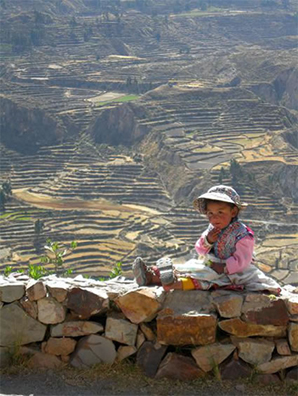
An indigenous young girl in Colca Canyon, Peru. In the background are the famed Inca irrigation terraces still in use today.
Click on image for full size
Photograph by Tamara Smith

Kids' Fun and Games - Climate Science from the Southeast Pacific

Not many people have heard of the Southeast Pacific. That's just the area that includes parts of Peru, Chile, and the Pacific Ocean. Scientists are going to study that area in depth. They will learn about the climate of that large region. Then they'll be able to understand the Earth's whole climate system better. There will be a big team of scientists all working together to make this study a success. They will use many instruments, even ships and airplanes!

And they will write postcards about their exciting experiences! Explore these games and activities to learn more about this interesting study. Most are available in three levels - Advanced, Intermediate, and Beginner. Try Advanced for a real challenge (use the top button bar to change level)!

Fun and Games on Windows to the Universe

The Clouds and Atmosphere Word Search

Crossword Puzzle - Climate Science from the Southeast Pacific

Crossword Puzzle - General Climate

Crossword Puzzle - Weather

The Motions of the Ocean Word Search

Learn more about the climate of the Southeast Pacific with our Flash interactive

More Games on Windows to the Universe

Fun and Games - Outside Links

Kidsgeo.com (geography for kids!)

Many Science Printable Coloring Pages (and more!)

National Geographic Games (and more for kids!)

Web Weather for Kids (games, activities, information for kids!)

Last modified October 1, 2008 by Jennifer Bergman.

Shop Windows to the Universe Science Store!

Our online store includes issues of NESTA's quarterly journal, The Earth Scientist, full of classroom activities on different topics in Earth and space science, as well as books on science education!

Windows to the Universe Community

News

Opportunities

You might also be interested in:

Traveling Nitrogen Classroom Activity Kit

Check out our online store - minerals, fossils, books, activities, jewelry, and household items!...more

What Is Climate?

The climate where you live is called regional climate. It is the average weather in a place over more than thirty years. To describe the regional climate of a place, people often tell what the temperatures...more

What Controls the Climate?

Some of the factors that have an affect on climate, like volcanic eruptions and changes in the amount of solar energy, are natural. Others, like the addition of greenhouse gases to the atmosphere, are...more

Climate Science from the Southeast Pacific - Educators' Page

As an educator, you have the challenging task of teaching content that is integrated into other content areas to many students at various learning levels. Hopefully, looking into the VOCALS campaign can...more

What is VOCALS?

What if you wanted to learn more about the climate of a very large area of the world? What would be involved in studying how the oceans, land, and atmosphere interact? You would need to have a team of...more

Satellites in the VOCALS Field Campaign

Scientists use lots of data from satellites in the VOCALS field campaign. They also gather data from instruments on ships and on airplanes. When they combine data from satellites, ships, and aircraft,...more

Ocean-Atmosphere Coupling in the Southeast Pacific

There are many connections between the ocean and the atmosphere in the Southeast Pacific Ocean. Strong winds blow north along the coast of South America. These winds stir up the ocean. That brings cold...more

Finding Water in the Sky

The Atacama Desert is one of the driest places on Earth. The lack of water makes life hard, yet more than a million people live there. One place where people get the water they need to survive is from...more

Shop Windows to the Universe

Dig into Montana Before History: 11K Years of Hunter-Gatherers in the Rockies and Plains by D. H. MacDonald, Ph.D. See our online store book collection.

Windows to the Universe, a project of the National Earth Science Teachers Association, is sponsored in part by the National Science Foundation and NASA, our Founding Partners (the American Geophysical Union and American Geosciences Institute) as well as through Institutional, Contributing, and Affiliate Partners, individual memberships and generous donors. Thank you for your support! NASA AGU AGI NSF