Current Events

  • Kansas Legislator Proposes Bill to Outlaw Sustainability Education
    A bill has been introduced in the Kansas legislature this week that would prohibit the promotion of ...Read more

    x

    Kansas Legislator Proposes Bill to Outlaw Sustainability Education

    A bill has been introduced in the Kansas legislature this week that would prohibit the promotion of sustainability. Here is a link to the one-page bill: http://www.kslegislature.org/li/b2013_14/measures/documents/hb2366_00_0000.pdf. See report on Bloomberg News.
  • Earth's Center Is 1,000 Degrees Hotter Than Previously Thought, Synchrotron X-Ray Experiment Shows
    Scientists have determined the temperature near the Earth’s center to be 6000 degrees Celsius, 1000 ...Read more

    x

    Earth's Center Is 1,000 Degrees Hotter Than Previously Thought, Synchrotron X-Ray Experiment Shows

    Scientists have determined the temperature near the Earth’s center to be 6000 degrees Celsius, 1000 degrees hotter than in a previous experiment run 20 years ago. These measurements confirm geophysical models that the temperature difference between the solid core and the mantle above, must be at least 1500 degrees to explain why the Earth has a magnetic field. For more information about this study, see the press release from the European Synchrotron Radiation Facility.
  • Ocean Volcanic Rocks Contain Samples of Recycled Crust
    Scientists have long believed that lava erupted from certain oceanic volcanoes contains materials fr...Read more

    x

    Ocean Volcanic Rocks Contain Samples of Recycled Crust

    Scientists have long believed that lava erupted from certain oceanic volcanoes contains materials from the early Earth’s crust. But decisive evidence for this phenomenon has proven elusive. New research from a team including Carnegie’s Erik Hauri demonstrates that oceanic volcanic rocks contain samples of recycled crust dating back to the Archean era 2.5 billion years ago. Their work is published in Nature. Oceanic crust sinks into the Earth’s mantle at so-called subduction zones, where two plates come together. Much of what happens to the crust during this journey is unknown. Model-dependent studies for how long subducted material can exist in the mantle are uncertain and evidence of very old crust returning to Earth’s surface via upwellings of magma has not been found until now. For more information about these results, see the press release from the Carnegie Institution.
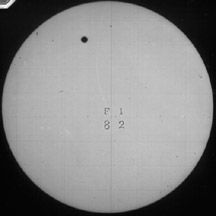
This picture was made in 1882. It shows Venus during the transit of 1882. The big white circle is the Sun. Venus is the black dot on the Sun. Venus is near the top of the Sun.
Click on image for full size
Image courtesy the U.S. Naval Observatory Library.

History of Venus Transits

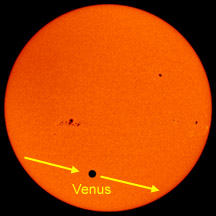
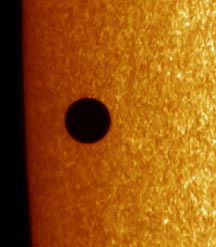
Sometimes the planet Venus goes between Earth and the Sun. From Earth it looks like a black dot moves across the Sun. Astronomers call this a transit of Venus.

Transits of Venus don't happen very often. Sometimes the wait between transits is about eight years. Sometimes the wait is more than 100 years!

There will be two Venus transits pretty soon. One is very soon. It will be on June 8, 2004. The next one will be eight years later on June 6, 2012. After that, you will have to wait a very long time before another Venus transit. The next one won't be until the year 2117!

People have only seen five transits of Venus so far. Those transits were in 1639, 1761, 1769, 1874, and 1882.

In the past, people didn't know how far the Sun is from Earth. We didn't know how big the rest of our Solar System is either. Astronomers made some measurements during Venus transits. They used those measurements to figure out how far away the Sun is. The Sun is about 150 million kilometers (93 million miles) from Earth. That is a very, very long way!

Last modified May 26, 2004 by Randy Russell.

Shop Windows to the Universe Science Store!

Our online store includes books on science education, ranging from evolution, classroom research, and the need for science and math literacy!

Windows to the Universe Community

News

Opportunities

You might also be interested in:

Transits of Venus

Sometimes the planet Venus gets between Earth and the Sun. When it does, we see a black dot move across the Sun. The black dot is Venus. Astronomers have a name for this. They call it a "transit"...more

Transit

"Transit" is a special term astronomers use. A transit is like an eclipse of the Sun. When an eclipse of the Sun happens, the Moon gets between us and the Sun and blocks the sunlight. When a transit happens,...more

Venus Transit in June 2004

Sometimes planets go in between Earth and the Sun. When that happens astronomers call it a "transit". On June 8, 2004, the planet Venus will move between Earth and the Sun. There will be a transit of Venus!...more

Mercury Transit on November 8, 2006

The planet Mercury will cross in front of the Sun on Wednesday, November 8, 2006. When that happens, astronomers call it a transit. A transit is like a solar eclipse. An eclipse happens when the Moon passes...more

Venus Inside and On Top

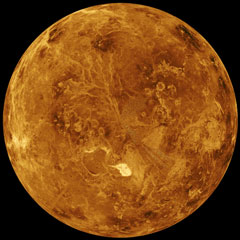
Venus is the second planet from the Sun, and is Earth's closest neighbor in the solar system. Venus is the brightest object in the sky after the Sun and the Moon, and sometimes looks like a bright star...more

History of Venus Transits

Sometimes the planet Venus goes between Earth and the Sun. From Earth it looks like a black dot moves across the Sun. Astronomers call this a transit of Venus. Transits of Venus don't happen very often....more

The Poles of Venus

Venus is the hottest planet in our Solar System. On Earth, places near the equator are hot. Places near the poles are cold. On Venus, it is really hot everywhere... even at the North and South Poles. Venus...more

The Polar Atmosphere of Venus

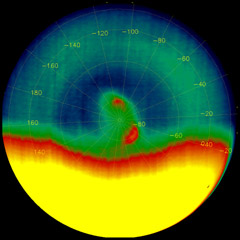
A vortex is a swirling, circular movement of air and clouds... like in a tornado or hurricane. The plural form of vortex is "vortices". The planet Venus has vortices in its atmosphere above each of its...more

Shop Windows to the Universe

Hands On Mineral Identification helps you to identify over 14,500 minerals! By M. Darby Dyar, Ph.D. See our DVD collection.

Windows to the Universe, a project of the National Earth Science Teachers Association, is sponsored in part by the National Science Foundation and NASA, our Founding Partners (the American Geophysical Union and American Geosciences Institute) as well as through Institutional, Contributing, and Affiliate Partners, individual memberships and generous donors. Thank you for your support! NASA AGU AGI NSF