Current Events

  • Atmospheric CO2 Level Tops 400 ppm
    During the week of May 13th, the CO2 level at the Mauna Loa Observatory in Hawaii topped 400 ppm rep...Read more

    x

    Atmospheric CO2 Level Tops 400 ppm

    During the week of May 13th, the CO2 level at the Mauna Loa Observatory in Hawaii topped 400 ppm repeatedly. Daily levels of CO2 can vary due to weather, and there are seasonal trends as well. The level of atmospheric greenhouse gases continues to increase, now over 120 ppm since the Industrial Revolution began. For more on the Keeling Curve, see http://keelingcurve.ucsd.edu/. Find out more about greenhouse gases and warming.
  • Massive Tornado Outbreak on Tornado Alley
    The week of May 19 brings dozens of tornadoes to Tornado Alley in the states of Oklahoma, Kansas, Io...Read more

    x

    Massive Tornado Outbreak on Tornado Alley

    The week of May 19 brings dozens of tornadoes to Tornado Alley in the states of Oklahoma, Kansas, Iowa, Illinois and Missouri. On May 20th, a massive tornado struck Moore, Oklahoma, devastating communities - destroying over 100 homes and hitting two elementary schools and a hospital - with many casualties and deaths. Our thoughts are with our friends and colleagues suffering from these storms. For more on the May 20th storms, see the NOAA Storm Prediction Center Storm Report.
  • Kansas Legislator Proposes Bill to Outlaw Sustainability Education
    A bill has been introduced in the Kansas legislature this week that would prohibit the promotion of ...Read more

    x

    Kansas Legislator Proposes Bill to Outlaw Sustainability Education

    A bill has been introduced in the Kansas legislature this week that would prohibit the promotion of sustainability. Here is a link to the one-page bill: http://www.kslegislature.org/li/b2013_14/measures/documents/hb2366_00_0000.pdf. See report on Bloomberg News.
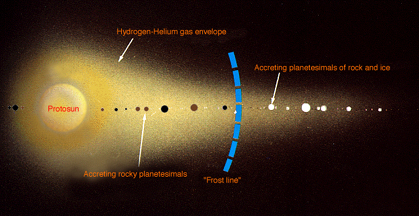
This is a schematic showing how atmospheres form.
Click on image for full size
Image from: The New Solar System

How a planet-to-be sweeps up nearby material to be part of itself

As shown in this picture, while they were forming in the solar nebula, the core of the planets-to-be drew material to themselves from the cloud of gas and dust around them. The bigger planets-to-be were able to draw even more material unto themselves because of gravity.

Big protoplanets such as Uranus and Neptune were positioned far out in the cloud where there was less gas. That is why Uranus and Neptune are not as big as Jupiter.


Shop Windows to the Universe Science Store!

Our online store includes issues of NESTA's quarterly journal, The Earth Scientist, full of classroom activities on different topics in Earth and space science, as well as books on science education!

Windows to the Universe Community

News

Opportunities

You might also be interested in:

Traveling Nitrogen Classroom Activity Kit

Check out our online store - minerals, fossils, books, activities, jewelry, and household items!...more

The position of Uranus when gas changed to ice

The position of the planets in the solar nebula affected how big they became and what they were made of. The blue line in the picture shows where it became so cold that ice began to form. Planets that...more

Uranus' Smog

Besides methane, Uranus' atmosphere contains even more complex molecules. These molecules form layers of smog over the clouds of Uranus, as shown in the picture. ...more

Uranus' Mesosphere

The mesosphere of Uranus is a region of balance between warming and cooling. That essentially means that nothing happens there. Except for diffusion, the atmosphere is still. Upper reaches of the atmosphere,...more

An Overview of Uranus' Atmospheric Structure

As on Earth, the atmosphere of Uranus consists of a troposphere, stratosphere, mesosphere, and thermosphere. The troposphere is the region where the visible clouds are to be found. The stratosphere, as...more

Altitude Changes of the Belts & Zones

On Uranus, as on Jupiter, the winds in the belts and zones blow first in one direction, then in the other direction. The clouds rise up in a belt, and drop down in a zone, as shown in this picture. This...more

Why Uranus looks like a "bullseye"

The clouds on Uranus, like Jupiter, are divided into stripes. On Uranus the stripes are hard to find. The left picture shows the north pole of Uranus. In this picture only the smog can be seen. The clouds,...more

Uranus Clouds, Overview

The clouds of Uranus, made of methane crystals, are found very low in the sky, and are difficult to find beneath the hazey smog of the pla net. False color is used, in the picture of Uranus to the right,...more

Shop Windows to the Universe

Ready, Set, SCIENCE!, by the National Research Council, focuses on K-8 science classsrooms. Check out the other publications in our online store, as well as classroom materials.

Windows to the Universe, a project of the National Earth Science Teachers Association, is sponsored in part by the National Science Foundation and NASA, our Founding Partners (the American Geophysical Union and American Geosciences Institute) as well as through Institutional, Contributing, and Affiliate Partners, individual memberships and generous donors. Thank you for your support! NASA AGU AGI NSF