Current Events

  • Kansas Legislator Proposes Bill to Outlaw Sustainability Education
    A bill has been introduced in the Kansas legislature this week that would prohibit the promotion of ...Read more

    x

    Kansas Legislator Proposes Bill to Outlaw Sustainability Education

    A bill has been introduced in the Kansas legislature this week that would prohibit the promotion of sustainability. Here is a link to the one-page bill: http://www.kslegislature.org/li/b2013_14/measures/documents/hb2366_00_0000.pdf. See report on Bloomberg News.
  • Earth's Center Is 1,000 Degrees Hotter Than Previously Thought, Synchrotron X-Ray Experiment Shows
    Scientists have determined the temperature near the Earth’s center to be 6000 degrees Celsius, 1000 ...Read more

    x

    Earth's Center Is 1,000 Degrees Hotter Than Previously Thought, Synchrotron X-Ray Experiment Shows

    Scientists have determined the temperature near the Earth’s center to be 6000 degrees Celsius, 1000 degrees hotter than in a previous experiment run 20 years ago. These measurements confirm geophysical models that the temperature difference between the solid core and the mantle above, must be at least 1500 degrees to explain why the Earth has a magnetic field. For more information about this study, see the press release from the European Synchrotron Radiation Facility.
  • Ocean Volcanic Rocks Contain Samples of Recycled Crust
    Scientists have long believed that lava erupted from certain oceanic volcanoes contains materials fr...Read more

    x

    Ocean Volcanic Rocks Contain Samples of Recycled Crust

    Scientists have long believed that lava erupted from certain oceanic volcanoes contains materials from the early Earth’s crust. But decisive evidence for this phenomenon has proven elusive. New research from a team including Carnegie’s Erik Hauri demonstrates that oceanic volcanic rocks contain samples of recycled crust dating back to the Archean era 2.5 billion years ago. Their work is published in Nature. Oceanic crust sinks into the Earth’s mantle at so-called subduction zones, where two plates come together. Much of what happens to the crust during this journey is unknown. Model-dependent studies for how long subducted material can exist in the mantle are uncertain and evidence of very old crust returning to Earth’s surface via upwellings of magma has not been found until now. For more information about these results, see the press release from the Carnegie Institution.
This is an image of Earth's tropospheric clouds.
Click on image for full size

Uranus' Troposphere

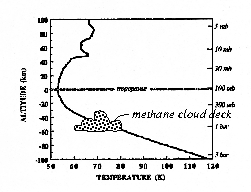
The troposphere of Uranus is where the methane clouds are. Clouds form in regions of strong atmospheric motion when condensation takes place. The troposphere is the region rapidly stirred by vertical motions.

The troposphere is warmed by the sun, warmed by Uranus' interior, and is cooled due to re-radiation to space by the gases of the atmosphere. For a picture showing how the temperature changes in this region, click here.


Shop Windows to the Universe Science Store!

Learn about Earth and space science, and have fun while doing it! The games section of our online store includes a climate change card game and the Traveling Nitrogen game!

Windows to the Universe Community

News

Opportunities

You might also be interested in:

Traveling Nitrogen Classroom Activity Kit

Check out our online store - minerals, fossils, books, activities, jewelry, and household items!...more

Uranus' Methane Clouds

The methane cloud deck of Uranus is found low in the troposphere. The methane clouds are the only clouds to be found on Uranus. The location of the clouds is predicted based upon the temperature at which...more

Uranus' Tropospheric Temperature Profile

This is the temperature profile of Uranus' troposphere. The temperature becomes cooler with height until the tropopause, or "top" of the troposphere is reached. The tropopause is defined to be the altitude...more

An Overview of Uranus' Atmospheric Structure

As on Earth, the atmosphere of Uranus consists of a troposphere, stratosphere, mesosphere, and thermosphere. The troposphere is the region where the visible clouds are to be found. The stratosphere, as...more

Uranus' Atmospheric Hazes

Besides methane, Uranus' atmosphere contains more sophisticated atmospheric molecules such as ethane gas, acetylene, and diacetylene. All these molecules form layers of haze at different altitudes high...more

Uranus' Mesosphere

The mesosphere of Uranus is a region of balance between warming and cooling. That essentially means that nothing happens there. Except for diffusion, the atmosphere is still. Upper reaches of the atmosphere,...more

Altitude Variations of the Belts & Zones

On Uranus, as on Jupiter, the winds in the belts and zones blow first in one direction, then in the opposite direction. Wind blows east in a belt, and west in a zone. The clouds rise up in a belt, and...more

Why Uranus looks like a "bullseye"

The striped cloud bands on Uranus, like Jupiter, are divided into belts and zones. On Uranus the belts and zones are hard to distinquish. The left picture shows the north pole of Uranus. In this picture...more

Shop Windows to the Universe

Dig into Montana Before History: 11K Years of Hunter-Gatherers in the Rockies and Plains by D. H. MacDonald, Ph.D. See our online store book collection.

Windows to the Universe, a project of the National Earth Science Teachers Association, is sponsored in part by the National Science Foundation and NASA, our Founding Partners (the American Geophysical Union and American Geosciences Institute) as well as through Institutional, Contributing, and Affiliate Partners, individual memberships and generous donors. Thank you for your support! NASA AGU AGI NSF