Current Events

  • Atmospheric CO2 Level Tops 400 ppm
    During the week of May 13th, the CO2 level at the Mauna Loa Observatory in Hawaii topped 400 ppm rep...Read more

    x

    Atmospheric CO2 Level Tops 400 ppm

    During the week of May 13th, the CO2 level at the Mauna Loa Observatory in Hawaii topped 400 ppm repeatedly. Daily levels of CO2 can vary due to weather, and there are seasonal trends as well. The level of atmospheric greenhouse gases continues to increase, now over 120 ppm since the Industrial Revolution began. For more on the Keeling Curve, see http://keelingcurve.ucsd.edu/. Find out more about greenhouse gases and warming.
  • Massive Tornado Outbreak on Tornado Alley
    The week of May 19 brings dozens of tornadoes to Tornado Alley in the states of Oklahoma, Kansas, Io...Read more

    x

    Massive Tornado Outbreak on Tornado Alley

    The week of May 19 brings dozens of tornadoes to Tornado Alley in the states of Oklahoma, Kansas, Iowa, Illinois and Missouri. On May 20th, a massive tornado struck Moore, Oklahoma, devastating communities - destroying over 100 homes and hitting two elementary schools and a hospital - with many casualties and deaths. Our thoughts are with our friends and colleagues suffering from these storms. For more on the May 20th storms, see the NOAA Storm Prediction Center Storm Report.
  • Kansas Legislator Proposes Bill to Outlaw Sustainability Education
    A bill has been introduced in the Kansas legislature this week that would prohibit the promotion of ...Read more

    x

    Kansas Legislator Proposes Bill to Outlaw Sustainability Education

    A bill has been introduced in the Kansas legislature this week that would prohibit the promotion of sustainability. Here is a link to the one-page bill: http://www.kslegislature.org/li/b2013_14/measures/documents/hb2366_00_0000.pdf. See report on Bloomberg News.
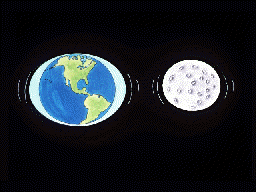
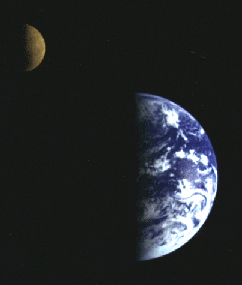
The Earth with its moon, as seen from space.
Click on image for full size
NASA.

The Moon's Orbit and Rotation

The Earth's Moon is the fifth largest in the whole solar system, and is bigger than the planet Pluto. The Moon has a nearly circular orbit (e=0.05) which is tilted about 5° to the plane of the Earth's orbit. Its average distance from the Earth is 384,400 km. The combination of the Moon's size and its distance from the Earth causes the Moon to appear the same size in the sky as the Sun, which is one reason we can have total solar eclipses.

The Moon's orbital period is 27.322 days. Because of this motion, the Moon appears to move about 13° against the stars each day, or about half of a degree per hour. If you watch the Moon over the course of several hours one night, you will notice that its position among the stars will change by a few degrees. The changing position of the Moon with respect to the Sun leads to lunar phases.

Have you ever heard the term the 'far-side' of the Moon? Because of the effect on the Moon of tidal forces due to the Earth, the same side of the moon always faces the Earth. The rotation period and the orbital period of the Moon are the same. Therefore, Earth-bound observers can never see the 'far-side' of the Moon. Tidal forces cause many of the moons of our solar system to have this type of orbit.

Shop Windows to the Universe Science Store!

The Summer 2010 issue of The Earth Scientist, available in our online store, includes articles on rivers and snow, classroom planetariums, satellites and oceanography, hands-on astronomy, and global warming.

Windows to the Universe Community

News

Opportunities

You might also be interested in:

Traveling Nitrogen Classroom Activity Kit

Check out our online store - minerals, fossils, books, activities, jewelry, and household items!...more

Tidal Forces

The force of gravity caused by an object gets weaker as you move farther away from that object. In this picture, the Earth is pulling on the Moon, and the Moon is pulling on the Earth. The Moon pulls more...more

What are the flat surfaces on the Moon called? What is maria? What are lunar highlands?

What phase was the Moon in on December, 22 1962? How long does it take the Moon to travel from one phase to the next? Suppose that the Moon spun twice on its axis during each orbit around the Earth. How...more

The Moons of Pluto

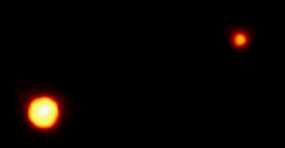
Pluto has // Call the moon count function defined in the document head print_moon_count('pluto'); known moons. Charon, the largest by far, was discovered in 1978 by the American astronomer James Christy....more

Charon - largest moon of Pluto

Charon is by far the largest of Pluto's // Call the moon count function defined in the document head print_moon_count('pluto'); known moons. Charon was discovered by the American astronomer James Christy...more

Native American Astronomy

By 30,000 B.C,. Asian hunter-gatherers had crossed the Bering Strait into North America. These people were the first to inhabit this new land and so they are known as the Native Americans of North America....more

Archeoastronomy

"The movements of the heavenly bodies are an admirable thing, well known and manifest to all peoples. There are no people, no matter how barbaric and primitive, that do not raise up their eyes, take note,...more

The Stones of Carnac

The stones of Carnac, France, are probably the most famous stones markings outside of those found at Stonehenge in England. Where Stonehenge is composed of standing stones, the Carnac area has many different...more

Shop Windows to the Universe

Young Voices for the Planet DVD in our online store includes 8 films where students speak out and take action on climate change.

Windows to the Universe, a project of the National Earth Science Teachers Association, is sponsored in part by the National Science Foundation and NASA, our Founding Partners (the American Geophysical Union and American Geosciences Institute) as well as through Institutional, Contributing, and Affiliate Partners, individual memberships and generous donors. Thank you for your support! NASA AGU AGI NSF