Current Events

  • Kansas Legislator Proposes Bill to Outlaw Sustainability Education
    A bill has been introduced in the Kansas legislature this week that would prohibit the promotion of ...Read more

    x

    Kansas Legislator Proposes Bill to Outlaw Sustainability Education

    A bill has been introduced in the Kansas legislature this week that would prohibit the promotion of sustainability. Here is a link to the one-page bill: http://www.kslegislature.org/li/b2013_14/measures/documents/hb2366_00_0000.pdf. See report on Bloomberg News.
  • Earth's Center Is 1,000 Degrees Hotter Than Previously Thought, Synchrotron X-Ray Experiment Shows
    Scientists have determined the temperature near the Earth’s center to be 6000 degrees Celsius, 1000 ...Read more

    x

    Earth's Center Is 1,000 Degrees Hotter Than Previously Thought, Synchrotron X-Ray Experiment Shows

    Scientists have determined the temperature near the Earth’s center to be 6000 degrees Celsius, 1000 degrees hotter than in a previous experiment run 20 years ago. These measurements confirm geophysical models that the temperature difference between the solid core and the mantle above, must be at least 1500 degrees to explain why the Earth has a magnetic field. For more information about this study, see the press release from the European Synchrotron Radiation Facility.
  • Ocean Volcanic Rocks Contain Samples of Recycled Crust
    Scientists have long believed that lava erupted from certain oceanic volcanoes contains materials fr...Read more

    x

    Ocean Volcanic Rocks Contain Samples of Recycled Crust

    Scientists have long believed that lava erupted from certain oceanic volcanoes contains materials from the early Earth’s crust. But decisive evidence for this phenomenon has proven elusive. New research from a team including Carnegie’s Erik Hauri demonstrates that oceanic volcanic rocks contain samples of recycled crust dating back to the Archean era 2.5 billion years ago. Their work is published in Nature. Oceanic crust sinks into the Earth’s mantle at so-called subduction zones, where two plates come together. Much of what happens to the crust during this journey is unknown. Model-dependent studies for how long subducted material can exist in the mantle are uncertain and evidence of very old crust returning to Earth’s surface via upwellings of magma has not been found until now. For more information about these results, see the press release from the Carnegie Institution.
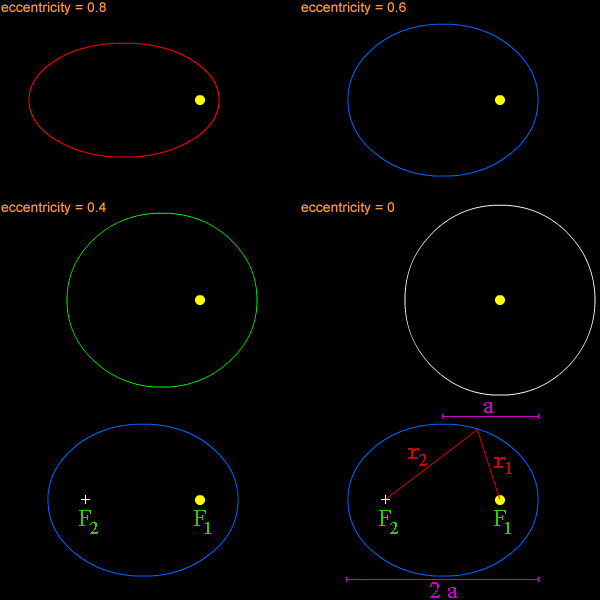
A diagram showing the elliptical orbits of some solar system objects.
Click on image for full size

Kepler's 1st Law: Orbits are Elliptical

With Tycho Brahe's observations, Kepler set out to determine if the paths of the planets could be described with a curve. By trial and error, he discovered that an ellipse with the Sun at one focus could accurately describe the orbit of a planet about the Sun.

Ellipses are described mainly by the length of their two axes. A circle has the same diameter whether you measure it across or up and down. But an ellipse has diameters of different lengths. The longest one is called the major axis, and the shortest one is the minor axis. The ratio of these two lengths determines the eccentricity (e) of the ellipse; it's a measure of how elliptical it is. Circles have e=0, and very stretched-out ellipses have an eccentricity nearly equal to 1.

Planets do move on ellipses, but they are nearly circular. Comets are a good example of objects in our solar system that may have very elliptical orbits. Compare the eccentricities and orbits of the objects in the diagram.

Once Kepler figured out that planets move around the Sun on ellipses, he then discovered another interesting fact about the speeds of planets as they go around the Sun.

Shop Windows to the Universe Science Store!

The Fall 2009 issue of The Earth Scientist, which includes articles on student research into building design for earthquakes and a classroom lab on the composition of the Earth’s ancient atmosphere, is available in our online store.

Windows to the Universe Community

News

Opportunities

You might also be interested in:

Traveling Nitrogen Classroom Activity Kit

Check out our online store - minerals, fossils, books, activities, jewelry, and household items!...more

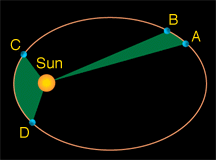
Kepler's 2nd Law: The Speeds of Planets

Kepler's second law he again discovered by trial and error. Kepler realized that the line connecting the planet and the Sun sweeps out equal area in equal time. Look at the diagram to the left. What Kepler...more

Elliptical Orbits

You may think that most objects in space that orbit something else move in circles, but that isn't the case. Although some objects follow circular orbits, most orbits are shaped more like "stretched...more

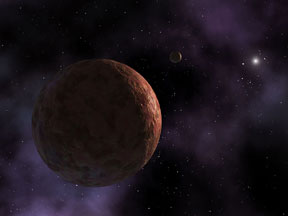
New planetoid named Sedna discovered

Astronomers have discovered a new planetoid at the far edge of our Solar System. The new object, named Sedna, is probably almost as big as the smallest planet, Pluto. Sedna is very, very far away. It is...more

Native American Astronomy

People from Asia crossed the Bering Strait into North America. These people were first in this new land and so they are known as Native Americans. Over time, these people broke into tribes (as seen on...more

Archeoastronomy

"The movements of the heavenly bodies are an admirable thing, well known and manifest to all peoples. There are no people, no matter how barbaric and primitive, that do not raise up their eyes, take note,...more

The Stones of Carnac

The stones of Carnac, France, are probably the most famous stones markings outside of those found at Stonehenge in England. There are many, many stones at Carnac. And these stones are very old too, the...more

The Cairns of Clava

Not too far from Loch Ness, there lies three giant tombs made of stones. They are called the Balnuaran of Clava. The Balnuaran of Clava, giant tombs encased in stone, can be found close to Inverness in...more

Shop Windows to the Universe

Hands On Mineral Identification helps you to identify over 14,500 minerals! By M. Darby Dyar, Ph.D. See our DVD collection.

Windows to the Universe, a project of the National Earth Science Teachers Association, is sponsored in part by the National Science Foundation and NASA, our Founding Partners (the American Geophysical Union and American Geosciences Institute) as well as through Institutional, Contributing, and Affiliate Partners, individual memberships and generous donors. Thank you for your support! NASA AGU AGI NSF