Artist's concept of the Polaris triple star system
Click on image for star map
NASA, ESA, G. Bacon (STScI)
Polaris - the North Star
|
What's in a Name: |
So named because it is the closest star to the celestial north pole.
|
|
Claim to Fame:
|
It's the famous North Star! (actually a triple star system) |
| Type of Star: |
Yellow-white Supergiant |
|
How Far Away: |
430 light years away |
|
How Big: |
About 46 times the size of the Sun |
| How Bright: |
Roughly 1800 times the luminosity of the Sun |
|
Where to View: | In the constellation Ursa Minor.
|
|
When to View: | All year round in the Northern Hemisphere |
You might also be interested in:
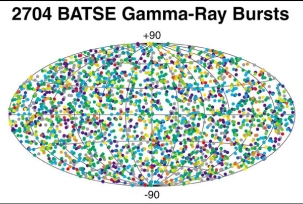
In the 1960's, the United States launched some satellites to look for very high energy light, called Gamma Rays. Gamma Rays are produced whenever a nuclear bomb explodes. The satellites found many bursts
...more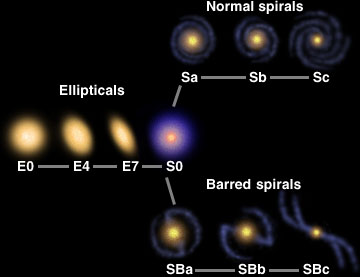
During the early 1900's, which is not very long ago, astronomers were unaware that there were other galaxies outside our own Milky Way Galaxy. When they saw a small fuzzy patch in the sky through their
...more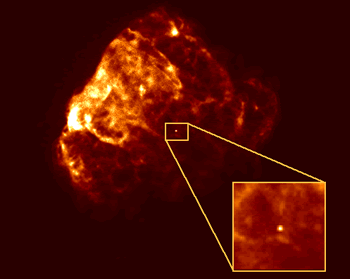
Neutron Stars are the end point of a massive star's life. When a really massive star runs out of nuclear fuel in its core the core begins to collapse under gravity. When the core collapses the entire star
...more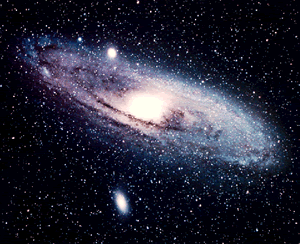
Spiral galaxies may remind you of a pinwheel. They are rotating disks of mostly hydrogen gas, dust and stars. Through a telescope or binoculars, the bright nucleus of the galaxy may be visible but the
...more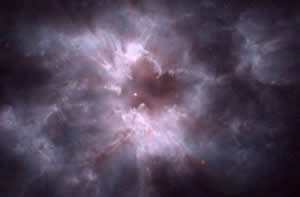
When stars like our own sun die they will become white dwarfs. As a star like our sun is running out of fuel in its core it begins to bloat into a red giant. This will happen to our sun in 5 Billion years.
...more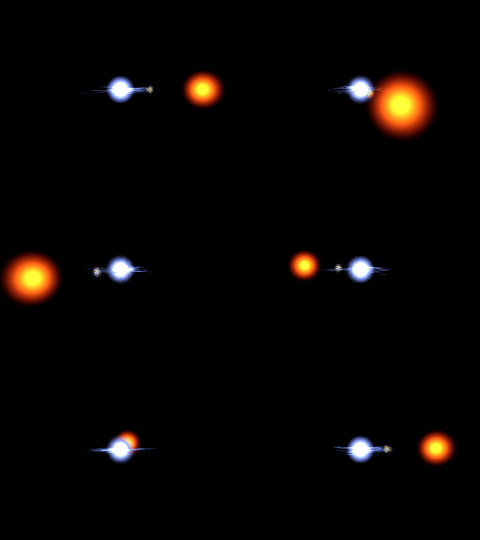
What's in a Name: Arabic for "head of the demon" Claim to Fame: Represents Medusa's eye in Perseus. A special variable star that "winks" every 3 days. Type of Star: Blue-white Main Sequence Star, and
...more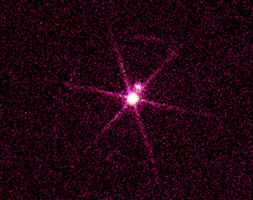
What's in a Name: Nicknamed the "Pup" because it is the companion to Sirius, "the Dog Star" Claim to Fame: Highly compressed white dwarf remnant. Density about 50,000 times that of water. It has approximately
...more