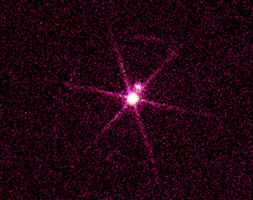
Brown Dwarf Gliese 229B - Hubble Space Telescope image
Click on image for full size
Hubble Space Telescope image (STScI/AURA)
Gliese 229b - Failed Star
|
What's in a Name:
| The 229th entry in the Gliese catalog of stars within 25 parsecs of the Sun (originally published in 1969). "B" means the secondary star in a binary system.
|
|
Claim to Fame: | First proven detection of a brown dwarf (an object too hot to be a planet but too cool to become a star - only 1300o F or 704o C) |
|
Type of Star: | Brown dwarf orbiting a red dwarf star. Shining from energy generated by gravitational contraction, not through nuclear reactions like stars.
|
|
How Far Away: | 18 light years |
|
How Big: | 20 - 50 times as massive as Jupiter (0.02 - 0.05 times the solar mass). Approximately the size of Jupiter
|
|
How Bright: | 1/100,000 of the sun's luminosity
|
|
Where to View: | Located in the constellation Lepus, the Hare. Orion's sword points towards Lepus. |
|
When to View: | Only visible in large telescopes. Lepus best viewed January - March |


Shop Windows to the Universe Science Store!
The
Fall 2009 issue of The Earth Scientist, which includes articles on student research into building design for earthquakes and a classroom lab on the composition of the Earth’s ancient atmosphere, is available in our
online store.
You might also be interested in:

In the 1960's, the United States launched some satellites to look for very high energy light, called Gamma Rays. Gamma Rays are produced whenever a nuclear bomb explodes. The satellites found many bursts
...more
During the early 1900's, which is not very long ago, astronomers were unaware that there were other galaxies outside our own Milky Way Galaxy. When they saw a small fuzzy patch in the sky through their
...more
Neutron Stars are the end point of a massive star's life. When a really massive star runs out of nuclear fuel in its core the core begins to collapse under gravity. When the core collapses the entire star
...more
Spiral galaxies may remind you of a pinwheel. They are rotating disks of mostly hydrogen gas, dust and stars. Through a telescope or binoculars, the bright nucleus of the galaxy may be visible but the
...more
When stars like our own sun die they will become white dwarfs. As a star like our sun is running out of fuel in its core it begins to bloat into a red giant. This will happen to our sun in 5 Billion years.
...more
What's in a Name: Arabic for "head of the demon" Claim to Fame: Represents Medusa's eye in Perseus. A special variable star that "winks" every 3 days. Type of Star: Blue-white Main Sequence Star, and
...more
What's in a Name: Nicknamed the "Pup" because it is the companion to Sirius, "the Dog Star" Claim to Fame: Highly compressed white dwarf remnant. Density about 50,000 times that of water. It has approximately
...more