Current Events

  • Atmospheric CO2 Level Tops 400 ppm
    During the week of May 13th, the CO2 level at the Mauna Loa Observatory in Hawaii topped 400 ppm rep...Read more

    x

    Atmospheric CO2 Level Tops 400 ppm

    During the week of May 13th, the CO2 level at the Mauna Loa Observatory in Hawaii topped 400 ppm repeatedly. Daily levels of CO2 can vary due to weather, and there are seasonal trends as well. The level of atmospheric greenhouse gases continues to increase, now over 120 ppm since the Industrial Revolution began. For more on the Keeling Curve, see http://keelingcurve.ucsd.edu/. Find out more about greenhouse gases and warming.
  • Massive Tornado Outbreak on Tornado Alley
    The week of May 19 brings dozens of tornadoes to Tornado Alley in the states of Oklahoma, Kansas, Io...Read more

    x

    Massive Tornado Outbreak on Tornado Alley

    The week of May 19 brings dozens of tornadoes to Tornado Alley in the states of Oklahoma, Kansas, Iowa, Illinois and Missouri. On May 20th, a massive tornado struck Moore, Oklahoma, devastating communities - destroying over 100 homes and hitting two elementary schools and a hospital - with many casualties and deaths. Our thoughts are with our friends and colleagues suffering from these storms. For more on the May 20th storms, see the NOAA Storm Prediction Center Storm Report.
  • Kansas Legislator Proposes Bill to Outlaw Sustainability Education
    A bill has been introduced in the Kansas legislature this week that would prohibit the promotion of ...Read more

    x

    Kansas Legislator Proposes Bill to Outlaw Sustainability Education

    A bill has been introduced in the Kansas legislature this week that would prohibit the promotion of sustainability. Here is a link to the one-page bill: http://www.kslegislature.org/li/b2013_14/measures/documents/hb2366_00_0000.pdf. See report on Bloomberg News.
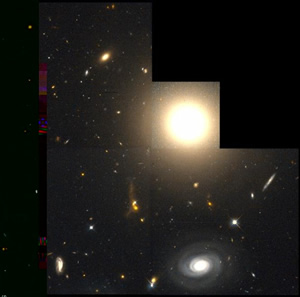
The Coma Cluster of Galaxies
Click on image for full size
Courtesy of NASA.

Large-Scale Structure: Your Place in the Universe

We have seen that stars cluster together to form galaxies. Galaxies also like to live together. There are clusters of galaxies called Groups which contain 10's of galaxies. Our own galaxy, the Milky Way lives in a group of about 30 galaxies, named the Local Group.

There are much larger clusters of galaxies that contain from 50 - 1000's of galaxies. Groups and Clusters live together to form even larger clusters known as Superclusters. The Local Group belongs to the Local Supercluster. In between Superclusters are enormous voids of space where there are almost no galaxies at all.

The Largest structures discovered in the Universe are systems of voids and clusters. At this scale the Universe looks foamy. The voids look like huge bubbles. Galaxies line these bubbles forming filaments that connect Superclusters.

Shop Windows to the Universe Science Store!

The Fall 2009 issue of The Earth Scientist, which includes articles on student research into building design for earthquakes and a classroom lab on the composition of the Earth’s ancient atmosphere, is available in our online store.

Windows to the Universe Community

News

Opportunities

You might also be interested in:

Traveling Nitrogen Classroom Activity Kit

Check out our online store - minerals, fossils, books, activities, jewelry, and household items!...more

Galaxies - Star Cities

When we look up at the night sky, we notice that there are many stars in our sky. Stars must like to live together in star cities - galaxies. Our city of stars is called the Milky Way, and it is home to...more

Gamma Ray Bursts - The Most Powerful Objects in the Universe?

Satellites in the 1960's looked for a type of light called Gamma Rays. They found bursts of Gamma Rays coming from outer space! They can't hurt you. They are stopped by the Earth's atmosphere. We have...more

Neutron Stars

Neutron Stars form when really big stars die. When such a star runs out of fuel its center begins to collapse under gravity. When the center collapses the entire star collapses. The surface of the star...more

Spiral Galaxies

Spiral galaxies may remind you of a pinwheel that blows in the breeze. Like a pinwheel, a spiral galaxy is rotating, and it has spiral arms. Through a telescope or binoculars,a spiral galaxy may look...more

White Dwarfs

When stars like our own sun die they will become White Dwarfs. As a star like our sun is running out of fuel in its center it grows into a red giant. This will happen to our sun in 5 Billion years. The...more

Algol

What's in a Name: Arabic for "head of the demon" Claim to Fame: Represents Medusa's eye in Perseus. A special variable star that "winks" every 3 days. Type of Star: Blue-white Main Sequence Star, and...more

Sirius B - Bizarre White Dwarf Companion of Sirius A

What's in a Name: Nicknamed the "Pup" because it is the companion to Sirius, "the Dog Star" Claim to Fame: Highly compressed white dwarf remnant. Density about 50,000 times that of water. It has approximately...more

Shop Windows to the Universe

Science, Evolution, and Creationism, by the National Academies, focuses on teaching evolution in today's classrooms. Check out the other publications in our online store.

Windows to the Universe, a project of the National Earth Science Teachers Association, is sponsored in part by the National Science Foundation and NASA, our Founding Partners (the American Geophysical Union and American Geosciences Institute) as well as through Institutional, Contributing, and Affiliate Partners, individual memberships and generous donors. Thank you for your support! NASA AGU AGI NSF