Current Events

  • Atmospheric CO2 Level Tops 400 ppm
    During the week of May 13th, the CO2 level at the Mauna Loa Observatory in Hawaii topped 400 ppm rep...Read more

    x

    Atmospheric CO2 Level Tops 400 ppm

    During the week of May 13th, the CO2 level at the Mauna Loa Observatory in Hawaii topped 400 ppm repeatedly. Daily levels of CO2 can vary due to weather, and there are seasonal trends as well. The level of atmospheric greenhouse gases continues to increase, now over 120 ppm since the Industrial Revolution began. For more on the Keeling Curve, see http://keelingcurve.ucsd.edu/. Find out more about greenhouse gases and warming.
  • Massive Tornado Outbreak on Tornado Alley
    The week of May 19 brings dozens of tornadoes to Tornado Alley in the states of Oklahoma, Kansas, Io...Read more

    x

    Massive Tornado Outbreak on Tornado Alley

    The week of May 19 brings dozens of tornadoes to Tornado Alley in the states of Oklahoma, Kansas, Iowa, Illinois and Missouri. On May 20th, a massive tornado struck Moore, Oklahoma, devastating communities - destroying over 100 homes and hitting two elementary schools and a hospital - with many casualties and deaths. Our thoughts are with our friends and colleagues suffering from these storms. For more on the May 20th storms, see the NOAA Storm Prediction Center Storm Report.
  • Kansas Legislator Proposes Bill to Outlaw Sustainability Education
    A bill has been introduced in the Kansas legislature this week that would prohibit the promotion of ...Read more

    x

    Kansas Legislator Proposes Bill to Outlaw Sustainability Education

    A bill has been introduced in the Kansas legislature this week that would prohibit the promotion of sustainability. Here is a link to the one-page bill: http://www.kslegislature.org/li/b2013_14/measures/documents/hb2366_00_0000.pdf. See report on Bloomberg News.
This image represents an expanding Universe. The arrows show that the movement is outward from the center. The spirals represent galaxies.
STsci

Hubble Flow: The Expanding Universe

In the 1920's the famous American astronomer Edwin Hubble made a startling discovery that forever changed our view of the Universe. He found that, no matter which direction he looked into space, distant galaxies appeared to be moving away from us. The farther away the galaxy is from our galaxy the faster it moves away from us. What could be causing this? Does our galaxy smell bad? Not at all. Hubble was observing the expansion of the Universe.

What does it mean that the Universe is expanding? Well, a simple way to think of it is to imagine baking a loaf of raisin bread. As the bread rises it also expands. All of the raisins move farther apart from one another. Every single raisin would see all of the others moving away from it. So to complete the analogy, all of the galaxies in the universe are like the raisins in the bread.

Shop Windows to the Universe Science Store!

The Fall 2009 issue of The Earth Scientist, which includes articles on student research into building design for earthquakes and a classroom lab on the composition of the Earth’s ancient atmosphere, is available in our online store.

Windows to the Universe Community

News

Opportunities

You might also be interested in:

Traveling Nitrogen Classroom Activity Kit

Check out our online store - minerals, fossils, books, activities, jewelry, and household items!...more

Scientists Find the True Hubble Constant!

After eight long years, the Hubble Space Telescope Key Project Team finally revealed what they believe is the real Hubble Constant. The Hubble Constant is the speed which the Universe is expanding at....more

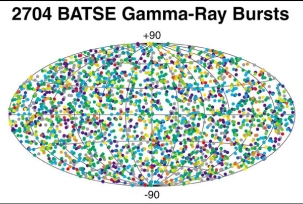
Gamma Ray Bursts - The Most Powerful Objects in the Universe?

In the 1960's, the United States launched some satellites to look for very high energy light, called Gamma Rays. Gamma Rays are produced whenever a nuclear bomb explodes. The satellites found many bursts...more

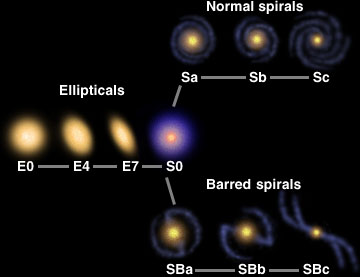
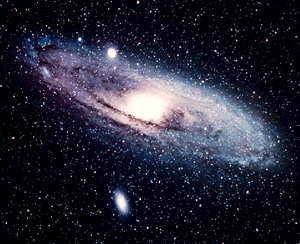
Galaxies

During the early 1900's, which is not very long ago, astronomers were unaware that there were other galaxies outside our own Milky Way Galaxy. When they saw a small fuzzy patch in the sky through their...more

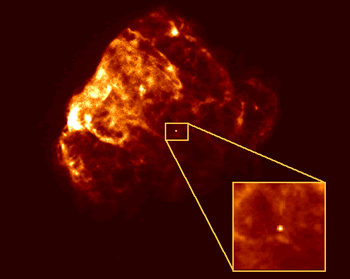
Neutron Stars

Neutron Stars are the end point of a massive star's life. When a really massive star runs out of nuclear fuel in its core the core begins to collapse under gravity. When the core collapses the entire star...more

Spiral Galaxies

Spiral galaxies may remind you of a pinwheel. They are rotating disks of mostly hydrogen gas, dust and stars. Through a telescope or binoculars, the bright nucleus of the galaxy may be visible but the...more

White Dwarfs

When stars like our own sun die they will become white dwarfs. As a star like our sun is running out of fuel in its core it begins to bloat into a red giant. This will happen to our sun in 5 Billion years....more

Algol

What's in a Name: Arabic for "head of the demon" Claim to Fame: Represents Medusa's eye in Perseus. A special variable star that "winks" every 3 days. Type of Star: Blue-white Main Sequence Star, and...more

Shop Windows to the Universe

Our Glaciers: Then and Now activity kit helps you see the changes taking place in glaciers around the world. See all our activity kits and classroom activities.

Windows to the Universe, a project of the National Earth Science Teachers Association, is sponsored in part by the National Science Foundation and NASA, our Founding Partners (the American Geophysical Union and American Geosciences Institute) as well as through Institutional, Contributing, and Affiliate Partners, individual memberships and generous donors. Thank you for your support! NASA AGU AGI NSF