Current Events

  • Irish Chronicles Document Links Between Volcanoes and Weather
    A study of over 40,000 written entries in Irish Annals and ice core measurements shows a strong corr...Read more

    x

    Irish Chronicles Document Links Between Volcanoes and Weather

    A study of over 40,000 written entries in Irish Annals and ice core measurements shows a strong correlation between the occurrence of volcanic eruptions and extreme cold weather in Ireland over a 1200 year period. Data analyzed in this study cover the period from 431 to 1649, during which time up to 48 volcanic eruptions are identified in Greenland ice core records through deposition of volcanic sulfate in annual layers of ice. You can find the study (open access), published on 6 June 2013 in IOP Publishing's journal Environmental Research Letters, at http://iopscience.iop.org/1748-9326/8/2/024035/article. Find out more about how volcanoes can influence climate.
  • EF-5 Tornado in El Reno, Oklahoma Widest Ever Recorded in US
    The EF-5 tornado that hit El Reno, Oklahoma on May 31st was the widest ever recorded in the US, acco...Read more

    x

    EF-5 Tornado in El Reno, Oklahoma Widest Ever Recorded in US

    The EF-5 tornado that hit El Reno, Oklahoma on May 31st was the widest ever recorded in the US, according to the National Weather Service in Norman Oklahoma. The tornado, which remained on the ground for 40 minutes and reached 2.6 miles across (4.2 km), took the lives of 18 people including storm chasers Tim Samaras, Paul Samaras and Carl Young. For more information on the tornado, visit http://ow.ly/i/2hfDG.
  • Atmospheric CO2 Level Tops 400 ppm
    During the week of May 13th, the CO2 level at the Mauna Loa Observatory in Hawaii topped 400 ppm rep...Read more

    x

    Atmospheric CO2 Level Tops 400 ppm

    During the week of May 13th, the CO2 level at the Mauna Loa Observatory in Hawaii topped 400 ppm repeatedly. Daily levels of CO2 can vary due to weather, and there are seasonal trends as well. The level of atmospheric greenhouse gases continues to increase, now over 120 ppm since the Industrial Revolution began. For more on the Keeling Curve, see http://keelingcurve.ucsd.edu/. Find out more about greenhouse gases and warming.
Virgo is found in the months of April through July.
Click on image for full size
Windows to the Universe original image

Virgo

The constellation Virgo is known as The Maiden. Virgo is the only female member of the zodiac. The constellation represents almost every famous and powerful female in mythology, including Athena, Artemis, Persephone and Demeter. She is usually carrying a grain of wheat and a staff.

The brightest star in the constellation is Spica, which happens to represent the grain of wheat. Hence the name, which is Latin for "ear of wheat". In the image, Spica is the large, white sphere in the lower left region. At first the constellation doesn't look like a person, until you realize she is lying down! Her head is towards the east.

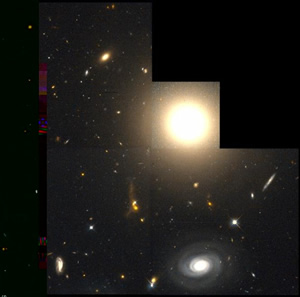
There is one cluster of stars called NGC 5634 located in Virgo's right leg. Unfortunately, there are no nebulae, but the large number of galaxies makes up for it. There is a large cluster of galaxies to the east of her left arm. It contains over 3,000 galaxies, many of which can be spotted with a telescope.

Shop Windows to the Universe Science Store!

The Fall 2009 issue of The Earth Scientist, which includes articles on student research into building design for earthquakes and a classroom lab on the composition of the Earth’s ancient atmosphere, is available in our online store.

Windows to the Universe Community

News

Opportunities

You might also be interested in:

Large-Scale Structure: Your Place in the Universe

When we look out into the Universe we observe some rather remarkable structure. We have seen that stars cluster together to form galaxies. But galaxies also cluster together to form much larger structures....more

Northern Hemisphere Constellations

Many different constellations fill the evening sky in the northern hemisphere. Depending on your location and the season, different constellations can be seen. Northern circumpolar constellations can be...more

Southern Hemisphere Constellations

Many different constellations fill the evening sky in the southern hemisphere. Depending on your location and the season, different constellations can be seen. Southern circumpolar constellations can be...more

Carina

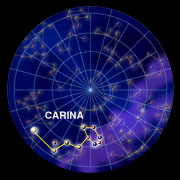
The constellation Carina is known as the Keel, which is the bottom part of old ships. Carina was originally a part of Argo Navis, which was a huge boat in the night sky. It has since been divided into...more

It All Depends On Your Point Of View

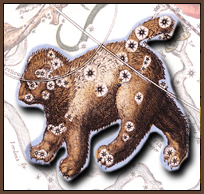
In most cases, however, the stars that we see that seem to be "close" to each other actually are quite far apart, some stars are much closer or farther than others as is shown in the example below of Ursa...more

As the World Turns

In our time, scientists (and most people!) know that the constellations seem to move across the sky because the earth rotates on its axis. What, you may ask, does the turning of the earth have to do with...more

The Changing Night Sky

If you look at the night sky at different times of the year you see different constellations. This change is due to the motion of the Earth in its orbit around the Sun. As the Earth revolves about the...more

Constellations

Many cultures have seen distinctive patterns, called constellations, formed by the stars in the heavens. Constellations are usually comprised of bright stars which appear close to each other on the sky,...more

Shop Windows to the Universe

Ready, Set, SCIENCE!, by the National Research Council, focuses on K-8 science classsrooms. Check out the other publications in our online store, as well as classroom materials.

Windows to the Universe, a project of the National Earth Science Teachers Association, is sponsored in part by the National Science Foundation and NASA, our Founding Partners (the American Geophysical Union and American Geosciences Institute) as well as through Institutional, Contributing, and Affiliate Partners, individual memberships and generous donors. Thank you for your support! NASA AGU AGI NSF