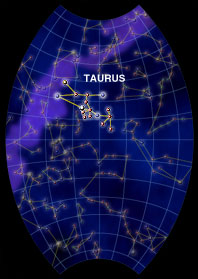
Taurus the Bull.
Click on image for full size
Windows to the Universe original image
Taurus
Taurus is commonly known as The Bull. It passes through the sky from November through March. Taurus was a very popular constellation in ancient times, so there are many myths about it.
The Greeks thought the stars represented Zeus in disguise as a white bull. He tricked Europa into climbing on his back. He then swam out to sea and carried her to Crete. In Egypt, the constellation was a reminder of Apis, the Bull of Memphis. He served as a servant to Osiris, god of the Sun.
Just as famous as Taurus is the group of stars within it. The Pleiades are a group of seven stars that lie on the Bull's shoulder. The Greeks believed these were the Seven Sisters, daughters of Atlas and Pleione. It was told that they asked Zeus to place them in the sky to escape Orion, who was desperately pursuing them. Little did they know that Orion would be placed right next to Taurus in the night sky!
The brightest star in Taurus is Aldebaran. It serves as the eye of the bull and is near the Hyades, a lesser known but still visible group of stars. The beautiful Crab Nebula is located above the tip of the bottom horn.
You might also be interested in:
Atlas is the son of Iapetus and Clymene, two of the Titans. One day Zeus raged a war against Cronus for the right to be ruler of the gods. Atlas joined the side of the Titans and Cronus. Zeus defeated
...more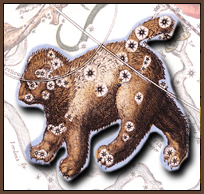
Many different constellations fill the evening sky in the northern hemisphere. Depending on your location and the season, different constellations can be seen. Northern circumpolar constellations can be
...more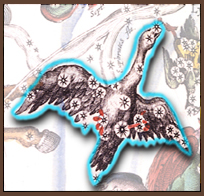
Many different constellations fill the evening sky in the southern hemisphere. Depending on your location and the season, different constellations can be seen. Southern circumpolar constellations can be
...more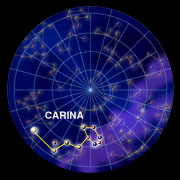
The constellation Carina is known as the Keel, which is the bottom part of old ships. Carina was originally a part of Argo Navis, which was a huge boat in the night sky. It has since been divided into
...more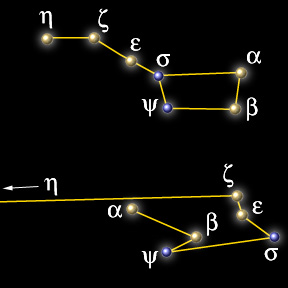
In most cases, however, the stars that we see that seem to be "close" to each other actually are quite far apart, some stars are much closer or farther than others as is shown in the example below of Ursa
...more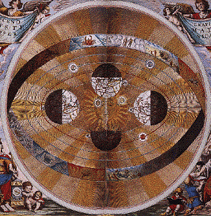
In our time, scientists (and most people!) know that the constellations seem to move across the sky because the earth rotates on its axis. What, you may ask, does the turning of the earth have to do with
...moreIf you look at the night sky different times of the year you see different constellations. This change is due to the motion of the Earth in its orbit around the Sun. Each day a few stars are visible in
...more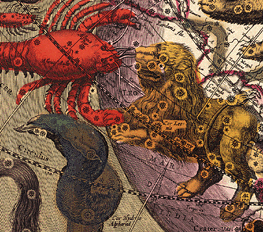
Constellations are formed of bright stars which appear close to each other on the sky, but are really far apart in space. The shapes you see all depend on your point of view. Many societies saw patterns
...more