Current Events

  • Atmospheric CO2 Level Tops 400 ppm
    During the week of May 13th, the CO2 level at the Mauna Loa Observatory in Hawaii topped 400 ppm rep...Read more

    x

    Atmospheric CO2 Level Tops 400 ppm

    During the week of May 13th, the CO2 level at the Mauna Loa Observatory in Hawaii topped 400 ppm repeatedly. Daily levels of CO2 can vary due to weather, and there are seasonal trends as well. The level of atmospheric greenhouse gases continues to increase, now over 120 ppm since the Industrial Revolution began. For more on the Keeling Curve, see http://keelingcurve.ucsd.edu/. Find out more about greenhouse gases and warming.
  • Massive Tornado Outbreak on Tornado Alley
    The week of May 19 brings dozens of tornadoes to Tornado Alley in the states of Oklahoma, Kansas, Io...Read more

    x

    Massive Tornado Outbreak on Tornado Alley

    The week of May 19 brings dozens of tornadoes to Tornado Alley in the states of Oklahoma, Kansas, Iowa, Illinois and Missouri. On May 20th, a massive tornado struck Moore, Oklahoma, devastating communities - destroying over 100 homes and hitting two elementary schools and a hospital - with many casualties and deaths. Our thoughts are with our friends and colleagues suffering from these storms. For more on the May 20th storms, see the NOAA Storm Prediction Center Storm Report.
  • Kansas Legislator Proposes Bill to Outlaw Sustainability Education
    A bill has been introduced in the Kansas legislature this week that would prohibit the promotion of ...Read more

    x

    Kansas Legislator Proposes Bill to Outlaw Sustainability Education

    A bill has been introduced in the Kansas legislature this week that would prohibit the promotion of sustainability. Here is a link to the one-page bill: http://www.kslegislature.org/li/b2013_14/measures/documents/hb2366_00_0000.pdf. See report on Bloomberg News.
The Constellation Lyra, the Harp
Click on image for full size

Lyra

Lyra, the Lyre, is a type of small harp held in the player's lap. The brightest star in Lyra, Vega, is placed in the handle of the harp. A small parallelogram of four faint stars just to the southeast of Vega outline the harp itself. Lyra is one of three constellations whose brightest stars form the Summer Triangle.

Vega is a very bright star (the fifth brightest in the whole sky) and is very close. Lyra is also home to one of the brightest, loveliest planetary nebulae, the Ring Nebula. It can be viewed with binoculars, although it's distinctive smoke-ring shape cannot.

According to Greek mythology, the lyre was invented by Hermes as a child when he strung a tortoise shell. He traded the lyre to Apollo, who then gave it to his son, Orpheus, a great poet and musician. Some Asian traditions see the bright star Vega as the Weaving-Princess star who marries a shepherd, the star Altair.

The Lyrid meteor shower happens in April each year. The meteors in the Lyrid meteor shower seem to shoot outward from the constellation Lyra.


Last modified March 29, 2009 by Randy Russell.

Shop Windows to the Universe Science Store!

The Summer 2010 issue of The Earth Scientist, available in our online store, includes articles on rivers and snow, classroom planetariums, satellites and oceanography, hands-on astronomy, and global warming.

Windows to the Universe Community

News

Opportunities

You might also be interested in:

Science, Evolution, and Creationism

How did life evolve on Earth? The answer to this question can help us understand our past and prepare for our future. Although evolution provides credible and reliable answers, polls show that many people turn away from science, seeking other explanations with which they are more comfortable....more

Altair

What's in a Name: Arabic for "Aquila". Claim to Fame: Brightest star in Aquila. One of the corners of the Summer Triangle. Type of Star: White Subgiant How Far Away: 17 light years away How Bright: Almost...more

Aquila

Aquila, the celestial eagle, is one of the three constellations which have bright stars forming the Summer Triangle. A nearly perfectly straight line of three stars symbolizes part of the wings. The center...more

Cygnus

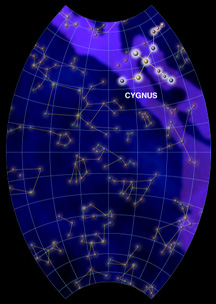
Cygnus, the Swan, is also known as the Northern Cross because of its shape. The tail of the swan is marked by the bright star Deneb, Arabic for "tail". Three fainter stars cross the line between Deneb...more

Hercules

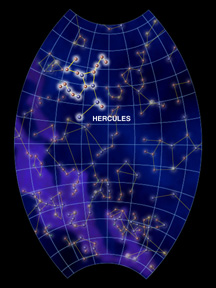
Hercules, the great Greek warrior, can be seen kneeling in the sky for northern latitudes throughout the Spring months. Hercules first becomes visible in the east in April, and works his way high across...more

Lyra

Lyra, the Lyre, is a type of small harp held in the player's lap. The brightest star in Lyra, Vega, is placed in the handle of the harp. A small parallelogram of four faint stars just to the southeast...more

Sagittarius

Sagittarius is a centaur, with the torso of a man atop the body of a horse. Unlike the wise and peaceful centaur Chiron (Centaurus), Sagittarius is aiming his giant bow at his neighbor, Scorpius. While...more

Scorpius

More than any other constellation, Scorpius resembles its given name. If you live in the northern hemisphere of the Earth, Scorpius crawls across the southern sky, close to the horizon. But if you live...more

Shop Windows to the Universe

With Explore the Planets, investigate the planets, their moons, and understand the processes that shape them. By G. Jeffrey Taylor, Ph.D. See our DVD collection.

Windows to the Universe, a project of the National Earth Science Teachers Association, is sponsored in part by the National Science Foundation and NASA, our Founding Partners (the American Geophysical Union and American Geosciences Institute) as well as through Institutional, Contributing, and Affiliate Partners, individual memberships and generous donors. Thank you for your support! NASA AGU AGI NSF