Current Events

  • Kansas Legislator Proposes Bill to Outlaw Sustainability Education
    A bill has been introduced in the Kansas legislature this week that would prohibit the promotion of ...Read more

    x

    Kansas Legislator Proposes Bill to Outlaw Sustainability Education

    A bill has been introduced in the Kansas legislature this week that would prohibit the promotion of sustainability. Here is a link to the one-page bill: http://www.kslegislature.org/li/b2013_14/measures/documents/hb2366_00_0000.pdf. See report on Bloomberg News.
  • Earth's Center Is 1,000 Degrees Hotter Than Previously Thought, Synchrotron X-Ray Experiment Shows
    Scientists have determined the temperature near the Earth’s center to be 6000 degrees Celsius, 1000 ...Read more

    x

    Earth's Center Is 1,000 Degrees Hotter Than Previously Thought, Synchrotron X-Ray Experiment Shows

    Scientists have determined the temperature near the Earth’s center to be 6000 degrees Celsius, 1000 degrees hotter than in a previous experiment run 20 years ago. These measurements confirm geophysical models that the temperature difference between the solid core and the mantle above, must be at least 1500 degrees to explain why the Earth has a magnetic field. For more information about this study, see the press release from the European Synchrotron Radiation Facility.
  • Ocean Volcanic Rocks Contain Samples of Recycled Crust
    Scientists have long believed that lava erupted from certain oceanic volcanoes contains materials fr...Read more

    x

    Ocean Volcanic Rocks Contain Samples of Recycled Crust

    Scientists have long believed that lava erupted from certain oceanic volcanoes contains materials from the early Earth’s crust. But decisive evidence for this phenomenon has proven elusive. New research from a team including Carnegie’s Erik Hauri demonstrates that oceanic volcanic rocks contain samples of recycled crust dating back to the Archean era 2.5 billion years ago. Their work is published in Nature. Oceanic crust sinks into the Earth’s mantle at so-called subduction zones, where two plates come together. Much of what happens to the crust during this journey is unknown. Model-dependent studies for how long subducted material can exist in the mantle are uncertain and evidence of very old crust returning to Earth’s surface via upwellings of magma has not been found until now. For more information about these results, see the press release from the Carnegie Institution.
The Constellation Lyra, the Harp
Click on image for full size

Lyra

It seems the sky is filled with mythical people and animals. But now meet the one and only musical instrument to grace the sky: Lyra, the Lyre! A lyre is a small harp, small enough to fit in your lap. The brightest star in Lyra, Vega, is placed in the handle of the harp. A small rectangle of four faint stars outline the harp itself.

Vega is a very bright star (the fifth brightest in the whole sky) and is very close. Lyra is also home to one of the brightest, loveliest planetary nebulae, the Ring Nebula.

The stories that we have from ancient Greece tell us that the lyre was invented by Hermes as a child by placing strings on a shell. He traded the lyre to Apollo, who then gave it to his son, Orpheus, a great musician.

The Lyrid meteor shower happens in April each year. The meteors in the Lyrid meteor shower seem to shoot outward from the constellation Lyra.


Last modified March 29, 2009 by Randy Russell.

Shop Windows to the Universe Science Store!

The Summer 2010 issue of The Earth Scientist, available in our online store, includes articles on rivers and snow, classroom planetariums, satellites and oceanography, hands-on astronomy, and global warming.

Windows to the Universe Community

News

Opportunities

You might also be interested in:

Ready, Set, SCIENCE!: Putting Research to Work in K-8 Science Classrooms

What types of instructional experiences help K-8 students learn science with understanding? What do science educators teachers, teacher leaders, science specialists, professional development staff, curriculum designers, school administrators need to know to create and support such experiences?...more

Cygnus

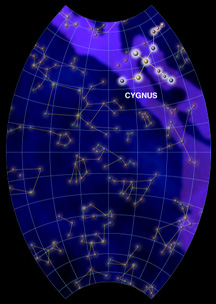
Cygnus, the Swan, looks like a big cross. The tail of the swan is marked by the bright star Deneb. The head of the swan is a star called Albireo, a star with a surprise! Three fainter stars cross the line...more

Aquila

Aquila, the Eagle, is one of many beautiful birds in the night sky. (Can you name all the others? There are 6 more "real" birds and one mythical bird!) A straight line of three stars is part of the wings...more

Hercules

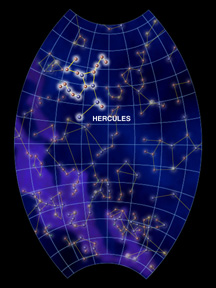
Hercules was a great warrior in Greek mythology. From the northern hemisphere he can be seen kneeling in the sky during Spring. From the southern hemisphere, he appears low in the north. Four bright stars...more

Lyra

It seems the sky is filled with mythical people and animals. But now meet the one and only musical instrument to grace the sky: Lyra, the Lyre! A lyre is a small harp, small enough to fit in your lap....more

Sagittarius

Sagittarius is a make-believe creature with the chest and head of a man and the body and legs of a horse. He is shooting his bow at the Scorpion, just next door. Sagittarius is big, but his stars are not...more

Scorpius

Some constellations do not really look like their names. It takes a lot of imagination to picture the stars of Pegasus as a winged horse, for example. But Scorpius really looks like a scorpion! It has...more

40 Eridani B - Burnt-Out Cinder

What's in a Name: Star designated 40 in the constellation Eridanus. Claim to Fame: One of the first white dwarfs found. A white dwarf is the exposed extremely hot core of a star that has blown off its...more

Shop Windows to the Universe

Ready, Set, SCIENCE!, by the National Research Council, focuses on K-8 science classsrooms. Check out the other publications in our online store, as well as classroom materials.

Windows to the Universe, a project of the National Earth Science Teachers Association, is sponsored in part by the National Science Foundation and NASA, our Founding Partners (the American Geophysical Union and American Geosciences Institute) as well as through Institutional, Contributing, and Affiliate Partners, individual memberships and generous donors. Thank you for your support! NASA AGU AGI NSF