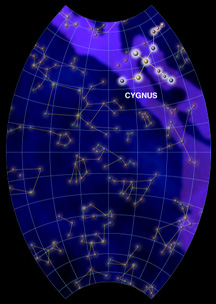
The Constellation Cygnus, the Swan
Click on image for full size
Cygnus
Cygnus, the Swan, is also known as the Northern Cross because of its
shape. The tail of the swan is marked by the bright star
Deneb, Arabic for "tail".
Three fainter stars cross the line between Deneb and the head of the
swan, Albireo. Cygnus flies southward along the summer
Milky Way, and
into the Summer Triangle.
Deneb is a bright, blue supergiant star, very young as stars go.
Albireo, the bill of the swan, is actually two stars which show a
spectacular amber and blue contrast. Cygnus is also sprinkled with a
variety of nebulae, including the North American Nebula and the Veil Nebula.
The identity of Cygnus is uncertain. He could be Zeus in the guise in
which he seduced Leda, the mother of Helen of Troy. In
one myth, Cygnus is a friend of Phaethon, the son of Apollo, the sun
god. Phaethon fell into the river Eridanus, trying to drive the
sun-gods chariot. Cygnus dove repeatedly into the water to search for
Phaethon. Out of pity, Zeus turned the boy into a swan.
You might also be interested in:

How did life evolve on Earth? The answer to this question can help us understand our past and prepare for our future. Although evolution provides credible and reliable answers, polls show that many people turn away from science, seeking other explanations with which they are more comfortable.
...more
What's in a Name: Arabic for "tail" because it is located in the tail of the Cygnus, the Swan. Claim to Fame: 19th brightest star in the sky (apparent visual magnitude = 1.3) Type of Star: White Supergiant
...more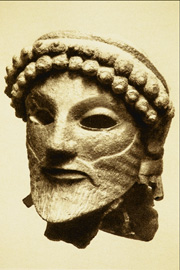
In Greek mythology, Zeus (Jupiter in Roman mythology) was the king of heaven and Earth and of all the Olympian gods. He was also known as the god of justice. He was named king of the gods in the special
...more
Eridanus is known as the Celestial River. It most often related to the Nile or Euphrates Rivers because they were so important to ancient civilizations. Eridanus is the second longest constellation in
...more
Gemini is one of the more famous constellations. The Twins are best seen during the winter and spring in the Northern Hemisphere. If you live in the Southern Hemisphere, look for Gemini in the summer.
...more
For the ancient Greeks, the constellation Cygnus, which means "swan", was related to the myth of Zeus and the goddess Nemesis. In order to escape from Zeus, Nemesis changed herself into many different
...moreFor the ancient Greeks, the constellation Cygnus, which means "swan", was related to the myth of Zeus and the goddess Nemesis. In order to escape from Zeus, Nemesis changed herself into many different
...more
For the ancient Greeks, the constellation Cygnus, which means "swan", was related to the myth of Zeus(called Jupiter by Romans) and the goddess Nemesis. In order to escape from Zeus, Nemesis changed herself
...more