The Constellation Centaurus, the Centaur
Click on image for full size
Centaurus - The Centaur
Below the stars of
Hydra, the sea serpent and
Scorpius,
the scorpion, you can find Centaurus. Centaurus is a half-man,
half-horse creature. He faces east holding a lance which he is using
to defend himself from Lupus, the wolf.
Centaurus' brightest star is called Toliman or Rigel Kentaurus.
Toliman is the third brightest star in the sky and is the closest star
to the Sun. The largest and brightest globular cluster in the sky is
in Centaurus. The cluster's name is Omega Centauri. To your eye, it
will look like a fuzzy ball, but it is really made up of more than a
million stars.
According to a Greek myth, it was Centaurus who first grouped the
stars into constellations. He also taught humans how to read the sky.
Centaurus placed a picture of himself in the sky to guide a group of
sailors called the Argonauts.
You might also be interested in:

How did life evolve on Earth? The answer to this question can help us understand our past and prepare for our future. Although evolution provides credible and reliable answers, polls show that many people turn away from science, seeking other explanations with which they are more comfortable.
...more
Hydra, the sea serpent, may be the longest and largest of all constellations, but its stars are very faint. It is so long that four constellations run along its northern side. These are Cancer, Leo, Virgo
...more
Some constellations do not really look like their names. It takes a lot of imagination to picture the stars of Pegasus as a winged horse, for example. But Scorpius really looks like a scorpion! It has
...more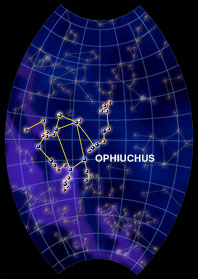
The constellation Ophiuchus is known as the Serpent Bearer. In Greek myth, he was the god of medicine. One day he killed a snake, but another serpent appeared and healed his friend with plants. Ophiuchus
...more
The constellation Gemini is really a set of twins! If you live in the Northern Hemisphere, you can see Gemini in the winter and spring. If you live in the Southern Hemisphere, you can see it in the summer
...more
Bootes, the herdsman, rides through the sky during the late Spring and early Summer. Bootes is fun to look at because it has the shape of a kite, with the bright star Arcturus at the point of the kite
...more
Leo, the lion, is easy to find because his head looks like a backward question mark with the bright star Regulus at the bottom. Regulus, Leo's brightest star, means "little king" in Latin. This star is
...more
What's in a Name: Star designated 40 in the constellation Eridanus. Claim to Fame: One of the first white dwarfs found. A white dwarf is the exposed extremely hot core of a star that has blown off its
...more








