Current Events

  • Kansas Legislator Proposes Bill to Outlaw Sustainability Education
    A bill has been introduced in the Kansas legislature this week that would prohibit the promotion of ...Read more

    x

    Kansas Legislator Proposes Bill to Outlaw Sustainability Education

    A bill has been introduced in the Kansas legislature this week that would prohibit the promotion of sustainability. Here is a link to the one-page bill: http://www.kslegislature.org/li/b2013_14/measures/documents/hb2366_00_0000.pdf. See report on Bloomberg News.
  • Earth's Center Is 1,000 Degrees Hotter Than Previously Thought, Synchrotron X-Ray Experiment Shows
    Scientists have determined the temperature near the Earth’s center to be 6000 degrees Celsius, 1000 ...Read more

    x

    Earth's Center Is 1,000 Degrees Hotter Than Previously Thought, Synchrotron X-Ray Experiment Shows

    Scientists have determined the temperature near the Earth’s center to be 6000 degrees Celsius, 1000 degrees hotter than in a previous experiment run 20 years ago. These measurements confirm geophysical models that the temperature difference between the solid core and the mantle above, must be at least 1500 degrees to explain why the Earth has a magnetic field. For more information about this study, see the press release from the European Synchrotron Radiation Facility.
  • Ocean Volcanic Rocks Contain Samples of Recycled Crust
    Scientists have long believed that lava erupted from certain oceanic volcanoes contains materials fr...Read more

    x

    Ocean Volcanic Rocks Contain Samples of Recycled Crust

    Scientists have long believed that lava erupted from certain oceanic volcanoes contains materials from the early Earth’s crust. But decisive evidence for this phenomenon has proven elusive. New research from a team including Carnegie’s Erik Hauri demonstrates that oceanic volcanic rocks contain samples of recycled crust dating back to the Archean era 2.5 billion years ago. Their work is published in Nature. Oceanic crust sinks into the Earth’s mantle at so-called subduction zones, where two plates come together. Much of what happens to the crust during this journey is unknown. Model-dependent studies for how long subducted material can exist in the mantle are uncertain and evidence of very old crust returning to Earth’s surface via upwellings of magma has not been found until now. For more information about these results, see the press release from the Carnegie Institution.

Northern Hemisphere Constellations

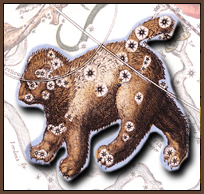
Many different constellations fill the evening sky in the northern hemisphere. Depending on your location and the season, different constellations can be seen. Northern circumpolar constellations can be seen all year long in the night sky of the northern hemisphere, and appear to circle about the Pole star. This image shows an illustration of Ursa Major, the Great Bear.

Northern Circumpolar Constellations Northern Spring Constellation Northern Summer Constellations Northern Autumn Constellations Northern Winter Constellations
Cassiopeia
Cepheus
Draco
Ursa Major
Ursa Minor
Bootes
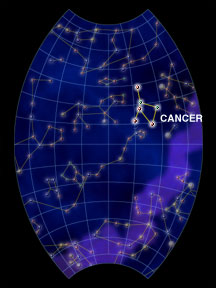
Cancer
Crater
Hydra
Leo
Virgo
Aquila
Cygnus
Hercules
Lyra
Ophiuchus
Sagittarius
Scorpius
Andromeda
Aquarius
Capricornus
Pegasus
Pisces
Canis Major
Cetus
Eridanus
Gemini
Orion
Perseus
Taurus

Shop Windows to the Universe Science Store!

The Summer 2010 issue of The Earth Scientist, available in our online store, includes articles on rivers and snow, classroom planetariums, satellites and oceanography, hands-on astronomy, and global warming.

Windows to the Universe Community

News

Opportunities

You might also be interested in:

Science, Evolution, and Creationism

How did life evolve on Earth? The answer to this question can help us understand our past and prepare for our future. Although evolution provides credible and reliable answers, polls show that many people turn away from science, seeking other explanations with which they are more comfortable....more

Ursa Major

Ursa Major is a very famous constellation. It is also called the Great Bear. Ursa Minor is the Little Bear. The body and tail of the Big Bear make up the Big Dipper. There are a lot of myths about this...more

Bootes

Bootes, the herdsman, rides through the sky during the late Spring and early Summer. Bootes is fun to look at because it has the shape of a kite, with the bright star Arcturus at the point of the kite...more

Cancer

The constellation Cancer is a crab. Look for Cancer from December through June. It's hard to see Cancer because the stars are so dim. To find Cancer, first find Gemini and Leo. Cancer is right between...more

Crater

The constellation Crater is known as the Cup! The stars in Crater are very faint, so it is hard to see. Crater is between Leo and Hydra. Corvus the Crow is next to it. You can see Crater from March through...more

Hydra

Hydra, the sea serpent, may be the longest and largest of all constellations, but its stars are very faint. It is so long that four constellations run along its northern side. These are Cancer, Leo, Virgo...more

Leo

Leo, the lion, is easy to find because his head looks like a backward question mark with the bright star Regulus at the bottom. Regulus, Leo's brightest star, means "little king" in Latin. This star is...more

Virgo

The constellation Virgo is The Maiden. People thought it was Athena, Artemis, Persephone or Demeter. She is carrying a grain of wheat and a staff. Can you tell it's a person in the picture? The maiden...more

Shop Windows to the Universe

Hands On Mineral Identification helps you to identify over 14,500 minerals! By M. Darby Dyar, Ph.D. See our DVD collection.

Windows to the Universe, a project of the National Earth Science Teachers Association, is sponsored in part by the National Science Foundation and NASA, our Founding Partners (the American Geophysical Union and American Geosciences Institute) as well as through Institutional, Contributing, and Affiliate Partners, individual memberships and generous donors. Thank you for your support! NASA AGU AGI NSF