Current Events

  • Atmospheric CO2 Level Tops 400 ppm
    During the week of May 13th, the CO2 level at the Mauna Loa Observatory in Hawaii topped 400 ppm rep...Read more

    x

    Atmospheric CO2 Level Tops 400 ppm

    During the week of May 13th, the CO2 level at the Mauna Loa Observatory in Hawaii topped 400 ppm repeatedly. Daily levels of CO2 can vary due to weather, and there are seasonal trends as well. The level of atmospheric greenhouse gases continues to increase, now over 120 ppm since the Industrial Revolution began. For more on the Keeling Curve, see http://keelingcurve.ucsd.edu/. Find out more about greenhouse gases and warming.
  • Massive Tornado Outbreak on Tornado Alley
    The week of May 19 brings dozens of tornadoes to Tornado Alley in the states of Oklahoma, Kansas, Io...Read more

    x

    Massive Tornado Outbreak on Tornado Alley

    The week of May 19 brings dozens of tornadoes to Tornado Alley in the states of Oklahoma, Kansas, Iowa, Illinois and Missouri. On May 20th, a massive tornado struck Moore, Oklahoma, devastating communities - destroying over 100 homes and hitting two elementary schools and a hospital - with many casualties and deaths. Our thoughts are with our friends and colleagues suffering from these storms. For more on the May 20th storms, see the NOAA Storm Prediction Center Storm Report.
  • Kansas Legislator Proposes Bill to Outlaw Sustainability Education
    A bill has been introduced in the Kansas legislature this week that would prohibit the promotion of ...Read more

    x

    Kansas Legislator Proposes Bill to Outlaw Sustainability Education

    A bill has been introduced in the Kansas legislature this week that would prohibit the promotion of sustainability. Here is a link to the one-page bill: http://www.kslegislature.org/li/b2013_14/measures/documents/hb2366_00_0000.pdf. See report on Bloomberg News.
Eridanus is best seen from November through February.
Click on image for full size
Windows to the Universe original image

Eridanus

Eridanus is the Celestial River. It's the second longest constellation in the sky. If you live in the Northern Hemisphere, you will only see the top half of the constellation.

The brightest star in Eridanus is at the very end. It's called Achernar. Can you find it on the image?

The best time to find Eridanus is from November through February. First find the bright star Rigel in Orion. See if you can find all the stars in the sky!

Shop Windows to the Universe Science Store!

The Summer 2010 issue of The Earth Scientist, available in our online store, includes articles on rivers and snow, classroom planetariums, satellites and oceanography, hands-on astronomy, and global warming.

Windows to the Universe Community

News

Opportunities

You might also be interested in:

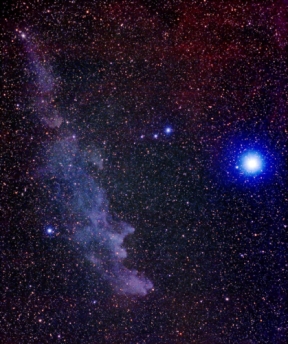
Rigel - Bluish-white Supergiant

What's in a Name: Arabic for "foot" Claim to Fame: One of the galaxy's brightest stars. Apparent visual magnitude = 0.1 Type of Star: Brilliant bluish-white Supergiant (B8 1a Spectral Type) How Far Away:...more

Northern Hemisphere Constellations

Many different constellations fill the evening sky in the northern hemisphere. Depending on your location and the season, different constellations can be seen. Northern circumpolar constellations can be...more

Southern Hemisphere Constellations

Many different constellations fill the evening sky in the southern hemisphere. Depending on your location and the season, different constellations can be seen. Southern circumpolar constellations can be...more

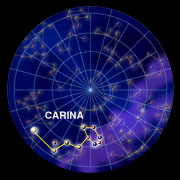
Carina

The constellation Carina is known as the Keel. A keel is the wooden bottom of old sailing ships. Carina used to be a part of the large constellation called Argo Navis. It was divided up into four different...more

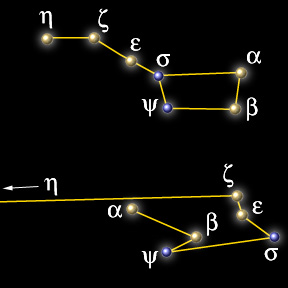
It All Depends On Your Point Of View

In most cases, however, the stars that we see that seem to be "close" to each other actually are quite far apart, some stars are much closer or farther than others as is shown in the example below of Ursa...more

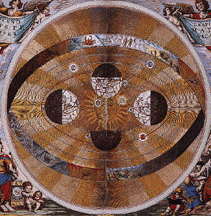
As the World Turns

In our time, scientists (and most people!) know that the constellations seem to move across the sky because the earth rotates on its axis. What, you may ask, does the turning of the earth have to do with...more

The Changing Night Sky

If you look at the night sky different times of the year you see different constellations. This change is due to the motion of the Earth in its orbit around the Sun. Each day a few stars are visible in...more

Constellations

Constellations are pictures made up of bright stars which appear close to each other on the sky. Like a game of connect the dots, if you use your imagination when you look at the stars, you may see a dog...more

Shop Windows to the Universe

The Spring 2011 issue of The Earth Scientist is focused on modernizing seismology education. Thanks to IRIS, you can download this issue for free as a pdf. Print copies are available in our online store.

Windows to the Universe, a project of the National Earth Science Teachers Association, is sponsored in part by the National Science Foundation and NASA, our Founding Partners (the American Geophysical Union and American Geosciences Institute) as well as through Institutional, Contributing, and Affiliate Partners, individual memberships and generous donors. Thank you for your support! NASA AGU AGI NSF