Current Events

  • Kansas Legislator Proposes Bill to Outlaw Sustainability Education
    A bill has been introduced in the Kansas legislature this week that would prohibit the promotion of ...Read more

    x

    Kansas Legislator Proposes Bill to Outlaw Sustainability Education

    A bill has been introduced in the Kansas legislature this week that would prohibit the promotion of sustainability. Here is a link to the one-page bill: http://www.kslegislature.org/li/b2013_14/measures/documents/hb2366_00_0000.pdf. See report on Bloomberg News.
  • Earth's Center Is 1,000 Degrees Hotter Than Previously Thought, Synchrotron X-Ray Experiment Shows
    Scientists have determined the temperature near the Earth’s center to be 6000 degrees Celsius, 1000 ...Read more

    x

    Earth's Center Is 1,000 Degrees Hotter Than Previously Thought, Synchrotron X-Ray Experiment Shows

    Scientists have determined the temperature near the Earth’s center to be 6000 degrees Celsius, 1000 degrees hotter than in a previous experiment run 20 years ago. These measurements confirm geophysical models that the temperature difference between the solid core and the mantle above, must be at least 1500 degrees to explain why the Earth has a magnetic field. For more information about this study, see the press release from the European Synchrotron Radiation Facility.
  • Ocean Volcanic Rocks Contain Samples of Recycled Crust
    Scientists have long believed that lava erupted from certain oceanic volcanoes contains materials fr...Read more

    x

    Ocean Volcanic Rocks Contain Samples of Recycled Crust

    Scientists have long believed that lava erupted from certain oceanic volcanoes contains materials from the early Earth’s crust. But decisive evidence for this phenomenon has proven elusive. New research from a team including Carnegie’s Erik Hauri demonstrates that oceanic volcanic rocks contain samples of recycled crust dating back to the Archean era 2.5 billion years ago. Their work is published in Nature. Oceanic crust sinks into the Earth’s mantle at so-called subduction zones, where two plates come together. Much of what happens to the crust during this journey is unknown. Model-dependent studies for how long subducted material can exist in the mantle are uncertain and evidence of very old crust returning to Earth’s surface via upwellings of magma has not been found until now. For more information about these results, see the press release from the Carnegie Institution.
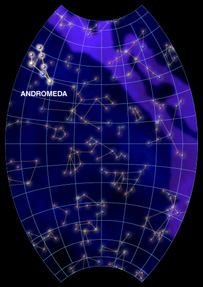
Andromeda is an autumn constellation found next to Pegasus.
Click on image for full size
Windows to the Universe original image

Andromeda

Andromeda is a "V" shaped constellation best viewed in Autumn if you live in the Northern Hemisphere. It was one of the earliest constellations to be recognized. Andromeda lies near the celestial north pole, so only a few in the Southern Hemisphere can see this strangely shaped constellation in the spring.

The myth of Andromeda is easily found in Greek mythology. Andromeda's mother, Queen Cassiopeia, bragged that she was prettier than the sea nymphs. The nymphs complained to Poseidon, who in turn sent a monster to destroy her land. The queen and her husband, King Cepheus, were told to sacrifice their daughter to save the country.

Andromeda was chained to a cliff for the monster, called Cetus. Just as the monster was ready to bite down on the maiden, Perseus rescued her. He used Medusa's head to turn Cetus into stone. Perseus and Andromeda were put in the sky along with Cepheus, Cassiopeia and Cetus.

Andromeda is right next to Pegasus, which leads some to believe that at one time, some of these stars used to be part of the winged horse. The Princess' head is the star Alpheratz, which is also the last star in Pegasus. The image shows Andromeda upside-down, which is often her position in the sky.

There is plenty to see in this fall constellation. With the help of a telescope, you can find two faint open clusters. NGC 752 is located to the left of Andromeda, while NGC7686 is in the upper right corner, above Pegasus. The Great Andromeda Galaxy is the most distant object visible to the naked eye. You can find this famous galaxy on the right side of Andromeda, about half-way up the constellation. There are several other galaxies located around the Princess, but most are too faint to see, even with a telescope.

Shop Windows to the Universe Science Store!

The Summer 2010 issue of The Earth Scientist, available in our online store, includes articles on rivers and snow, classroom planetariums, satellites and oceanography, hands-on astronomy, and global warming.

Windows to the Universe Community

News

Opportunities

You might also be interested in:

Cassiopeia

Cassiopeia was the wife of King Cepheus. She was very pretty, and would often boast that she and her daughter were more beautiful than the sea nymphs, the Nereids. They complained to Poseidon, who unleashed...more

King Cepheus

Cepheus is one of the oldest constellations in the night sky. He is a circumpolar constellation, circling around the North Star all year long. This house-shaped constellation is named after an ancient...more

Constellations

Many cultures have seen distinctive patterns, called constellations, formed by the stars in the heavens. Constellations are usually comprised of bright stars which appear close to each other on the sky,...more

Northern Hemisphere Constellations

Many different constellations fill the evening sky in the northern hemisphere. Depending on your location and the season, different constellations can be seen. Northern circumpolar constellations can be...more

Southern Hemisphere Constellations

Many different constellations fill the evening sky in the southern hemisphere. Depending on your location and the season, different constellations can be seen. Southern circumpolar constellations can be...more

Carina

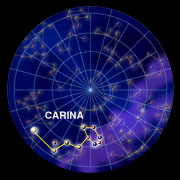
The constellation Carina is known as the Keel, which is the bottom part of old ships. Carina was originally a part of Argo Navis, which was a huge boat in the night sky. It has since been divided into...more

It All Depends On Your Point Of View

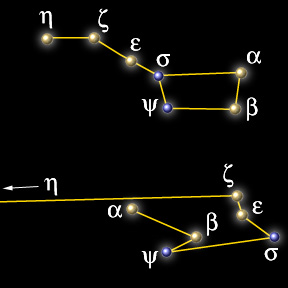
In most cases, however, the stars that we see that seem to be "close" to each other actually are quite far apart, some stars are much closer or farther than others as is shown in the example below of Ursa...more

As the World Turns

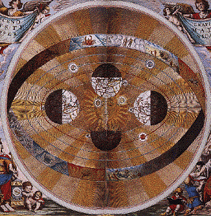
In our time, scientists (and most people!) know that the constellations seem to move across the sky because the earth rotates on its axis. What, you may ask, does the turning of the earth have to do with...more

Shop Windows to the Universe

Hands On Mineral Identification helps you to identify over 14,500 minerals! By M. Darby Dyar, Ph.D. See our DVD collection.

Windows to the Universe, a project of the National Earth Science Teachers Association, is sponsored in part by the National Science Foundation and NASA, our Founding Partners (the American Geophysical Union and American Geosciences Institute) as well as through Institutional, Contributing, and Affiliate Partners, individual memberships and generous donors. Thank you for your support! NASA AGU AGI NSF