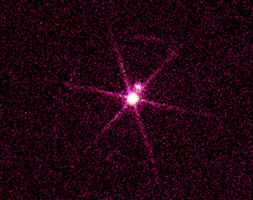
An infrared image of the binary star Capella, obtained from an array of optical telescopes.
COAST / MRAO Cambridge

Capella - Actually a Pair of Yellow Giants

What's in a Name: Latin for "little she-goat". Also called alpha Aurigae.
Claim to Fame: 6th brightest star in the night sky. Capella is the name given to a double star system (both stars are yellow giants). The two stars appear unresolved even when looking through a telescope (ie, they appear to be only one star). Only interferometry shows that Capella is actually two stars! Important for navigation because it is the closest bright star to the north star and therefore is visible at least part of the night every month.
Type of Star: Yellow Giant (Spectral Class G5 III). Approximately the same color and temperature as the sun but a giant star.
How Far Away: 46 light years
How Big: 16 times the sun's radius
How Bright: 150 times brighter than the sun in visible light
Where to View: In the constellation of Auriga
When to View: Near celestial pole, visible all year from mid-northern latitudes
Last modified April 29, 2005 by Travis Metcalfe.

Shop Windows to the Universe Science Store!

The Summer 2010 issue of The Earth Scientist, available in our online store, includes articles on rivers and snow, classroom planetariums, satellites and oceanography, hands-on astronomy, and global warming.

Windows to the Universe Community

News

Opportunities

You might also be interested in:

The Earth Scientist, Volume XXVI, Issue 2, Summer 2010

Our 2010 Summer issue of The Earth Scientist includes six articles dealing with various aspects of Earth Science. An article from NOAA details how lake effect snow can, under the right conditions, actually occur on the narrow Mississippi River....more

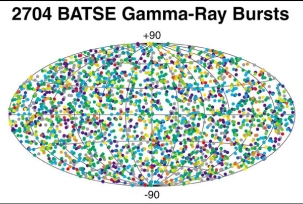
Gamma Ray Bursts - The Most Powerful Objects in the Universe?

In the 1960's, the United States launched some satellites to look for very high energy light, called Gamma Rays. Gamma Rays are produced whenever a nuclear bomb explodes. The satellites found many bursts...more

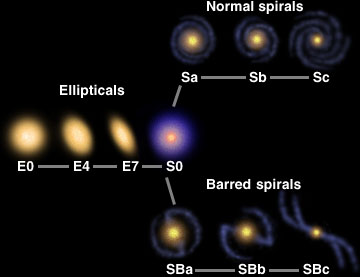
Galaxies

During the early 1900's, which is not very long ago, astronomers were unaware that there were other galaxies outside our own Milky Way Galaxy. When they saw a small fuzzy patch in the sky through their...more

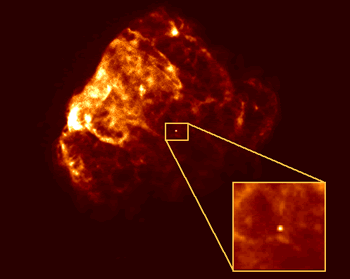
Neutron Stars

Neutron Stars are the end point of a massive star's life. When a really massive star runs out of nuclear fuel in its core the core begins to collapse under gravity. When the core collapses the entire star...more

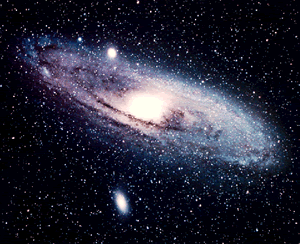
Spiral Galaxies

Spiral galaxies may remind you of a pinwheel. They are rotating disks of mostly hydrogen gas, dust and stars. Through a telescope or binoculars, the bright nucleus of the galaxy may be visible but the...more

White Dwarfs

When stars like our own sun die they will become white dwarfs. As a star like our sun is running out of fuel in its core it begins to bloat into a red giant. This will happen to our sun in 5 Billion years....more

Algol

What's in a Name: Arabic for "head of the demon" Claim to Fame: Represents Medusa's eye in Perseus. A special variable star that "winks" every 3 days. Type of Star: Blue-white Main Sequence Star, and...more

Sirius B - Bizarre White Dwarf Companion of Sirius A

What's in a Name: Nicknamed the "Pup" because it is the companion to Sirius, "the Dog Star" Claim to Fame: Highly compressed white dwarf remnant. Density about 50,000 times that of water. It has approximately...more

Shop Windows to the Universe

8" banded onyx bowls are available in our online store, along with minerals, fossils, classroom materials, and jewelry.

Generous sponsorship of Windows to the Universe is provided by the Hewlett Foundation, the American Geological Institute, the American Geophysical Union, the National Science Foundation, NASA, NCAR, and the CISM and CMMAP projects. NASA CMMAP AGU CISM NCAR Hewlett AGI NSF