Workshop at the 2007 NSTA National Conference in St. Louis
 Windows to the Universe staff presented a workshop titled "Interactive Simulations and Hands-on Activities across the Earth and Space Sciences" at the NSTA National Conference in St. Louis, Missouri, from 5-6 PM on Friday, March 30, 2007.
This workshop combined hands-on activities with computer-based interactives and animations. The bulk of the workshop dealt with three topics of potential relevance to Earth science teachers:
- Annual and Long-term Variations in Sea Ice Extent in the Arctic and Antarctic
- Magnetism, Geomagnetism, and Space Weather
- Paleoclimatology - Tree Rings and Dendrochronology
Below are links to the resources (write-ups of hands-on activities and accompanying student worksheets, interactive simulations, animations, images, and web pages with relevant background information) used or referred to during this workshop:
- Magnetism & Space Weather
- Hands-on activities
- Magnetometer (in
Spanish)
- Magnetometer
Extensions [Ore Deposits & Seafloor Spreading] (in
Spanish)
- Terrabagga (in
Spanish)
- Computer-based interactives
- Bar
magnet & compass
- Earth's
magnetic field
- Earth's
North Magnetic Pole
- Background info on site
- Planetary magnetosphere pages
- Mercury, Earth, Mars, Jupiter, Saturn, Uranus, Neptune
- Detecting Planetary Magnetism
- Basics of magnetism pages
- Magnetic
Field, Magnetism, The
Force of Magnetism
- Paleoclimateology - Dendrochronology
- Dendrochronology Interactives
- "Build a Tree" Dendrochronology Activity
- Align Tree Ring Cores Activity
- Project Learn activity page
- "Time &
Cycles - Dendrochronology" activity
- Student
guide
- Climate Discovery Teacher's Guide activity - "Trees: Recorders of Climate Change"
- Sea Ice Extent Graphing Activity
- Activity: Graphing Sea Ice Extent in the Arctic and Antarctic
- Interactive Image Viewers (compare sea ice maps side-by-side)
- Compare Images of Arctic Sea Ice Extent Side-by-side
- Compare Images of Antarctic Sea Ice Extent Side-by-side
- Animations
- Animation of Annual Variation in Sea Ice Extent in the Northern Hemisphere
- Animation of Annual Variation in Sea Ice Extent in the Southern Hemisphere
You might also be interested in:

Mercury is the only terrestrial planet other than the Earth that has a significant magnetic field (220 nT). This field, along with the planet's high density and small size relative to the Earth, indicates
...more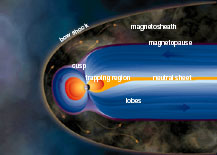
The Earth has a magnetic field with north and south poles. The magnetic field of the Earth is enclosed in a region surrounding the Earth called the magnetosphere. As the Earth rotates, its hot core generates
...more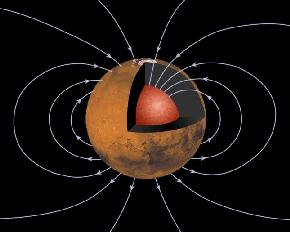
An important new result from the Mars Global Surveyor (MGS) mission is the definite confirmation of the presence of a magnetosphere around Mars. Previous missions made inconclusive measurements of the
...more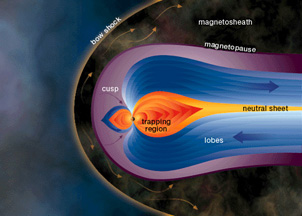
Jupiter's magnetosphere is a unique object in the solar system. It is the biggest object in the entire solar system. Not only is it big enough to contain all of Jupiter's moons, but the sun itself could
...more
Saturn's magnetosphere is not as big as Jupiter's, but is very large nonetheless. It extends well beyond the orbits of Saturn's moons. It is probably generated in the same manner as is Jupiter's, which
...more
The magnetosphere of Uranus is medium sized, but still much larger than the Earth's. It extends well beyond the orbits of Uranus' moons. It is probably generated in the icy interior layers, rather than
...moreA magnetometer is an instrument for measuring magnetic fields. Many spacecraft carry magnetometers to measure the magnetic fields around planets they orbit or fly by. When a spacecraft takes such measurements,
...more