
Current Events

  • Irish Chronicles Document Links Between Volcanoes and Weather
    A study of over 40,000 written entries in Irish Annals and ice core measurements shows a strong corr...Read more

    x

    Irish Chronicles Document Links Between Volcanoes and Weather

    A study of over 40,000 written entries in Irish Annals and ice core measurements shows a strong correlation between the occurrence of volcanic eruptions and extreme cold weather in Ireland over a 1200 year period. Data analyzed in this study cover the period from 431 to 1649, during which time up to 48 volcanic eruptions are identified in Greenland ice core records through deposition of volcanic sulfate in annual layers of ice. You can find the study (open access), published on 6 June 2013 in IOP Publishing's journal Environmental Research Letters, at http://iopscience.iop.org/1748-9326/8/2/024035/article. Find out more about how volcanoes can influence climate.
  • EF-5 Tornado in El Reno, Oklahoma Widest Ever Recorded in US
    The EF-5 tornado that hit El Reno, Oklahoma on May 31st was the widest ever recorded in the US, acco...Read more

    x

    EF-5 Tornado in El Reno, Oklahoma Widest Ever Recorded in US

    The EF-5 tornado that hit El Reno, Oklahoma on May 31st was the widest ever recorded in the US, according to the National Weather Service in Norman Oklahoma. The tornado, which remained on the ground for 40 minutes and reached 2.6 miles across (4.2 km), took the lives of 18 people including storm chasers Tim Samaras, Paul Samaras and Carl Young. For more information on the tornado, visit http://ow.ly/i/2hfDG.
  • Atmospheric CO2 Level Tops 400 ppm
    During the week of May 13th, the CO2 level at the Mauna Loa Observatory in Hawaii topped 400 ppm rep...Read more

    x

    Atmospheric CO2 Level Tops 400 ppm

    During the week of May 13th, the CO2 level at the Mauna Loa Observatory in Hawaii topped 400 ppm repeatedly. Daily levels of CO2 can vary due to weather, and there are seasonal trends as well. The level of atmospheric greenhouse gases continues to increase, now over 120 ppm since the Industrial Revolution began. For more on the Keeling Curve, see http://keelingcurve.ucsd.edu/. Find out more about greenhouse gases and warming.
Coastal carvings: The Big Sur coastline in California is the result of a great geological uplifting, which occurred roughly 30 million years ago.
Image courtesy of Kip F. Evans

Ocean Literacy Framework

Essential Principles and Fundamental Concepts of Ocean Science

The Earth's ocean covers about 71% of the planet's surface with saline waters. Ocean currents flow continuously, exchanging nutrients and energy between the surface and great depths, and between ocean basins and smaller seas. The ocean is the source of most life on Earth, provides most of our oxygen, regulates our weather and climate, and feeds much of the human population. Many forms of ocean life are familiar to us, but because more than half of the ocean is over 3,000 meters (9,800 ft) deep, much is unexplored and unknown.

It is important for us to understand the ocean's influence on us and our influence on the ocean. Though vast, the ocean's resources are depleted and degraded in many regions due to the demands place on them by human activities. Managing fisheries and minerals extracted from the seas and the watersheds which replenish sea water and ocean life involves complex agreements among cities, states, and nations that share them. Educational efforts about the ocean can help to enhance public ocean literacy. This will enable people to better understand how the ocean functions, communicate about the ocean in meaningful ways; and make informed and responsible decisions regarding the ocean and its resources.

The Essential Principles and Fundamental Concepts outlined in this guide to ocean science literacy represents content that does not always fall neatly within particular disciplines. This is unavoidable and demonstrates the interdisciplinary nature of ocean sciences and its relationship to the entire Earth system of which it is a part. For more information on this effort, please visit the Ocean Science Literacy web site. In addition, the Ocean Science Literacy Framework has been aligned with the National Science Education Standards.

The Ocean Literacy Campaign has been and continues to be supported by numerous professional organizations and individuals with an interest in improving public ocean literacy and protecting our ocean planet. For more information visit: www.oceanliteracy.net/index.html.

Last modified July 29, 2009 by Becca Hatheway.

Shop Windows to the Universe Science Store!

The Winter 2009 issue of The Earth Scientist, focuses on Earth System science, including articles on student inquiry, differentiated instruction, geomorphic concepts, the rock cycle, and much more!

Windows to the Universe Community

News

Opportunities

You might also be interested in:

Traveling Nitrogen Classroom Activity Kit

Check out our online store - minerals, fossils, books, activities, jewelry, and household items!...more

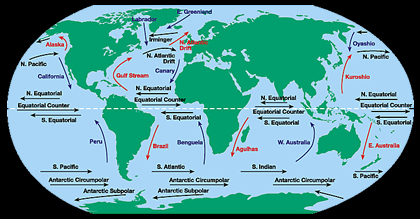
Surface Ocean Currents

The water at the ocean surface is moved primarily by winds. Large scale winds move in specific directions because they are affected by Earth’s spin and the Coriolis Effect. Because Earth spins constantly,...more

Oxygen

Oxygen is a chemical element with an atomic number of 8 (it has eight protons in its nucleus). Oxygen forms a chemical compound (O2) of two atoms which is a colorless gas at normal temperatures and pressures....more

What Is Climate?

Climate in your place on the globe is called regional climate. It is the average weather pattern in a place over more than thirty years, including the variations in seasons. To describe the regional climate...more

What Is a Mineral?

Minerals occur naturally on rocky planets and form the building blocks of rocks. They are non-living, solid, and, like all matter, are made of atoms of elements. There are many different types of minerals...more

Ocean Literacy - Essential Principle 1

The Earth has one big ocean with many features. Fundamental Concept 1a. The ocean is the dominant physical feature on our planet Earth—covering approximately 70% of the planet’s surface. There is one ocean...more

Ocean Literacy - Essential Principle 2

The ocean and life in the ocean shape the features of the Earth. Fundamental Concept 2a. Many earth materials and geochemical cycles originate in the ocean. Many of the sedimentary rocks now exposed on...more

Ocean Literacy - Essential Principle 4

The ocean makes Earth habitable. Fundamental Concept 4a. Most of the oxygen in the atmosphere originally came from the activities of photosynthetic organisms in the ocean. Fundamental Concept 4b. The first...more

Shop Windows to the Universe

With Explore the Planets, investigate the planets, their moons, and understand the processes that shape them. By G. Jeffrey Taylor, Ph.D. See our DVD collection.

Windows to the Universe, a project of the National Earth Science Teachers Association, is sponsored in part by the National Science Foundation and NASA, our Founding Partners (the American Geophysical Union and American Geosciences Institute) as well as through Institutional, Contributing, and Affiliate Partners, individual memberships and generous donors. Thank you for your support! NASA AGU AGI NSF