Current Events

  • Kansas Legislator Proposes Bill to Outlaw Sustainability Education
    A bill has been introduced in the Kansas legislature this week that would prohibit the promotion of ...Read more

    x

    Kansas Legislator Proposes Bill to Outlaw Sustainability Education

    A bill has been introduced in the Kansas legislature this week that would prohibit the promotion of sustainability. Here is a link to the one-page bill: http://www.kslegislature.org/li/b2013_14/measures/documents/hb2366_00_0000.pdf. See report on Bloomberg News.
  • Earth's Center Is 1,000 Degrees Hotter Than Previously Thought, Synchrotron X-Ray Experiment Shows
    Scientists have determined the temperature near the Earth’s center to be 6000 degrees Celsius, 1000 ...Read more

    x

    Earth's Center Is 1,000 Degrees Hotter Than Previously Thought, Synchrotron X-Ray Experiment Shows

    Scientists have determined the temperature near the Earth’s center to be 6000 degrees Celsius, 1000 degrees hotter than in a previous experiment run 20 years ago. These measurements confirm geophysical models that the temperature difference between the solid core and the mantle above, must be at least 1500 degrees to explain why the Earth has a magnetic field. For more information about this study, see the press release from the European Synchrotron Radiation Facility.
  • Ocean Volcanic Rocks Contain Samples of Recycled Crust
    Scientists have long believed that lava erupted from certain oceanic volcanoes contains materials fr...Read more

    x

    Ocean Volcanic Rocks Contain Samples of Recycled Crust

    Scientists have long believed that lava erupted from certain oceanic volcanoes contains materials from the early Earth’s crust. But decisive evidence for this phenomenon has proven elusive. New research from a team including Carnegie’s Erik Hauri demonstrates that oceanic volcanic rocks contain samples of recycled crust dating back to the Archean era 2.5 billion years ago. Their work is published in Nature. Oceanic crust sinks into the Earth’s mantle at so-called subduction zones, where two plates come together. Much of what happens to the crust during this journey is unknown. Model-dependent studies for how long subducted material can exist in the mantle are uncertain and evidence of very old crust returning to Earth’s surface via upwellings of magma has not been found until now. For more information about these results, see the press release from the Carnegie Institution.
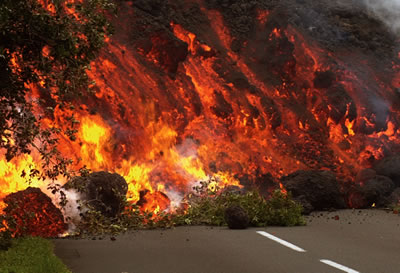
A lava flow devours a road in Hawaii. This natural hazard creates an inconvenience; however, many natural hazards can be greatly reduced through the education of citizens about the risks in their region.
Click on image for full size
Courtesy of the Earth Science Literacy Initiative

Earth Science Literacy - Big Idea 8

Natural hazards pose risks to humans.

Big Idea 8.1
Natural hazards result from natural Earth processes. These hazards include earthquakes, tsunamis, hurricanes, floods, droughts, landslides, volcanic eruptions, extreme weather, lightning-induced fires, sinkholes, coastal erosion, and comet and asteroid impacts.

Big Idea 8.2
Natural hazards shape the history of human societies. Hazardous events can significantly alter the size of human populations and drive human migrations. Risks from natural hazards increase as populations expand into vulnerable areas or concentrate in already-inhabited areas.

Big Idea 8.3
Human activities can contribute to the frequency and intensity of some natural hazards. These hazards include floods, landslides, droughts, forest fires, and erosion.

Big Idea 8.4
Hazardous events can be sudden or gradual. They range from sudden events such as earthquakes and explosive volcanic eruptions, to more gradual phenomena such as droughts, which may last decades or longer. Changes caused by continual processes such as erosion and land subsidence can also result in risks to human populations, as with the increased risk of flooding in New Orleans.

Big Idea 8.5
Natural hazards can be local or global in origin. Local events can have distant impacts because of the interconnectedness of both human societies and Earth’s systems. For example, a volcanic eruption in the Pacific Ocean can impact climate around the globe.

Big Idea 8.6
Earth scientists are continually improving estimates of when and where natural hazards occur. This analysis is done through continuously monitoring Earth, increasing our understanding of the physical processes that underlie its changes, and developing scientific models that can explain hazard-related scientific observations.

Big Idea 8.7
Humans cannot eliminate natural hazards, but can engage in activities that reduce their impacts. Loss of life, property damage, and economic costs can be reduced by identifying high-risk locations and minimizing human habitation and societal activities in them, improving construction methods, developing warning systems, and recognizing how human behavior influences preparedness and response.

Big Idea 8.8
An Earth-science-literate public is essential for reducing risks from natural hazards. This literacy leads to the promotion of community awareness about natural hazards and to the development of scientifically informed policies that reduce risk.

Last modified July 29, 2009 by Becca Hatheway.

Shop Windows to the Universe Science Store!

The Winter 2009 issue of The Earth Scientist, focuses on Earth System science, including articles on student inquiry, differentiated instruction, geomorphic concepts, the rock cycle, and much more!

Windows to the Universe Community

News

Opportunities

You might also be interested in:

Traveling Nitrogen Classroom Activity Kit

Check out our online store - minerals, fossils, books, activities, jewelry, and household items!...more

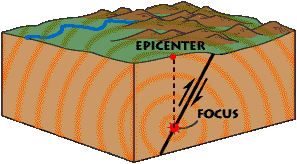
What Is an Earthquake?

The expression "on solid ground" is often used to describe something as stable. But sometimes the solid ground underfoot is not stable. It moves as Earth’s tectonic plates move. Sometimes it moves gradually....more

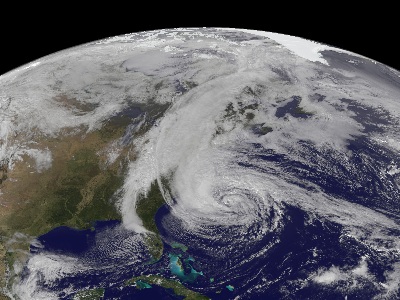
Hurricanes (also known as Tropical Cyclones)

As a strong hurricane heads towards a vulnerable coast, people take precautions - boarding up houses, packing the car, and evacuating. These massive storms can spell disaster for people in hurricane prone...more

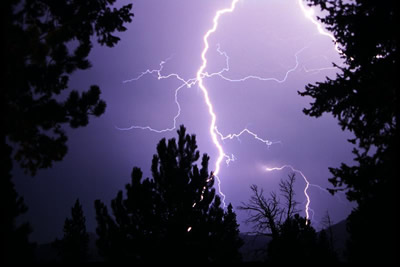
Thunder and Lightning

Lightning is the most spectacular element of a thunderstorm. In fact it is how thunderstorms got their name. Wait a minute, what does thunder have to do with lightning? Well, lightning causes thunder....more

Step 2: Erosion and Transport (Sediments on the Move!)

Sneeze into a pile of dust and the particles fly everywhere. Sneeze into a pile of rocks and they stay put. That’s because they have more mass. You need more force than a sneeze to move those rocks. Wind...more

Earth as a System

The first time people got a glimpse of the whole Earth was December 1968. Apollo 8 astronauts, en route to and from the Moon, took pictures of the Earth from space.  In their photographs, the Earth looks...more

What Is Climate?

Climate in your place on the globe is called regional climate. It is the average weather pattern in a place over more than thirty years, including the variations in seasons. To describe the regional climate...more

Guide to Weather Advisories, Watches, and Warnings

A watch, warning, or advisory is an important way for the National Weather Service of the United States to alert people about hazardous weather. As a community member, it is vital to be aware of any watches,...more

Shop Windows to the Universe

The Winter 2010 issue of The Earth Scientist includes a variety of educational resources, ranging from astronomy to glaciers. Check out the other publications and classroom materials in our online store.

Windows to the Universe, a project of the National Earth Science Teachers Association, is sponsored in part by the National Science Foundation and NASA, our Founding Partners (the American Geophysical Union and American Geosciences Institute) as well as through Institutional, Contributing, and Affiliate Partners, individual memberships and generous donors. Thank you for your support! NASA AGU AGI NSF