This image shows wind speeds and directions over a segment of the ocean. The red color denotes faster wind speeds while the blue color denotes slower wind speeds. Scientists once wondered if changes in the Sun affected wind patterns on Earth.
Click on image for full size
Courtesy of U.S. Navy/NRL/NOAA
Sun's Effect on Earth's Weather (Wind)
Energy from
the Sun affects many things
on Earth. One of the main things the Sun does is warm our planet, including
the atmosphere. This energy drives much of our
weather.
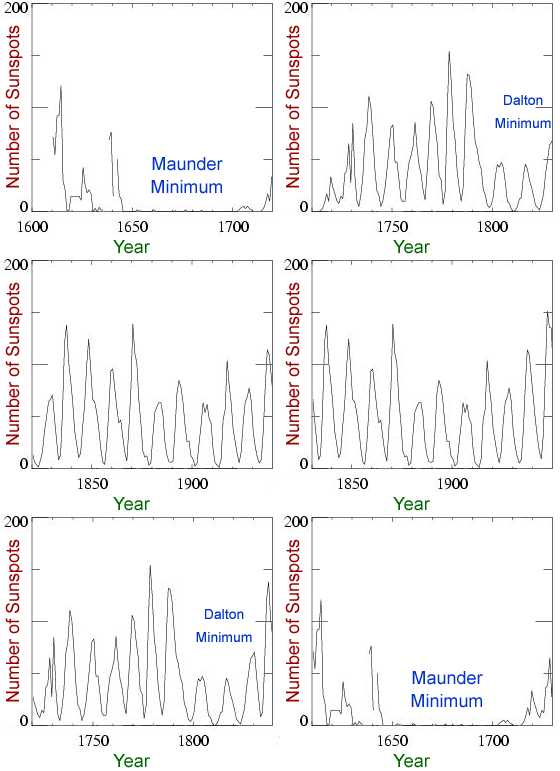
The solar cycle, the rise and fall of the number of sunspots on the Sun, has been known since the mid-19th century. Soon after this discovery scientists started to ask how the solar cycle might affect the Earth's weather.
The solar cycle goes from when the Sun has a minimum number of sunspots (a solar minimum) to when the Sun has a maximum number of sunspots (a solar maximum) back to a minimum. The time between two minimums is about 10.5 to 11 years. Really all aspects of the Sun and solar activity are influenced by the solar cycle. Solar activity (like coronal mass ejections) is more frequent at solar maximums and less frequent at solar minimums.
Scientists tried, but were not able to find correlations between this solar cycle and the Earth's weather. These attempts to find correlations ran into many difficulties. One problem was that weather data quality was variable. Finally, most scientists concluded that there is most likely no significant physical relationship between the solar cycle and Earth’s weather.
One example was a study to see if the solar cycle affected wind patterns on Earth. In 1949, H.C. Willett looked to see if the solar cycle affected long-term changes of wind patterns. He saw the solar cycle as a definite factor in influencing wind variations. He did admit that, "the physical basis of any such relationship must be utterly complex, and is as yet not at all understood." However, attempts to confirm his conclusions were not successful.
In fact, over time and with more and more studies and better instruments (especially satellites outside the Earth's atmosphere), connections between the solar cycle and Earth's weather have been found more and more unlikely. One exception to this seems to be that solar cosmic rays do affect Earth's cloudiness.
Through decades of study by scientists around the world, Sun-weather connections have largely been rejected by the scientific community.



Shop Windows to the Universe Science Store!
Cool It! is the new card game from the Union of Concerned Scientists that teaches kids about the choices we have when it comes to climate change—and how policy and technology decisions made today will matter. Cool It! is available in our
online store.
You might also be interested in:

Once energy from the Sun gets to Earth, several things can happen to it: Energy can be scattered or absorbed by aerosols in the atmosphere. Aerosols are dust, soot, sulfates and nitric oxides. When aerosols
...more
You may not know that humans have observed sunspots for a very long time. These records have been around so long in fact, that we can link sunspot number with solar activity. Large sunspots can sometimes
...more
The Sun is not a quiet place, but one that exhibits sudden releases of energy. One of the most frequently observed events are solar flares: sudden, localized, transient increases in brightness that occur
...more
"Without warning, the relatively calm solar atmosphere can be torn asunder by sudden outbursts of a scale unknown on Earth. Catastrophic events of incredible energy...stretch up to halfway across the visible
...more
It's important in their work for scientists to know if two sets of data (or variables) are related to each other. For example, you might wonder if the amount of time a student spends reading the Windows
...more
Clouds can come in all sizes and shapes, and can form near the ground or high in the atmosphere. Clouds are groups of tiny water droplets or ice crystals in the sky and are formed by different processes.
...more
The study of space weather is a relatively young science. As such it has many unanswered questions and unsolved mysteries. Although some of our data relevant to space weather, such as sunspot counts, go
...more
IMF stands for Interplanetary Magnetic Field. It is another name for the Sun's magnetic field. The Sun's magnetic field is huge! It goes beyond any of the planets. The Sun's magnetic field got its name
...more