Current Events

  • Atmospheric CO2 Level Tops 400 ppm
    During the week of May 13th, the CO2 level at the Mauna Loa Observatory in Hawaii topped 400 ppm rep...Read more

    x

    Atmospheric CO2 Level Tops 400 ppm

    During the week of May 13th, the CO2 level at the Mauna Loa Observatory in Hawaii topped 400 ppm repeatedly. Daily levels of CO2 can vary due to weather, and there are seasonal trends as well. The level of atmospheric greenhouse gases continues to increase, now over 120 ppm since the Industrial Revolution began. For more on the Keeling Curve, see http://keelingcurve.ucsd.edu/. Find out more about greenhouse gases and warming.
  • Massive Tornado Outbreak on Tornado Alley
    The week of May 19 brings dozens of tornadoes to Tornado Alley in the states of Oklahoma, Kansas, Io...Read more

    x

    Massive Tornado Outbreak on Tornado Alley

    The week of May 19 brings dozens of tornadoes to Tornado Alley in the states of Oklahoma, Kansas, Iowa, Illinois and Missouri. On May 20th, a massive tornado struck Moore, Oklahoma, devastating communities - destroying over 100 homes and hitting two elementary schools and a hospital - with many casualties and deaths. Our thoughts are with our friends and colleagues suffering from these storms. For more on the May 20th storms, see the NOAA Storm Prediction Center Storm Report.
  • Kansas Legislator Proposes Bill to Outlaw Sustainability Education
    A bill has been introduced in the Kansas legislature this week that would prohibit the promotion of ...Read more

    x

    Kansas Legislator Proposes Bill to Outlaw Sustainability Education

    A bill has been introduced in the Kansas legislature this week that would prohibit the promotion of sustainability. Here is a link to the one-page bill: http://www.kslegislature.org/li/b2013_14/measures/documents/hb2366_00_0000.pdf. See report on Bloomberg News.
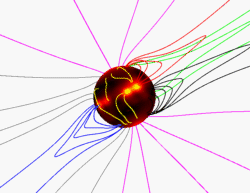
Magnetic field lines from a computer simulation of the solar corona show some of the complexity of the Sun's magnetic field. Colors on the Sun's surface show the strength of the magnetic field (yellow is largest).
Click on image for full size

The Sun's Magnetic Field

Text for this level has not been written yet.

Please see the "Intermediate" text for this page if you want to learn about this topic.

To get to the "Intermediate" text, click on the blue "Intermediate" button at the top of the page (between the "Beginner" and "Advanced" buttons).

Last modified June 23, 2010 by Randy Russell.

Shop Windows to the Universe Science Store!

Cool It! is the new card game from the Union of Concerned Scientists that teaches kids about the choices we have when it comes to climate change—and how policy and technology decisions made today will matter. Cool It! is available in our online store.

Windows to the Universe Community

News

Opportunities

You might also be interested in:

Traveling Nitrogen Classroom Activity Kit

Check out our online store - minerals, fossils, books, activities, jewelry, and household items!...more

Sunspots and Magnetic Fields

You probably have magnets on your refrigerator holding up some of your artwork or a photograph of a friend or family. Did you know that it is magnetic fields (which all magnets have) that make sunspots...more

Solar Dynamics Observatory

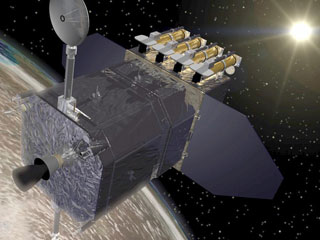
Solar Dynamics Observatory (SDO) is a satellite which studies the Sun. SDO carries several telescopes and other instruments for observing the Sun. The cameras on SDO take much better pictures than cameras...more

The Photosphere - the "Surface" of the Sun

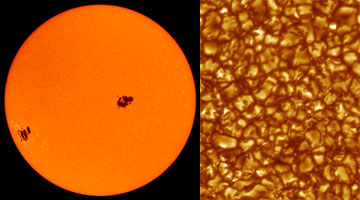
Most of the energy we receive from the Sun is the visible (white) light emitted from the photosphere. The photosphere is one of the coolest regions of the Sun (6000 K), so only a small fraction (0.1%)...more

Active Regions on the Sun

An active region on the Sun is an area with an especially strong magnetic field. Sunspots frequently form in active regions. Active regions appear bright in X-ray and ultraviolet images. Solar activity,...more

Lower Solar Activity Linked to Changes in Sun's Conveyor Belt

The sun goes through cycles that last approximately 11 years. These solar cycle include phases with more magnetic activity, sunspots, and solar flares. They also include phases with less activity. The...more

The Sun's Magnetic Field

Text for this level has not been written yet. Please see the "Intermediate" text for this page if you want to learn about this topic. To get to the "Intermediate" text, click on the blue "Intermediate"...more

Sun's Effect on Earth

The Sun is very important to the Earth. The Sun warms our planet, heating the surface, the oceans and the atmosphere. The Sun also gives us light. We definitely couldn't live on Earth without the Sun!...more

Shop Windows to the Universe

Please help support Windows to the Universe, and our activities to help Earth and space science teachers, with a tax-exempt donation today!

Windows to the Universe, a project of the National Earth Science Teachers Association, is sponsored in part by the National Science Foundation and NASA, our Founding Partners (the American Geophysical Union and American Geosciences Institute) as well as through Institutional, Contributing, and Affiliate Partners, individual memberships and generous donors. Thank you for your support! NASA AGU AGI NSF