Current Events

  • Irish Chronicles Document Links Between Volcanoes and Weather
    A study of over 40,000 written entries in Irish Annals and ice core measurements shows a strong corr...Read more

    x

    Irish Chronicles Document Links Between Volcanoes and Weather

    A study of over 40,000 written entries in Irish Annals and ice core measurements shows a strong correlation between the occurrence of volcanic eruptions and extreme cold weather in Ireland over a 1200 year period. Data analyzed in this study cover the period from 431 to 1649, during which time up to 48 volcanic eruptions are identified in Greenland ice core records through deposition of volcanic sulfate in annual layers of ice. You can find the study (open access), published on 6 June 2013 in IOP Publishing's journal Environmental Research Letters, at http://iopscience.iop.org/1748-9326/8/2/024035/article. Find out more about how volcanoes can influence climate.
  • EF-5 Tornado in El Reno, Oklahoma Widest Ever Recorded in US
    The EF-5 tornado that hit El Reno, Oklahoma on May 31st was the widest ever recorded in the US, acco...Read more

    x

    EF-5 Tornado in El Reno, Oklahoma Widest Ever Recorded in US

    The EF-5 tornado that hit El Reno, Oklahoma on May 31st was the widest ever recorded in the US, according to the National Weather Service in Norman Oklahoma. The tornado, which remained on the ground for 40 minutes and reached 2.6 miles across (4.2 km), took the lives of 18 people including storm chasers Tim Samaras, Paul Samaras and Carl Young. For more information on the tornado, visit http://ow.ly/i/2hfDG.
  • Atmospheric CO2 Level Tops 400 ppm
    During the week of May 13th, the CO2 level at the Mauna Loa Observatory in Hawaii topped 400 ppm rep...Read more

    x

    Atmospheric CO2 Level Tops 400 ppm

    During the week of May 13th, the CO2 level at the Mauna Loa Observatory in Hawaii topped 400 ppm repeatedly. Daily levels of CO2 can vary due to weather, and there are seasonal trends as well. The level of atmospheric greenhouse gases continues to increase, now over 120 ppm since the Industrial Revolution began. For more on the Keeling Curve, see http://keelingcurve.ucsd.edu/. Find out more about greenhouse gases and warming.
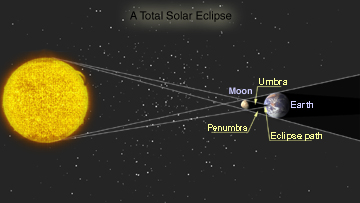
This is a diagram of a typical solar eclipse. During a total solar eclipse, the umbra reaches the Earth. During an annular eclipse, it does not. An eclipse occurs when the Moon passes in the path of the Sun and Earth.
Click on image for full size
Windows to the Universe original image

Solar Eclipses

An eclipse of the Sun occurs when the Earth passes through the Moon's shadow. A total eclipse of the Sun takes place only during a new moon, when the Moon is directly between the Sun and the Earth.

When a total eclipse does occur, the Moon's shadow covers only a small portion of the Earth, where the eclipse is visible. As the Moon moves in its orbit, the position of the shadow changes, so total solar eclipses usually only last a minute or two in a given location.

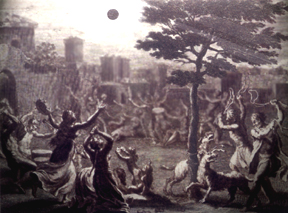
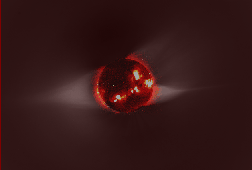
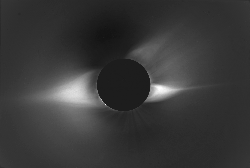
In ancient times, people were frightened by solar eclipses (even back then people realized that the Sun was essential to life on Earth). Now eclipses are of great interest to the public and to astronomers. Eclipses provide an opportunity to view the Sun's outer atmosphere, the solar corona.

If you ever get to view a solar eclipse, make sure to never look at the Sun directly! Always use one of these safe techniques.

Last modified April 27, 2006 by Randy Russell.

Shop Windows to the Universe Science Store!

Cool It! is the new card game from the Union of Concerned Scientists that teaches kids about the choices we have when it comes to climate change—and how policy and technology decisions made today will matter. Cool It! is available in our online store.

Windows to the Universe Community

News

Opportunities

You might also be interested in:

Traveling Nitrogen Classroom Activity Kit

Check out our online store - minerals, fossils, books, activities, jewelry, and household items!...more

Solar Eclipses Were not Always Enjoyed

Eclipses have been watched for centuries, but it was only recently that we understood what really occurs. Eclipses have always been fascinating to watch, but they weren't always welcome. For many years,...more

The Solar Corona

Rising above the Sun's chromosphere , the temperature jumps sharply from a few tens of thousands of kelvins to as much as a few million kelvins in the Sun's outer atmosphere, the solar corona. Understanding...more

A Big Day for the Sun

On Thursday, June 21, 2001, there will be a total eclipse of the Sun. The eclipse will only be visible from parts of Africa and Madagascar. The triple line on the image to the left shows the path of where...more

Last Solar Eclipse of the Millennium on August 11

The last solar eclipse of this millennium occurred on August 11, 1999. Amateurs and scientists witnessed a truly awesome site. This was a total eclipse, which means the Moon completely covered the Sun....more

Lunar Eclipse January 20, 2000

The last lunar eclipse of the millennium in North America is this week! On January 20, 2000, which is Thursday for those living in North America, a total lunar eclipse will occur. A lunar eclipse is different...more

President of Peru Visits Ancient Incan Sites

Peru's new president, Alejandro Toledo, was sworn in on July 28, 2001. The next day he visited Machu Picchu and Cuzco. There were ceremonies at both locations where Toledo asked for the blessing of the...more

Total Solar Eclipse - Coming Soon!

There is a solar eclipse coming to a movie theater near you! Actually, this is better than a theater! This is the real thing! There will be a total solar eclipse on February 26th. The total eclipse will...more

Shop Windows to the Universe

The Winter 2010 issue of The Earth Scientist includes a variety of educational resources, ranging from astronomy to glaciers. Check out the other publications and classroom materials in our online store.

Windows to the Universe, a project of the National Earth Science Teachers Association, is sponsored in part by the National Science Foundation and NASA, our Founding Partners (the American Geophysical Union and American Geosciences Institute) as well as through Institutional, Contributing, and Affiliate Partners, individual memberships and generous donors. Thank you for your support! NASA AGU AGI NSF