Current Events

  • Kansas Legislator Proposes Bill to Outlaw Sustainability Education
    A bill has been introduced in the Kansas legislature this week that would prohibit the promotion of ...Read more

    x

    Kansas Legislator Proposes Bill to Outlaw Sustainability Education

    A bill has been introduced in the Kansas legislature this week that would prohibit the promotion of sustainability. Here is a link to the one-page bill: http://www.kslegislature.org/li/b2013_14/measures/documents/hb2366_00_0000.pdf. See report on Bloomberg News.
  • Earth's Center Is 1,000 Degrees Hotter Than Previously Thought, Synchrotron X-Ray Experiment Shows
    Scientists have determined the temperature near the Earth’s center to be 6000 degrees Celsius, 1000 ...Read more

    x

    Earth's Center Is 1,000 Degrees Hotter Than Previously Thought, Synchrotron X-Ray Experiment Shows

    Scientists have determined the temperature near the Earth’s center to be 6000 degrees Celsius, 1000 degrees hotter than in a previous experiment run 20 years ago. These measurements confirm geophysical models that the temperature difference between the solid core and the mantle above, must be at least 1500 degrees to explain why the Earth has a magnetic field. For more information about this study, see the press release from the European Synchrotron Radiation Facility.
  • Ocean Volcanic Rocks Contain Samples of Recycled Crust
    Scientists have long believed that lava erupted from certain oceanic volcanoes contains materials fr...Read more

    x

    Ocean Volcanic Rocks Contain Samples of Recycled Crust

    Scientists have long believed that lava erupted from certain oceanic volcanoes contains materials from the early Earth’s crust. But decisive evidence for this phenomenon has proven elusive. New research from a team including Carnegie’s Erik Hauri demonstrates that oceanic volcanic rocks contain samples of recycled crust dating back to the Archean era 2.5 billion years ago. Their work is published in Nature. Oceanic crust sinks into the Earth’s mantle at so-called subduction zones, where two plates come together. Much of what happens to the crust during this journey is unknown. Model-dependent studies for how long subducted material can exist in the mantle are uncertain and evidence of very old crust returning to Earth’s surface via upwellings of magma has not been found until now. For more information about these results, see the press release from the Carnegie Institution.

Helioseismology

Helioseismology studies the wave oscillations in the Sun. This is like the study of seismic waves on Earth.

These waves are affected by the temperature of the Sun and the deep motions inside the Sun.

Scientists observe these waves at the Sun's surface. Since the waves are created deep inside the Sun, scientists use these waves to understand the Sun's interior. That is why helioseismology is called a diagnostic.

We can see similar waves in other stars too.


60 foot tower at Mt. Wilson Observatory where helioseismology work began in the 1960's
Click on image for full size (26K JPEG)
Image courtesy of University of Southern California, 60 Foot Solar Tower at Mt. Wilson Observatory.

A computer-generated image of a wave moving through the interior of the Sun.

Sounds of the Stars

The Sounds of the Sun brought to you by the BiSON network...

Movie: Journey Beneath a Sunspot

Last modified January 12, 2010 by Randy Russell.

Shop Windows to the Universe Science Store!

Cool It! is the new card game from the Union of Concerned Scientists that teaches kids about the choices we have when it comes to climate change—and how policy and technology decisions made today will matter. Cool It! is available in our online store.

Windows to the Universe Community

News

Opportunities

You might also be interested in:

George Hale

George Hale was an American astronomer born in 1868. Even as a child, Hale was interested in the stars. When George was young, his father even built him his own observatory in the backyard. After attending...more

Diagnostics for the Solar Interior

The Sun releases energy. The processes that make this energy take place in the center of the Sun. We can't see past the surface of the Sun. But scientists use indirect ways (diagnostics) to figure out...more

Instruments & Techniques for Space Weather Measurements

How do scientists measure space weather? Let's take a look! Scientists watch the Sun with special telescopes. Some of the telescopes are on Earth, while others are on satellites. Some of the telescopes...more

IMF

IMF stands for Interplanetary Magnetic Field. It is another name for the Sun's magnetic field. The Sun's magnetic field is huge! It goes beyond any of the planets. The Sun's magnetic field got its name...more

The Hydrogen Fusion Process

In the basic Hydrogen fusion cycle, four Hydrogen nuclei (protons) come together to make a Helium nucleus. This is the simple version of the story. There are actually electrons, neutrinos and photons involved...more

Fusion Inside the Stars

Fusion in the core of stars is reached when the density and temperature are high enough. There are different fusion cycles that occur in different phases of the life of a star. These different cycles make...more

The Neutron Capture Process

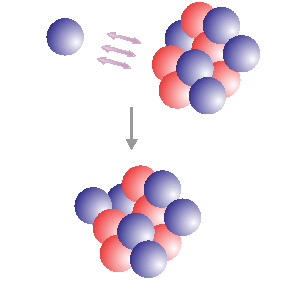
Neutron capture can occur when a neutron approaches a nucleus close enough for nuclear forces to be effective. The neutron is captured and forms a heavier isotope of the capturing element. When the new...more

The Supernova

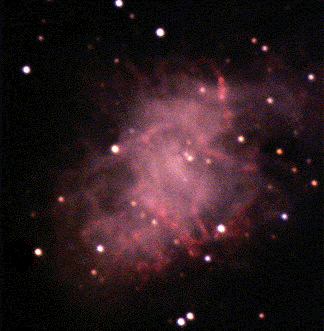
A Supernova is a very massive star that explodes at the end of its life cycle. The supernova is the furnace where the heavy elements (heavier than iron) are formed. ...more

Shop Windows to the Universe

We now offer the Cool It! card game in our Science Store. Cool It! is the new card game from UCS that teaches kids about the choices we have when it comes to climate change.

Windows to the Universe, a project of the National Earth Science Teachers Association, is sponsored in part by the National Science Foundation and NASA, our Founding Partners (the American Geophysical Union and American Geosciences Institute) as well as through Institutional, Contributing, and Affiliate Partners, individual memberships and generous donors. Thank you for your support! NASA AGU AGI NSF