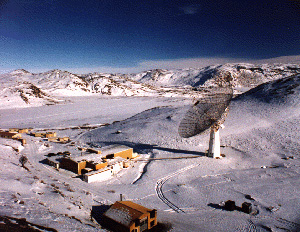
This radar dish at the Sondrestrom Observatory in Greenland is used to study the ionosphere.
Ground-based Observations of Space Weather
Spacecraft help us look at space weather. We can also make some space weather measurements from the surface of Earth. Instruments on the ground are cheaper and are easier to fix than instruments on spacecraft.
Watching the Sun from Earth
Astronomers have used special telescopes to view the Sun for a long time. Remember, these are special telescopes so that scientists won't hurt their eyes (Never look directly at the Sun with your own eyes!). Using these special telescopes, scientists have noted the number of sunspots for a long time.
Scientists use coronagraphs, instruments that make artificial eclipses, to study the Sun's atmosphere.
Northern Lights and Southern Lights - the Aurora
There is a glow sometimes in the sky that we call the aurora (or Southern or Northern Lights). People have looked at aurora for many years. The Lights are made when space weather storms hit Earth's atmosphere. Aurora watchers can notice how bright an aurora is and how long it lasts. This helps us know how strong a space weather storm is.
Using Radio Waves to Observe the Ionosphere
Space weather makes changes in Earth's atmosphere. Instruments on Earth help us keep track of how the atmosphere changes. Scientists keep a close eye on one part of the atmosphere, the ionosphere. Using instruments like radars, they can see how the ionosphere changes as space weather changes.
Measuring Magnetic Fields around the Globe
Did you know that the Sun is magnetic? When solar wind leaves the Sun, it actually carries the Sun's magnetic field with it. Scientists use magnetometers all over the Earth to measure the Earth's own magnetic field and the Sun's magnetic field when it comes to Earth.
You might also be interested in:

Satellites in space help us measure space weather. They collect info about the Sun, Earth's magnetosphere, Earth's atmosphere, and space weather. Spacecraft that Watch the Sun Some spacecraft watch the
...more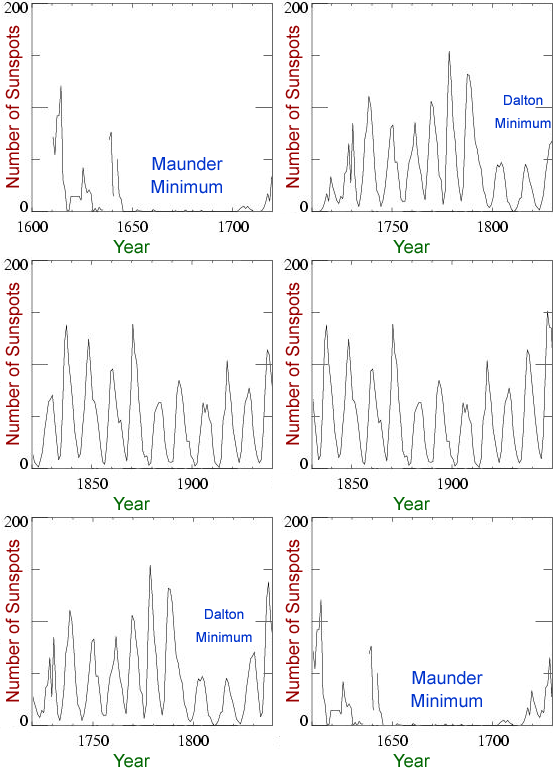
Humans have looked for and written down information about sunspots for a very long time! In fact, the first time someone wrote down sunspot information was almost 3,000 years ago in China! An English monk
...more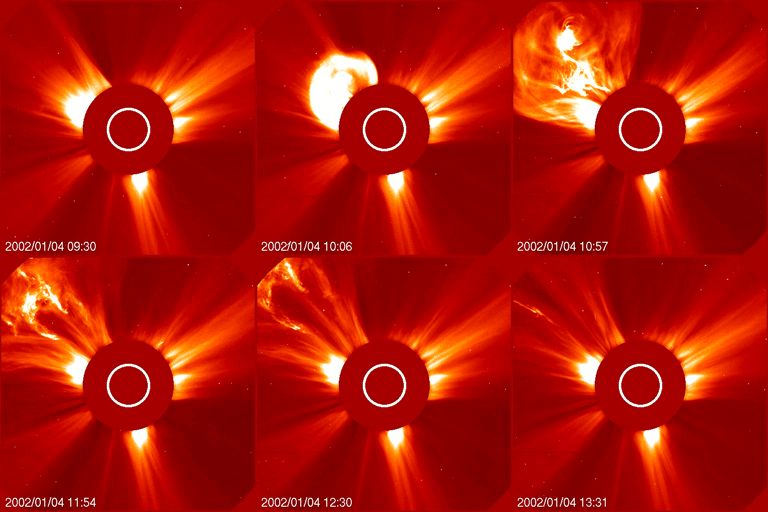
You know that there are all kinds of storms here on Earth - thunderstorms, blizzards, tornadoes, and hurricanes. The Sunalso has storms. There are two different kinds of storms on the Sun. They are called
...more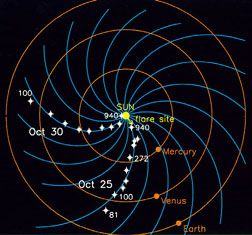
The Sun acts like it has a big magnet in the middle of it. We call this the Sun's magnetic field. The Sun's magnetic field has a fancier name, the Interplanetary Magnetic Field (IMF). This just means that
...more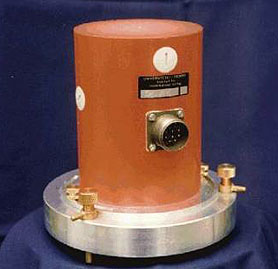
Even though the Sun is very far away, it has a big effect on Earth. It gives us warmth and light. Storms on the Sun can also bring about what scientists call space weather on Earth or near Earth (just
...more
Scientists use different ways to study space weather. They use instruments in space like satellites and orbiting telescopes. Scientists also use instruments on Earth to study space weather. They use these
...more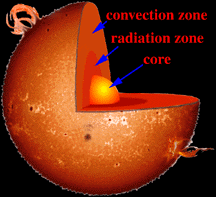
Scientists have named the parts of the Sun. The "surface" of the Sun is called the photosphere. The three areas inside the Sun are called the core, the radiation zone, and the convection zone.
...more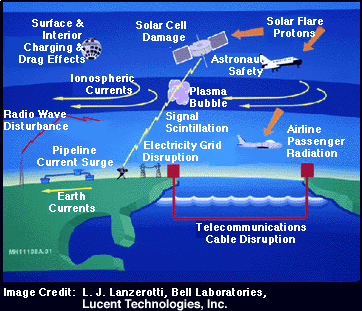
Earth's magnetic field is a shield that keeps most of space weather's effects where they belong; safely out in space! But space weather does effect life on Earth. Outside of the Earth's magnetic field,
...more