Current Events

  • Atmospheric CO2 Level Tops 400 ppm
    During the week of May 13th, the CO2 level at the Mauna Loa Observatory in Hawaii topped 400 ppm rep...Read more

    x

    Atmospheric CO2 Level Tops 400 ppm

    During the week of May 13th, the CO2 level at the Mauna Loa Observatory in Hawaii topped 400 ppm repeatedly. Daily levels of CO2 can vary due to weather, and there are seasonal trends as well. The level of atmospheric greenhouse gases continues to increase, now over 120 ppm since the Industrial Revolution began. For more on the Keeling Curve, see http://keelingcurve.ucsd.edu/. Find out more about greenhouse gases and warming.
  • Massive Tornado Outbreak on Tornado Alley
    The week of May 19 brings dozens of tornadoes to Tornado Alley in the states of Oklahoma, Kansas, Io...Read more

    x

    Massive Tornado Outbreak on Tornado Alley

    The week of May 19 brings dozens of tornadoes to Tornado Alley in the states of Oklahoma, Kansas, Iowa, Illinois and Missouri. On May 20th, a massive tornado struck Moore, Oklahoma, devastating communities - destroying over 100 homes and hitting two elementary schools and a hospital - with many casualties and deaths. Our thoughts are with our friends and colleagues suffering from these storms. For more on the May 20th storms, see the NOAA Storm Prediction Center Storm Report.
  • Kansas Legislator Proposes Bill to Outlaw Sustainability Education
    A bill has been introduced in the Kansas legislature this week that would prohibit the promotion of ...Read more

    x

    Kansas Legislator Proposes Bill to Outlaw Sustainability Education

    A bill has been introduced in the Kansas legislature this week that would prohibit the promotion of sustainability. Here is a link to the one-page bill: http://www.kslegislature.org/li/b2013_14/measures/documents/hb2366_00_0000.pdf. See report on Bloomberg News.
A graph of sunspot numbers from 1700 through 1993, showing the 11-year sunspot cycle.
Click on image for full size
Image courtesy NOAA/NGDC.

Space Weather: Quiet vs. Active Times

We tend to think of the Sun as constant and unchanging. However, most aspects of our neighborhood star do vary, some in dramatic fashion, over time scales as short as minutes and as long as billions of years.

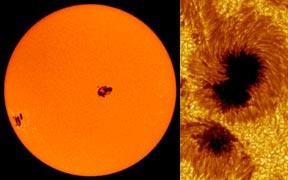
Dark spots appear on the face of the Sun from time to time. The number, size, and locations of these sunspots varies over the years. Observational records, going back centuries, show that sunspot counts vary dramatically and regularly in an 11-year cycle. When sunspots are few, the Sun is sedate and solar storms are rare. When sunspots are plentiful, the Sun becomes unsettled and much more active. During peaks in solar activity huge explosions on the Sun (called solar flares) generate bursts of radiation and energetic particles. Active periods bring increased levels of ultraviolet radiation and X-ray emissions, more streamers and prominences above the Sun's surface, and an expansion of the solar atmosphere and heliosphere.

The level of activity on the Sun has consequences throughout our Solar System, including here on Earth. Satellites and astronauts are vulnerable to damage and injury from increased radiation levels at active times. Solar storms generate beautiful auroral light shows high in our atmosphere - the Southern and Northern Lights! Solar activity can also interrupt communications, disrupt electrical power systems, and hasten corrosion of pipelines. Variations in the Sun probably influence our weather and climate, though the exact form that those influences take is still being researched.

The Sun also changes over longer timescales. The 11-year sunspot cycle has been interrupted at times, and some scientists believe there are longer-term cyclical variations in solar activity. The Sun has gradually brightened (by roughly 30%) over its six billion year history, dramatically increasing the heat delivered to Earth's climate. Our star was also much more active in its youth, displaying wilder variations in activity level as compared to modern times.

Last modified September 5, 2008 by Randy Russell.

Shop Windows to the Universe Science Store!

Our online store includes issues of NESTA's quarterly journal, The Earth Scientist, full of classroom activities on different topics in Earth and space science, as well as books on science education!

Windows to the Universe Community

News

Opportunities

You might also be interested in:

Cool It! Game

Check out our online store - minerals, fossils, books, activities, jewelry, and household items!...more

Sunspots

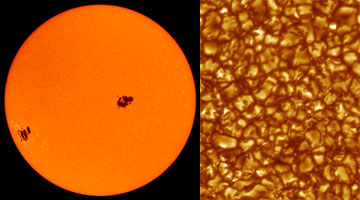
Sunspots are dark, planet-sized regions that appear on the "surface" of the Sun. Sunspots are "dark" because they are cooler than their surroundings. A large sunspot might have a central temperature of...more

Electromagnetic Radiation

Electromagnetic radiation is the result of oscillating electric and magnetic fields. The wave of energy generated by such vibrations moves through space at the speed of light. And well it should... for...more

Particle Radiation

One main type of radiation, particle radiation, is the result of subatomic particles hurtling at tremendous speeds. Protons, cosmic rays, and alpha and beta particles are some of the most common types...more

Helmet Streamers and the Magnetic Structure of the Corona

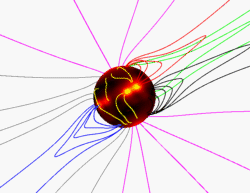
The gas in the solar corona is at very high temperatures (typically 1-2 million kelvins in most regions) so it is almost completely in a plasma state (made up of charged particles, mostly protons and electrons)....more

Solar Prominence

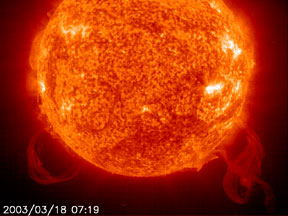
Large impressive loop-like structures on the edge of the solar disk sometimes stand out brightly against the dark background of space. Though these structures, called "prominences", appear to be very bright...more

The Photosphere - the "Surface" of the Sun

Most of the energy we receive from the Sun is the visible (white) light emitted from the photosphere. The photosphere is one of the coolest regions of the Sun (6000 K), so only a small fraction (0.1%)...more

Radiation

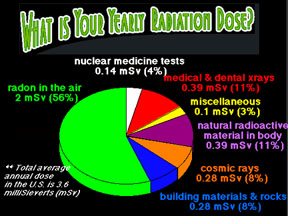
Radiation comes in two basic types: electromagnetic radiation transmitted by photons, and particle radiation consisting of electrons, protons, alpha particles, and so forth. Electromagnetic radiation,...more

Shop Windows to the Universe

Young Voices for the Planet DVD in our online store includes 8 films where students speak out and take action on climate change.

Windows to the Universe, a project of the National Earth Science Teachers Association, is sponsored in part by the National Science Foundation and NASA, our Founding Partners (the American Geophysical Union and American Geosciences Institute) as well as through Institutional, Contributing, and Affiliate Partners, individual memberships and generous donors. Thank you for your support! NASA AGU AGI NSF