Current Events

  • Kansas Legislator Proposes Bill to Outlaw Sustainability Education
    A bill has been introduced in the Kansas legislature this week that would prohibit the promotion of ...Read more

    x

    Kansas Legislator Proposes Bill to Outlaw Sustainability Education

    A bill has been introduced in the Kansas legislature this week that would prohibit the promotion of sustainability. Here is a link to the one-page bill: http://www.kslegislature.org/li/b2013_14/measures/documents/hb2366_00_0000.pdf. See report on Bloomberg News.
  • Earth's Center Is 1,000 Degrees Hotter Than Previously Thought, Synchrotron X-Ray Experiment Shows
    Scientists have determined the temperature near the Earth’s center to be 6000 degrees Celsius, 1000 ...Read more

    x

    Earth's Center Is 1,000 Degrees Hotter Than Previously Thought, Synchrotron X-Ray Experiment Shows

    Scientists have determined the temperature near the Earth’s center to be 6000 degrees Celsius, 1000 degrees hotter than in a previous experiment run 20 years ago. These measurements confirm geophysical models that the temperature difference between the solid core and the mantle above, must be at least 1500 degrees to explain why the Earth has a magnetic field. For more information about this study, see the press release from the European Synchrotron Radiation Facility.
  • Ocean Volcanic Rocks Contain Samples of Recycled Crust
    Scientists have long believed that lava erupted from certain oceanic volcanoes contains materials fr...Read more

    x

    Ocean Volcanic Rocks Contain Samples of Recycled Crust

    Scientists have long believed that lava erupted from certain oceanic volcanoes contains materials from the early Earth’s crust. But decisive evidence for this phenomenon has proven elusive. New research from a team including Carnegie’s Erik Hauri demonstrates that oceanic volcanic rocks contain samples of recycled crust dating back to the Archean era 2.5 billion years ago. Their work is published in Nature. Oceanic crust sinks into the Earth’s mantle at so-called subduction zones, where two plates come together. Much of what happens to the crust during this journey is unknown. Model-dependent studies for how long subducted material can exist in the mantle are uncertain and evidence of very old crust returning to Earth’s surface via upwellings of magma has not been found until now. For more information about these results, see the press release from the Carnegie Institution.

Space Weather Hands-on Activities for Classroom & Home

Hands-on Activities, Lesson Plans, Games and Quizzes for use in the Classroom or at Home

These activities cover Space Weather and related topics, such as magnetism and the Sun.

Our team of content developers and expert teachers created some of the activities in this section. Other activities listed here are ones that we use and recommend.


Space Weather

Space Weather Activities, Project, and Problems

Last modified October 19, 2004 by Randy Russell.

Shop Windows to the Universe Science Store!

Our online store includes issues of NESTA's quarterly journal, The Earth Scientist, full of classroom activities on different topics in Earth and space science, ranging from seismology, rocks and minerals, oceanography, and Earth system science to astronomy!

Windows to the Universe Community

News

Opportunities

You might also be interested in:

Traveling Nitrogen Classroom Activity Kit

Check out our online store - minerals, fossils, books, activities, jewelry, and household items!...more

Projects - for Science Fairs & Beyond

Interested in doing a project related to space weather for a science fair? The Stanford SOLAR Center provides information about space weather monitors that you can build yourself, including the Sudden...more

Space Weather throughout the Solar System

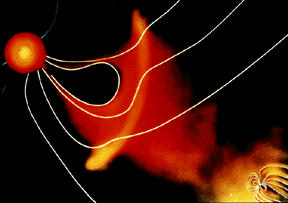
The Sun is surrounded by a "bubble" in space called the heliosphere. In a sense, we Earthlings live within the outer atmosphere of our Sun. The solar wind fills the heliosphere with energetic...more

Space Weather at Earth and in Near-Earth Space (Geospace)

Earth's global magnetic field generates a huge cavity or bubble in space, the magnetosphere, which shields our planet from most of the solar wind. Some solar wind particles do leak in and combine with...more

Ground-based Observations of Space Weather

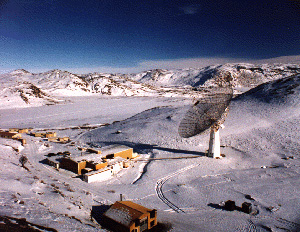
Some observations of space weather phenomena are made by spacecraft. Other observations are made from the ground on or near the surface of Earth. Spacecraft have certain advantages, such as being able...more

Modeling Space Weather

Scientists who study space weather make extensive use of computer models to make sense of complex phenomena. This is a way in which space weather is quite similar to Earthly weather, for weather forecasters...more

Space Weather Effects on Pipelines

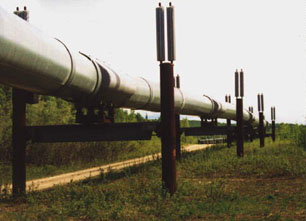
Pipelines for transporting oil, natural gas, and water are often made of conducting materials like steel. Very long pipelines (thousands of kilometers/miles) are used to transport oil and gas at high latitudes,...more

Pipelines - Basic Information

The invention of the seamless, electrically-welded pipe in the 1920's which was capable of carrying material under high pressures, enabled the building of profitable pipelines over a thousand miles long....more

Shop Windows to the Universe

Our Glaciers: Then and Now activity kit helps you see the changes taking place in glaciers around the world. See all our activity kits and classroom activities.

Windows to the Universe, a project of the National Earth Science Teachers Association, is sponsored in part by the National Science Foundation and NASA, our Founding Partners (the American Geophysical Union and American Geosciences Institute) as well as through Institutional, Contributing, and Affiliate Partners, individual memberships and generous donors. Thank you for your support! NASA AGU AGI NSF