Current Events

  • Irish Chronicles Document Links Between Volcanoes and Weather
    A study of over 40,000 written entries in Irish Annals and ice core measurements shows a strong corr...Read more

    x

    Irish Chronicles Document Links Between Volcanoes and Weather

    A study of over 40,000 written entries in Irish Annals and ice core measurements shows a strong correlation between the occurrence of volcanic eruptions and extreme cold weather in Ireland over a 1200 year period. Data analyzed in this study cover the period from 431 to 1649, during which time up to 48 volcanic eruptions are identified in Greenland ice core records through deposition of volcanic sulfate in annual layers of ice. You can find the study (open access), published on 6 June 2013 in IOP Publishing's journal Environmental Research Letters, at http://iopscience.iop.org/1748-9326/8/2/024035/article. Find out more about how volcanoes can influence climate.
  • EF-5 Tornado in El Reno, Oklahoma Widest Ever Recorded in US
    The EF-5 tornado that hit El Reno, Oklahoma on May 31st was the widest ever recorded in the US, acco...Read more

    x

    EF-5 Tornado in El Reno, Oklahoma Widest Ever Recorded in US

    The EF-5 tornado that hit El Reno, Oklahoma on May 31st was the widest ever recorded in the US, according to the National Weather Service in Norman Oklahoma. The tornado, which remained on the ground for 40 minutes and reached 2.6 miles across (4.2 km), took the lives of 18 people including storm chasers Tim Samaras, Paul Samaras and Carl Young. For more information on the tornado, visit http://ow.ly/i/2hfDG.
  • Atmospheric CO2 Level Tops 400 ppm
    During the week of May 13th, the CO2 level at the Mauna Loa Observatory in Hawaii topped 400 ppm rep...Read more

    x

    Atmospheric CO2 Level Tops 400 ppm

    During the week of May 13th, the CO2 level at the Mauna Loa Observatory in Hawaii topped 400 ppm repeatedly. Daily levels of CO2 can vary due to weather, and there are seasonal trends as well. The level of atmospheric greenhouse gases continues to increase, now over 120 ppm since the Industrial Revolution began. For more on the Keeling Curve, see http://keelingcurve.ucsd.edu/. Find out more about greenhouse gases and warming.

New Horizons Trajectory Movie

This animation illustrates the trajectory (path through the Solar System) of the New Horizons space mission to Pluto and beyond.

Note: If you cannot see the movie you may need to download the latest QuickTime player.

Movie courtesy of NASA/Johns Hopkins University Applied Physics Laboratory/Southwest Research Institute.

The animation begins with the launch of New Horizons from Earth on January 19, 2006. New Horizons zoomed away from our planet at the highest speed of any spacecraft leaving Earth so far... it was traveling at 16.21 km/s (36,300 mph) when its engine shut down!

New Horizons crossed the orbit of Mars on April 7, 2006. The spacecraft safely passed through the asteroid belt between the orbits of Mars and Jupiter during a five month period lasting from May through October 2006.

Next, the animation shows the spacecraft during its Jupiter flyby in February 2007. A gravity assist from the gas giant planet increases New Horizon's speed, cutting years off its journey to Pluto.

The spacecraft is expected to fly past Pluto and its largest moon Charon in July 2015. After that, scientists hope to steer New Horizons on to a close encounter with one or more Kuiper Belt Objects.

More New Horizons mission movies:

Animation icon Animation of the New Horizons mission (6.4 MB)

Animation icon Video of the launch of the New Horizons mission (5.5 MB)

Last modified January 23, 2007 by Randy Russell.

Shop Windows to the Universe Science Store!

Our online store includes issues of NESTA's quarterly journal, The Earth Scientist, full of classroom activities on different topics in Earth and space science, ranging from seismology, rocks and minerals, oceanography, and Earth system science to astronomy!

Windows to the Universe Community

News

Opportunities

You might also be interested in:

New Horizons Mission to Pluto

NASA is sending a spacecraft to Pluto. The spacecraft is named New Horizons. New Horizons, which is a robot, will be the first spacecraft to visit Pluto. New Horizons blasted off in January 2006. New Horizons...more

The Kuiper Belt

The outer edge of our Solar System is not empty. There are many, many huge spheres of ice and rock out near Pluto's orbit. Astronomers call this huge group of planetoids "Kuiper Belt Objects", or "KBOs"...more

Results from the New Horizons Jupiter Flyby

The New Horizons spacecraft is on its way to Pluto. Along the way, it flew past the giant planet Jupiter. When the spacecraft flew by Jupiter, Jupiter's strong gravity gave New Horizons a "slingshot...more

Images & Multimedia

Here you will find links to all sorts of pictures, animations, videos, sounds, and interactive multimedia that are on Windows to the Universe Explore collections of images in the Image Galleries. Watch...more

ACE Mission Page

Have you ever wondered what you are made of? Where did the elements come from that make up your body? The elements that make up your body are the same elements found on the Earth. Where did those Earth...more

ACE Instrumentation Page

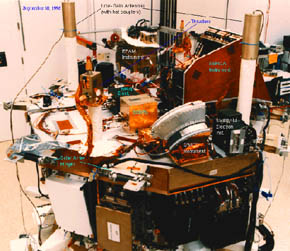
The ACE spacecraft consists of a two-deck irregular octagon, about 1.6 meters (65 inches) across and about 1 meter (40 inches) high. Eight of the scientific instruments which measure a variety of particle...more

Apollo 17

Astronauts Eugene Cernan and Harold Schmitt were the last humans to walk on the Moon, in the final mission of the Apollo space program. Together with Ronald Evans, they lifted off on Dec. 7, 1972 aboard...more

The Sun's Magnetic Field Polarity

This image shows the magnetic field polarity that Ulysses measured while traveling from the South pole to the North pole of the Sun. Blue values represent regions where the magnetic field pointed toward...more

Shop Windows to the Universe

Earth Science Rocks! Select one of our four cool NESTA t-shirts from our online store, and express your love of Earth and space science!

Windows to the Universe, a project of the National Earth Science Teachers Association, is sponsored in part by the National Science Foundation and NASA, our Founding Partners (the American Geophysical Union and American Geosciences Institute) as well as through Institutional, Contributing, and Affiliate Partners, individual memberships and generous donors. Thank you for your support! NASA AGU AGI NSF