Current Events

  • Kansas Legislator Proposes Bill to Outlaw Sustainability Education
    A bill has been introduced in the Kansas legislature this week that would prohibit the promotion of ...Read more

    x

    Kansas Legislator Proposes Bill to Outlaw Sustainability Education

    A bill has been introduced in the Kansas legislature this week that would prohibit the promotion of sustainability. Here is a link to the one-page bill: http://www.kslegislature.org/li/b2013_14/measures/documents/hb2366_00_0000.pdf. See report on Bloomberg News.
  • Earth's Center Is 1,000 Degrees Hotter Than Previously Thought, Synchrotron X-Ray Experiment Shows
    Scientists have determined the temperature near the Earth’s center to be 6000 degrees Celsius, 1000 ...Read more

    x

    Earth's Center Is 1,000 Degrees Hotter Than Previously Thought, Synchrotron X-Ray Experiment Shows

    Scientists have determined the temperature near the Earth’s center to be 6000 degrees Celsius, 1000 degrees hotter than in a previous experiment run 20 years ago. These measurements confirm geophysical models that the temperature difference between the solid core and the mantle above, must be at least 1500 degrees to explain why the Earth has a magnetic field. For more information about this study, see the press release from the European Synchrotron Radiation Facility.
  • Ocean Volcanic Rocks Contain Samples of Recycled Crust
    Scientists have long believed that lava erupted from certain oceanic volcanoes contains materials fr...Read more

    x

    Ocean Volcanic Rocks Contain Samples of Recycled Crust

    Scientists have long believed that lava erupted from certain oceanic volcanoes contains materials from the early Earth’s crust. But decisive evidence for this phenomenon has proven elusive. New research from a team including Carnegie’s Erik Hauri demonstrates that oceanic volcanic rocks contain samples of recycled crust dating back to the Archean era 2.5 billion years ago. Their work is published in Nature. Oceanic crust sinks into the Earth’s mantle at so-called subduction zones, where two plates come together. Much of what happens to the crust during this journey is unknown. Model-dependent studies for how long subducted material can exist in the mantle are uncertain and evidence of very old crust returning to Earth’s surface via upwellings of magma has not been found until now. For more information about these results, see the press release from the Carnegie Institution.
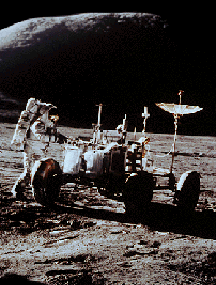
Image of an astronaut and the Lunar Rover.
Click on image for full size
Aris Multimedia Entertainment, Inc 1994.

Human Spaceflight

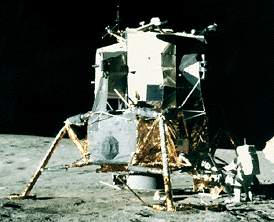
It was not long after the first space satellites were launched that we succeeded in getting a human being into space. These first astronauts and cosmonauts (the Russian word for astronaut) were test pilots who were very familiar with flying in fast and dangerous planes! The first human being to travel into space was Yuri Gagarin (USSR, 1961), followed a month later by the US astronaut Alan Shepard.

Once we found out that humans could travel in space, a "space race" quickly developed between the United States and the Soviet Union. The United States main interest was to land on the moon. The Soviet Union was more interested in setting endurance records and doing scientific research.

Russia, the United States, and 14 other countries are now working together on the International Space Station project.

For a brief history of the United States and Soviet Union human spaceflight programs, click here.

Discover more about human spaceflight through the links below!


Last modified May 10, 2004 by Randy Russell.

Shop Windows to the Universe Science Store!

Our online store includes issues of NESTA's quarterly journal, The Earth Scientist, full of classroom activities on different topics in Earth and space science, ranging from seismology, rocks and minerals, oceanography, and Earth system science to astronomy!

Windows to the Universe Community

News

Opportunities

You might also be interested in:

Cool It! Game

Check out our online store - minerals, fossils, books, activities, jewelry, and household items!...more

International Space Station

The International Space Station (ISS) is a large space station that orbits Earth. There are astronauts and cosmonauts living onboard the ISS right now. The ISS isn't completely finished, though. New sections...more

Shuttle Columbia Launched July 1st

The orbiter Columbia was launched July 1, 1997. This begins a 16-day mission. The purpose of this mission is to study the influences of a micro-gravity environment. This mission includes the MSL-1 or Microgravity...more

STS-95 Launch: "Let the wings of Discovery lift us on to the future."

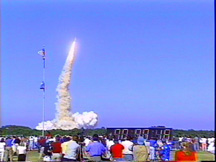
The Space Shuttle Discovery lifted off from Kennedy Space Center on October 29th at 2:19 p.m. EST. The weather was great as Discovery took 8 1/2 minutes to reach orbit. This was the United States' 123rd...more

Administrator Goldin's Statement on NASA's Fortieth Anniversary

This is Administrator Goldin's speech about NASA's 40th anniversary: "Forty years ago, in 1958, the National Aeronautics and Space Administration was created with the boldest and most noble of missions:...more

Hubble Space Telescope

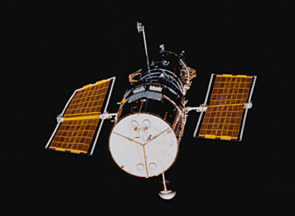
The Hubble Space Telescope (HST) was one of the most important exploration tools of the past two decades, and will continue to serve as a great resource well into the new millennium. The HST found numerous...more

Apollo 11

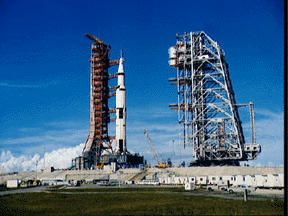
Driven by a recent surge in space research, the Apollo program hoped to add to the accomplishments of the Lunar Orbiter and Surveyor missions of the late 1960's. Apollo 11 was the name of the first mission...more

Apollo 12

Apollo 12 was launched on Nov. 14, 1969, surviving a lightning strike which temporarily shut down many systems, and arrived at the Moon three days later. Astronauts Charles Conrad and Alan Bean descended...more

Shop Windows to the Universe

Warnings: The True Story of How Science Tamed the Weather by Mike Smith tells the story of our storm warning system. See our online store book collection.

Windows to the Universe, a project of the National Earth Science Teachers Association, is sponsored in part by the National Science Foundation and NASA, our Founding Partners (the American Geophysical Union and American Geosciences Institute) as well as through Institutional, Contributing, and Affiliate Partners, individual memberships and generous donors. Thank you for your support! NASA AGU AGI NSF