Current Events

  • Atmospheric CO2 Level Tops 400 ppm
    During the week of May 13th, the CO2 level at the Mauna Loa Observatory in Hawaii topped 400 ppm rep...Read more

    x

    Atmospheric CO2 Level Tops 400 ppm

    During the week of May 13th, the CO2 level at the Mauna Loa Observatory in Hawaii topped 400 ppm repeatedly. Daily levels of CO2 can vary due to weather, and there are seasonal trends as well. The level of atmospheric greenhouse gases continues to increase, now over 120 ppm since the Industrial Revolution began. For more on the Keeling Curve, see http://keelingcurve.ucsd.edu/. Find out more about greenhouse gases and warming.
  • Massive Tornado Outbreak on Tornado Alley
    The week of May 19 brings dozens of tornadoes to Tornado Alley in the states of Oklahoma, Kansas, Io...Read more

    x

    Massive Tornado Outbreak on Tornado Alley

    The week of May 19 brings dozens of tornadoes to Tornado Alley in the states of Oklahoma, Kansas, Iowa, Illinois and Missouri. On May 20th, a massive tornado struck Moore, Oklahoma, devastating communities - destroying over 100 homes and hitting two elementary schools and a hospital - with many casualties and deaths. Our thoughts are with our friends and colleagues suffering from these storms. For more on the May 20th storms, see the NOAA Storm Prediction Center Storm Report.
  • Kansas Legislator Proposes Bill to Outlaw Sustainability Education
    A bill has been introduced in the Kansas legislature this week that would prohibit the promotion of ...Read more

    x

    Kansas Legislator Proposes Bill to Outlaw Sustainability Education

    A bill has been introduced in the Kansas legislature this week that would prohibit the promotion of sustainability. Here is a link to the one-page bill: http://www.kslegislature.org/li/b2013_14/measures/documents/hb2366_00_0000.pdf. See report on Bloomberg News.
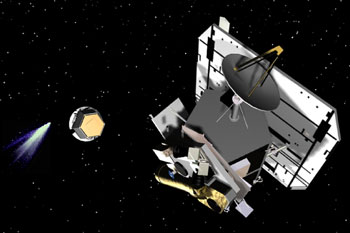
This is a picture from the Discovery program web site.
Click on image for full size
Courtesy of NASA

Discovery Program

NASA has a special program called the Discovery program. The Discovery program tries to send missions into space for low cost. But these missions are making important science discoveries. You may recognize some missions that are part of the Discovery Program: Lunar Prospector, Mars Pathfinder, NEAR, Stardust, Genesis, CONTOUR, Deep Impact and the MESSENGER mission to Mercury
Last modified July 17, 2001 by Jennifer Bergman.
Shop Windows to the Universe Science Store!

Our online store includes issues of NESTA's quarterly journal, The Earth Scientist, full of classroom activities on different topics in Earth and space science, as well as books on science education!

Windows to the Universe Community

News

Opportunities

You might also be interested in:

Traveling Nitrogen Classroom Activity Kit

Check out our online store - minerals, fossils, books, activities, jewelry, and household items!...more

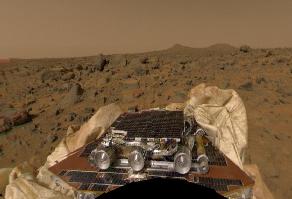
An Overview of the Mars Pathfinder Mission

People were really excited when Pathfinder landed on Mars on July 4, 1997. The Mars Pathfinder mission (MPF for short!) was sent to Mars to look at the rocks and soil of Mars. The MPF was actually 2 parts,...more

In the Beginning...

On July 30, 2001, NASA is set to launch the next of its robotic space missions: The Genesis mission. The Genesis spacecraft will orbit the Sun and collect particles that make up the solar wind. These particles...more

Deep Impact Mission

NASA chose Deep Impact to be part of a special series called the Discovery Program. This program is for cheap, scientific projects. In May 2001, NASA said it was ok to start with mission development for...more

MESSENGER

Do you know what MESSENGER stands for? It's the MErcury Surface Space ENvironment, GEochemistry Ranging mission! What does this mean? Well, the spacecraft will study Mercury's atmosphere, crust and polar...more

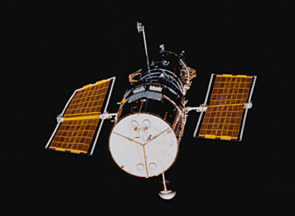
Hubble Space Telescope

The Hubble Space Telescope (HST) is really neat! It was first launched in 1990, but scientists started building it in the 1970's! We have found all kinds of objects like stars, nebulae and galaxies. The...more

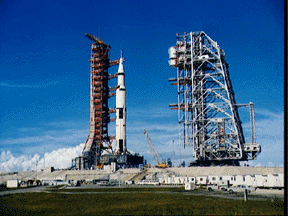
Apollo 11

Apollo 11 was the first mission that landed a person on the moon. On July 16, 1969, the U. S. rocket Saturn 5 was launched carrying the lunar landing module Eagle. The Eagle was released and it reached...more

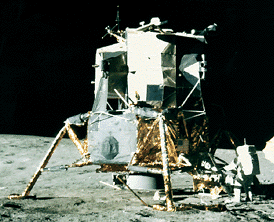
Apollo 12

Apollo 12 was launched on Nov. 14, 1969 and arrived at the Moon three days later. Astronauts Charles Conrad and Alan Bean descended to its surface, while Richard Gordon remained in lunar orbit aboard the...more

Shop Windows to the Universe

We now offer the Cool It! card game in our Science Store. Cool It! is the new card game from UCS that teaches kids about the choices we have when it comes to climate change.

Windows to the Universe, a project of the National Earth Science Teachers Association, is sponsored in part by the National Science Foundation and NASA, our Founding Partners (the American Geophysical Union and American Geosciences Institute) as well as through Institutional, Contributing, and Affiliate Partners, individual memberships and generous donors. Thank you for your support! NASA AGU AGI NSF