Current Events

  • Irish Chronicles Document Links Between Volcanoes and Weather
    A study of over 40,000 written entries in Irish Annals and ice core measurements shows a strong corr...Read more

    x

    Irish Chronicles Document Links Between Volcanoes and Weather

    A study of over 40,000 written entries in Irish Annals and ice core measurements shows a strong correlation between the occurrence of volcanic eruptions and extreme cold weather in Ireland over a 1200 year period. Data analyzed in this study cover the period from 431 to 1649, during which time up to 48 volcanic eruptions are identified in Greenland ice core records through deposition of volcanic sulfate in annual layers of ice. You can find the study (open access), published on 6 June 2013 in IOP Publishing's journal Environmental Research Letters, at http://iopscience.iop.org/1748-9326/8/2/024035/article. Find out more about how volcanoes can influence climate.
  • EF-5 Tornado in El Reno, Oklahoma Widest Ever Recorded in US
    The EF-5 tornado that hit El Reno, Oklahoma on May 31st was the widest ever recorded in the US, acco...Read more

    x

    EF-5 Tornado in El Reno, Oklahoma Widest Ever Recorded in US

    The EF-5 tornado that hit El Reno, Oklahoma on May 31st was the widest ever recorded in the US, according to the National Weather Service in Norman Oklahoma. The tornado, which remained on the ground for 40 minutes and reached 2.6 miles across (4.2 km), took the lives of 18 people including storm chasers Tim Samaras, Paul Samaras and Carl Young. For more information on the tornado, visit http://ow.ly/i/2hfDG.
  • Atmospheric CO2 Level Tops 400 ppm
    During the week of May 13th, the CO2 level at the Mauna Loa Observatory in Hawaii topped 400 ppm rep...Read more

    x

    Atmospheric CO2 Level Tops 400 ppm

    During the week of May 13th, the CO2 level at the Mauna Loa Observatory in Hawaii topped 400 ppm repeatedly. Daily levels of CO2 can vary due to weather, and there are seasonal trends as well. The level of atmospheric greenhouse gases continues to increase, now over 120 ppm since the Industrial Revolution began. For more on the Keeling Curve, see http://keelingcurve.ucsd.edu/. Find out more about greenhouse gases and warming.
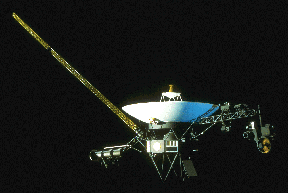
Image of Voyager spacecraft
Click on image for full size
NASA/JPL

Voyager

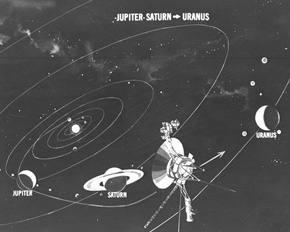
The rare geometric arrangement of planets Jupiter, Saturn, Uranus, and Neptune in the 1980's made it possible for the Voyager spacecrafts to visit them over a 12 year span instead of the normal 30. They used gravity assists to swing from one planet to the next, conserving fuel.

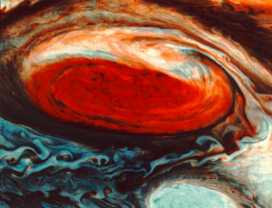
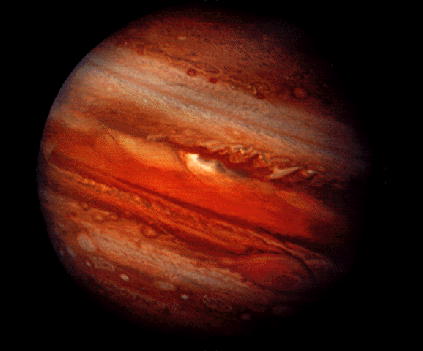
Voyager 2 was launched on Aug. 20, 1977, followed by Voyager 1 on Sep. 5. Both encountered Jupiter in 1979, returning photographs and information on its many moons. Scientists learned that Jupiter's Great Red Spot is really a complex storm, and that Io, one of Jupiter's moons, has active volcanism. These volcanoes are caused by extreme tidal bulges, due to the gravitational "tug of war" of Jupiter and its other moons on Io.

Voyagers 1 and 2 then continued to Saturn, with Voyager 1 arriving in November 1980 and Voyager 2 in August 1981, where they studied the true composition of Titan's atmosphere, believed to be similar to Earth's ancient environment. They also learned that Saturn's rings formed from particles broken off its moons by comets and meteors.

Voyager 2 then headed for Uranus and Neptune. It gave us our first close-range look at the two planets, finding an unusually shaped magnetic field around Uranus caused by the tilt of that planet's axis of rotation. Voyager 2 later learned that the strongest winds in our solar system exist on Neptune, and that Neptune's Great Dark Spot is really a hole in its atmosphere.

The Voyager missions discovered a total of 21 new moons and returned information that has revolutionized the field of space science. The two spacecrafts have almost reached the boundary of our solar system called the heliopause. Because the Sun is so faint at such a distance, the Voyagers are nuclear powered, using energy released from the decay of plutonium. They will continue transmitting for another 20 years until their nuclear generators no longer supply adequate energy.


Last modified September 26, 2000 by Jennifer Bergman.

Shop Windows to the Universe Science Store!

Our online store includes fun classroom activities for you and your students. Issues of NESTA's quarterly journal, The Earth Scientist are also full of classroom activities on different topics in Earth and space science!

Windows to the Universe Community

News

Opportunities

You might also be interested in:

Cool It! Game

Check out our online store - minerals, fossils, books, activities, jewelry, and household items!...more

The Great Red Spot of Jupiter

The Great Red Spot is thought to be a hurricane which has been raging on Jupiter for at least 400 years. The connected page shows an image of the Great Red Spot next to Tropical Storm Emily for comparison....more

Radioactive Decay

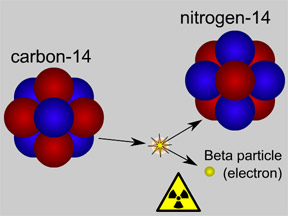
Some materials are radioactive. They emit radiation. When an atom of a radioactive substance emits radiation, it is transformed to a new type of atom. This process is called radioactive decay. There are...more

Administrator Goldin's Statement on NASA's Fortieth Anniversary

This is Administrator Goldin's address about NASA's 40th anniversary: "Forty years ago, in 1958, the National Aeronautics and Space Administration was created with the boldest and most noble of missions:...more

Missions Possible!

The servicing mission to the Hubble Space Telescope in early March looks to have been a great success. Four weeks after the servicing mission, the Telescope has been declared healthy and fit...and is frankly,...more

Voyager to Take the Lead!

At approximately 5:10 p.m. EST on February 17, 1998, the Voyager 1 spacecraft will become the spacecraft that has traveled farthest away from the planet Earth. For 25 years, Pioneer 10 has been in the...more

Happy Birthday to Voyager!

NASA's Voyager mission is 25 years old and still going strong! Both spacecrafts Voyager 1 (launched September 5, 1977) and Voyager 2 (launched August 20, 1977) continue to travel through space and still...more

Discover Jupiter

Jupiter is the largest planet in our solar system. It is also one of the brighter objects in the night sky. No one knows for sure who discovered Jupiter, but we know the ancient Greeks named him after...more

Shop Windows to the Universe

Our Glaciers: Then and Now activity kit helps you see the changes taking place in glaciers around the world. See all our activity kits and classroom activities.

Windows to the Universe, a project of the National Earth Science Teachers Association, is sponsored in part by the National Science Foundation and NASA, our Founding Partners (the American Geophysical Union and American Geosciences Institute) as well as through Institutional, Contributing, and Affiliate Partners, individual memberships and generous donors. Thank you for your support! NASA AGU AGI NSF