Current Events

  • Irish Chronicles Document Links Between Volcanoes and Weather
    A study of over 40,000 written entries in Irish Annals and ice core measurements shows a strong corr...Read more

    x

    Irish Chronicles Document Links Between Volcanoes and Weather

    A study of over 40,000 written entries in Irish Annals and ice core measurements shows a strong correlation between the occurrence of volcanic eruptions and extreme cold weather in Ireland over a 1200 year period. Data analyzed in this study cover the period from 431 to 1649, during which time up to 48 volcanic eruptions are identified in Greenland ice core records through deposition of volcanic sulfate in annual layers of ice. You can find the study (open access), published on 6 June 2013 in IOP Publishing's journal Environmental Research Letters, at http://iopscience.iop.org/1748-9326/8/2/024035/article. Find out more about how volcanoes can influence climate.
  • EF-5 Tornado in El Reno, Oklahoma Widest Ever Recorded in US
    The EF-5 tornado that hit El Reno, Oklahoma on May 31st was the widest ever recorded in the US, acco...Read more

    x

    EF-5 Tornado in El Reno, Oklahoma Widest Ever Recorded in US

    The EF-5 tornado that hit El Reno, Oklahoma on May 31st was the widest ever recorded in the US, according to the National Weather Service in Norman Oklahoma. The tornado, which remained on the ground for 40 minutes and reached 2.6 miles across (4.2 km), took the lives of 18 people including storm chasers Tim Samaras, Paul Samaras and Carl Young. For more information on the tornado, visit http://ow.ly/i/2hfDG.
  • Atmospheric CO2 Level Tops 400 ppm
    During the week of May 13th, the CO2 level at the Mauna Loa Observatory in Hawaii topped 400 ppm rep...Read more

    x

    Atmospheric CO2 Level Tops 400 ppm

    During the week of May 13th, the CO2 level at the Mauna Loa Observatory in Hawaii topped 400 ppm repeatedly. Daily levels of CO2 can vary due to weather, and there are seasonal trends as well. The level of atmospheric greenhouse gases continues to increase, now over 120 ppm since the Industrial Revolution began. For more on the Keeling Curve, see http://keelingcurve.ucsd.edu/. Find out more about greenhouse gases and warming.
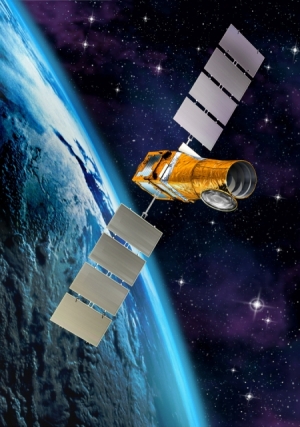
An artist's concept of the CoRoT satellite in orbit.
Click on image for full size
CNES / D. Ducros

CoRoT - Searching for distant worlds

In December 2006, the European Space Agency launched a satellite that will study convection and rotation in pulsating stars. The mission will also look for planets that pass in front of, or transit, these distant stars. The lead scientists from France named the satellite CoRoT, which stands for Convection, Rotation, and planetary Transits.

CoRoT will make very accurate measurements of the amount of light coming from many stars over time. Some of these stars will have planets around them. Some of those planets will pass directly in front of the star and cause a brief drop in the amount of light CoRoT records. If these drops happen regularly from the same star, if the color of the light does not change, and if the shape of the drop is right -- it could be a planet.

Even planets as small as the Earth around other stars might be found with CoRoT. This is about 10 times smaller than the smallest planets that have been found from telescopes on the ground. If it finds a planet like the Earth, then we can begin looking for signs of liquid water, green plants, and maybe even intelligent life!

Last modified April 12, 2007 by Travis Metcalfe.

Shop Windows to the Universe Science Store!

Our online store includes fun classroom activities for you and your students. Issues of NESTA's quarterly journal, The Earth Scientist are also full of classroom activities on different topics in Earth and space science!

Windows to the Universe Community

News

Opportunities

You might also be interested in:

Traveling Nitrogen Classroom Activity Kit

Check out our online store - minerals, fossils, books, activities, jewelry, and household items!...more

Winter observing in July

Remember me? Last month I was observing targets of the Kepler space mission at Teide Observatory on Tenerife. Now I am in Chile to observe targets of the CoRoT space mission. CoRoT is a satellite devoted...more

Hubble Space Telescope

The Hubble Space Telescope (HST) was one of the most important exploration tools of the past two decades, and will continue to serve as a great resource well into the new millennium. The HST is credited...more

Apollo 11

Driven by a recent surge in space research, the Apollo program hoped to add to the accomplishments of the Lunar Orbiter and Surveyor missions of the late 1960's. Apollo 11 was the first mission to succeed...more

Apollo 12

Apollo 12 survived a lightning strike during its launch on Nov. 14, 1969, and arrived at the Moon three days later. Astronauts Charles Conrad and Alan Bean descended to the surface, while Richard Gordon...more

Apollo 15

Apollo 15 marked the start of a new series of missions from the Apollo space program, each capable of exploring more lunar terrain than ever before. Launched on July 26, 1971, Apollo 15 reached the Moon...more

Deep Impact Mission

NASA chose Deep Impact to be part of a special series called the Discovery Program on July 7, 1999. In May 2001, Deep Impact was given the "go" from NASA to start with mission development. Deep Impact...more

Galileo

The Galileo spacecraft was launched on October 19, 1989. Galileo had two parts: an orbiter and a descent probe that parachuted into Jupiter's atmosphere. Galileo's primary mission was to explore the Jovian...more

Shop Windows to the Universe

The Universe at Your Fingertips 2.0 DVD from the Astronomical Society of the Pacific is in our online store, filled with Earth and space science resources.

Windows to the Universe, a project of the National Earth Science Teachers Association, is sponsored in part by the National Science Foundation and NASA, our Founding Partners (the American Geophysical Union and American Geosciences Institute) as well as through Institutional, Contributing, and Affiliate Partners, individual memberships and generous donors. Thank you for your support! NASA AGU AGI NSF