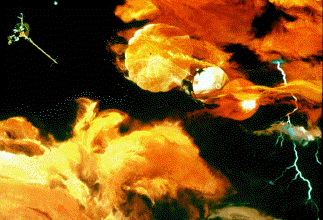
This is a drawing of the Galileo probe exploring the environment of Jupiter.
Click on image for full size
Image from: The Jet Propulsion Laboratory
Can there be Life in the Environment of Titan?
Titan's atmosphere is a lot like the Earth's, except that it is very cold, from -330 degrees to -290 degrees! Like the Earth, there is a lot of Nitrogen and other complex molecules. There also may be an ocean of methane, or perhaps a liquid water layer
inside the moon. Except for the cold, these signs would be favorable for some sort of life. Some creatures on Earth are known to live in an environment of very cold water.
In the atmosphere there are layers of clouds composed of complex molecules such as methane. Moreover there is energy from ultraviolet light, and the charged particles of the magnetosphere. This type of environment, aside from the cold, is the kind of environment in which scientists think life began.
Overall, the environment sounds unfriendly to life as we know it on earth, because of the cold. Since not much is known about the moon Titan, up close exploration of this moon, with a probe, as shown in this drawing, would help scientists better understand if life could survive there.
You might also be interested in:

This is an image of the Earth's moon, shown in the lower left, with the much smaller icy moons of Saturn. The moons in order, starting from the top left are: Mimas, Enceladus, Tethys, Dione, Rhea, and
...more
Dione was discovered by G. Cassini in 1684. Dione is the 7th farthest moon from Saturn, with a standoff distance of 377,400 km. It is a small icy moon, lightly cratered, with wispy white streaks across
...moreThe surface of Dione does not have many craters. Instead it has wispy white streaks similar to those found on Rhea extending for many kilometers over the entire surface. These two things indicate that
...more
The surface of Enceladus does not have many craters. Instead it has grooves similar to those found on Ganymede. These grooves extend for many kilometers over the surface. The presence of grooves indicates
...more
Helene was discovered by the French astronomers Pierre Laques, Raymond Despiau and J. Lecacheux on February 29, 1980. Even though Helene is so far away, they were able to make their discovery at an observatory
...more
Hyperion was discovered by W. Bond in 1848. Hyperion is the 3rd farthest moon from Saturn, with a standoff distance of 1,481,000 km. Hyperion is 175 x 100 km (117 x 67 miles) in size. Its dimensions make
...more
Rhea was discovered by G. Cassini in 1672. Rhea is the 5th farthest moon from Saturn. It is one of the icy moons, similar to the Galilean satellites. Rhea is about as wide as the state of California is
...moreThe surface of Rhea is typical of an icy moon. Rhea is as heavily cratered (despite the appearance of this picture) as Saturn's "death star" moon Mimas on its leading side. Its trailing side has unusual
...more