Current Events

  • Atmospheric CO2 Level Tops 400 ppm
    During the week of May 13th, the CO2 level at the Mauna Loa Observatory in Hawaii topped 400 ppm rep...Read more

    x

    Atmospheric CO2 Level Tops 400 ppm

    During the week of May 13th, the CO2 level at the Mauna Loa Observatory in Hawaii topped 400 ppm repeatedly. Daily levels of CO2 can vary due to weather, and there are seasonal trends as well. The level of atmospheric greenhouse gases continues to increase, now over 120 ppm since the Industrial Revolution began. For more on the Keeling Curve, see http://keelingcurve.ucsd.edu/. Find out more about greenhouse gases and warming.
  • Massive Tornado Outbreak on Tornado Alley
    The week of May 19 brings dozens of tornadoes to Tornado Alley in the states of Oklahoma, Kansas, Io...Read more

    x

    Massive Tornado Outbreak on Tornado Alley

    The week of May 19 brings dozens of tornadoes to Tornado Alley in the states of Oklahoma, Kansas, Iowa, Illinois and Missouri. On May 20th, a massive tornado struck Moore, Oklahoma, devastating communities - destroying over 100 homes and hitting two elementary schools and a hospital - with many casualties and deaths. Our thoughts are with our friends and colleagues suffering from these storms. For more on the May 20th storms, see the NOAA Storm Prediction Center Storm Report.
  • Kansas Legislator Proposes Bill to Outlaw Sustainability Education
    A bill has been introduced in the Kansas legislature this week that would prohibit the promotion of ...Read more

    x

    Kansas Legislator Proposes Bill to Outlaw Sustainability Education

    A bill has been introduced in the Kansas legislature this week that would prohibit the promotion of sustainability. Here is a link to the one-page bill: http://www.kslegislature.org/li/b2013_14/measures/documents/hb2366_00_0000.pdf. See report on Bloomberg News.
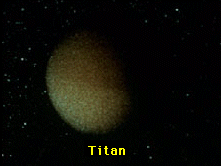
Titan's atmosphere is orange. We cannot see the surface of Titan because of the thick atmosphere.
Click on image for full size
Image courtesy NASA/JPL/Space Science Institute.

Titan

Titan is the largest moon of the planet Saturn. Titan is the second largest moon in our Solar System. The diameter of Titan is 5,150 km (3,200 miles), which is about the distance across the United States. Jupiter's moon Ganymede is the only moon in our Solar System that is larger than Titan. Titan is larger than the planets Mercury and Pluto!

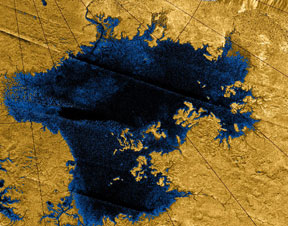
Titan is the only moon in the Solar System that has a thick atmosphere. Titan's atmosphere is even thicker than Earth's! We can't see through Titan's atmosphere to get a clear view of the moon's surface. Thanks to the Huygens lander and to radar on the Cassini spacecraft we are beginning to get some good looks at the surface of Titan. Scientists have discovered lakes of liquid methane and ethane near Titan's poles. They have also spotted clouds in the atmosphere of Titan.

Titan was discovered by Christiaan Huygens in 1655. It orbits Saturn at a distance of 1,221,830 km (759,208 miles). Titan is very cold (-178º C, or -288º F, at the surface), and is mostly made of ice. The moon has an unusual history, and some scientists believe there is a very tiny chance that life might exist on Titan!


Last modified January 22, 2009 by Randy Russell.

Shop Windows to the Universe Science Store!

Our online store includes issues of NESTA's quarterly journal, The Earth Scientist, full of classroom activities on different topics in Earth and space science, as well as books on science education!

Windows to the Universe Community

News

Opportunities

You might also be interested in:

Cool It! Game

Check out our online store - minerals, fossils, books, activities, jewelry, and household items!...more

Pluto

Pluto is a frigid ball of ice and rock that orbits far from the Sun on the frozen fringes of our Solar System. Considered a planet, though a rather odd one, from its discovery in 1930 until 2006, it was...more

Cassini

A spacecraft named Cassini will study the planet Saturn for several years. Cassini blasted off from Earth in October 1997. After flying past Venus, Earth, and Jupiter, Cassini finally arrived at Saturn...more

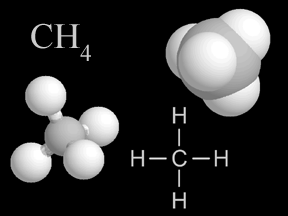
Methane - CH4

Methane is a kind of gas. There is a small amount of methane in the air you breathe. A methane molecule has carbon and hydrogen atoms in it. Methane is a greenhouse gas. That means it helps make Earth...more

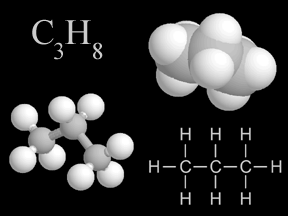
Hydrocarbons

There is a group of chemicals called hydrocarbons. The molecules of hydrocarbons are made of hydrogen and carbon atoms. Most kinds of fuel have hydrocarbons in them. Hydrocarbons store energy. Coal, oil,...more

The Poles of Titan

Titan is the largest moon of Saturn. It is the second largest moon in the whole Solar System. Titan is the only moon with a thick atmosphere. Titan's poles are interesting places. Scientists have discovered...more

How Titan Formed

Titan is similar to the other icy moons, but Titan is the only icy moon to have a big atmosphere. It is natural to ask how is this possible? The nebula was colder near Saturn, than near Jupiter. The nebula...more

Can there be Life in the Environment of Titan?

Titan's atmosphere is a lot like the Earth's, except that it is very cold, from -330 degrees to -290 degrees! Like the Earth, there is a lot of Nitrogen and other complex molecules. There also may be an...more

Shop Windows to the Universe

Check out the fun Earth science related bumper stickers in our online store! Express yourself!

Windows to the Universe, a project of the National Earth Science Teachers Association, is sponsored in part by the National Science Foundation and NASA, our Founding Partners (the American Geophysical Union and American Geosciences Institute) as well as through Institutional, Contributing, and Affiliate Partners, individual memberships and generous donors. Thank you for your support! NASA AGU AGI NSF