This is an image of Rhea.
Click on image for full size
NASA/JPL
Rhea
Rhea was discovered by G. Cassini in 1672. Rhea is the 5th farthest moon from Saturn. It is one of the
icy moons, similar to the
Galilean satellites. Rhea is about as wide as the state of California is long, with a width of 1500 km (1000 miles).
Rhea is heavily cratered but with wispy white streaks across the surface. In appearance, this moon looks very much like Dione, Enceladus, and Tethys, and is the biggest of the four.
You might also be interested in:

The Galilean satellites are the 4 major moons of Jupiter, Io, Europa, Ganymede, and Callisto. In this picture, Io, and Io’s surface, are shown on the left-most end, then Europa, and its surface, then Ganymede,
...more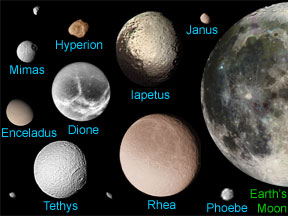
Saturn has // Call the moon count function defined in the document head print_moon_count('saturn'); moons. Many of those are tiny chunks of rock or ice only a few kilometers (miles) across. One of Saturn's
...more
Saturn has // Call the moon count function defined in the document head print_moon_count('saturn'); moons. Many of those are tiny chunks of rock or ice only a few kilometers (miles) across. One of Saturn's
...more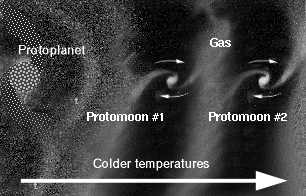
Titan is similar to the other icy moons, but Titan is the only icy moon to have a big atmosphere. It is natural to ask how is this possible? The nebula was colder near Saturn, than near Jupiter. The nebula
...more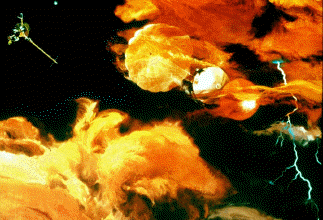
Titan's atmosphere is a lot like the Earth's, except that it is very cold, from -330 degrees to -290 degrees! Like the Earth, there is a lot of Nitrogen and other complex molecules. There also may be an
...more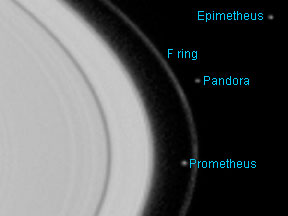
Pandora is a small moon of Saturn. It was discovered by S. Collins and others in 1980 from photos taken by the Voyager 1 spacecraft. Pandora's name comes from Greek mythology. Pandora was the first woman,
...morePrometheus is a small moon of Saturn. It was discovered by S. Collins and others in 1980 from photos taken by the Voyager 1 spacecraft. This moon's name comes from Greek mythology. Prometheus was a Titan
...more