Current Events

  • Atmospheric CO2 Level Tops 400 ppm
    During the week of May 13th, the CO2 level at the Mauna Loa Observatory in Hawaii topped 400 ppm rep...Read more

    x

    Atmospheric CO2 Level Tops 400 ppm

    During the week of May 13th, the CO2 level at the Mauna Loa Observatory in Hawaii topped 400 ppm repeatedly. Daily levels of CO2 can vary due to weather, and there are seasonal trends as well. The level of atmospheric greenhouse gases continues to increase, now over 120 ppm since the Industrial Revolution began. For more on the Keeling Curve, see http://keelingcurve.ucsd.edu/. Find out more about greenhouse gases and warming.
  • Massive Tornado Outbreak on Tornado Alley
    The week of May 19 brings dozens of tornadoes to Tornado Alley in the states of Oklahoma, Kansas, Io...Read more

    x

    Massive Tornado Outbreak on Tornado Alley

    The week of May 19 brings dozens of tornadoes to Tornado Alley in the states of Oklahoma, Kansas, Iowa, Illinois and Missouri. On May 20th, a massive tornado struck Moore, Oklahoma, devastating communities - destroying over 100 homes and hitting two elementary schools and a hospital - with many casualties and deaths. Our thoughts are with our friends and colleagues suffering from these storms. For more on the May 20th storms, see the NOAA Storm Prediction Center Storm Report.
  • Kansas Legislator Proposes Bill to Outlaw Sustainability Education
    A bill has been introduced in the Kansas legislature this week that would prohibit the promotion of ...Read more

    x

    Kansas Legislator Proposes Bill to Outlaw Sustainability Education

    A bill has been introduced in the Kansas legislature this week that would prohibit the promotion of sustainability. Here is a link to the one-page bill: http://www.kslegislature.org/li/b2013_14/measures/documents/hb2366_00_0000.pdf. See report on Bloomberg News.
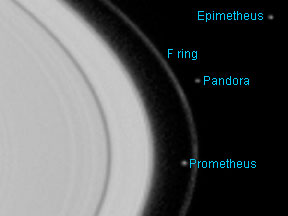
This image shows three of Saturn's small moons and a portion of its rings (left). The two shepherd moons, Prometheus and Pandora, guide particles in the F ring into a narrow band. Another small moon, Epimetheus, can be seen in the upper right corner of the image. This image was taken by the Cassini spacecraft on May 1, 2004 when Cassini was 31.4 million km (19.5 million miles) from Saturn.
Click on image for full size
Image courtesy NASA/JPL/Space Science Institute.

Prometheus

Prometheus is a small moon of Saturn. It was discovered by S. Collins and others in 1980 from photos taken by the Voyager 1 spacecraft.

This moon's name comes from Greek mythology. Prometheus was a Titan who stole fire from the gods of Mount Olympus and gave it to humankind. Zeus punished Prometheus for this deed. Prometheus was the son of Iapetus and the brother of Epimetheus and Atlas. Prometheus means "foresight" in Greek.

Prometheus and Pandora, another small moon of Saturn, are known as shepherd satellites. These two small moons orbit within Saturn's vast ring system. Like shepherds guiding their flocks of sheep, these two moons guide the particles of Saturn's "F ring" into a narrow band. The combined gravitational pulls of the two moons force the ring particles to orbit within a narrow range.

Prometheus is not round, but is more of a "potato-shaped" moon. It is about 145 by 85 by 62 km (90 x 53 x 39 miles) in size. It orbits Saturn at a distance of 139,353 km (86,590 miles) from the planet's center.

Last modified June 4, 2004 by Randy Russell.

Shop Windows to the Universe Science Store!

Learn about Earth and space science, and have fun while doing it! The games section of our online store includes a climate change card game and the Traveling Nitrogen game!

Windows to the Universe Community

News

Opportunities

You might also be interested in:

Traveling Nitrogen Classroom Activity Kit

Check out our online store - minerals, fossils, books, activities, jewelry, and household items!...more

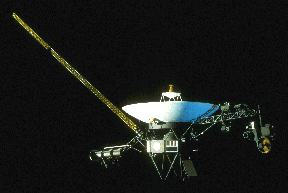
Voyager

The rare geometric arrangement of planets Jupiter, Saturn, Uranus, and Neptune in the 1980's made it possible for the Voyager spacecrafts to visit them over a 12 year span instead of the normal 30. They...more

Pandora

Pandora is a small moon of Saturn. It was discovered by S. Collins and others in 1980 from photos taken by the Voyager 1 spacecraft. Pandora's name comes from Greek mythology. Pandora was the first woman,...more

Saturn's Rings

Many people are fascinated by Saturn's rings. Although Saturn isn't the only planet with rings, it is the only planet famous for them. Almost every image or drawing of the planet has the rings included....more

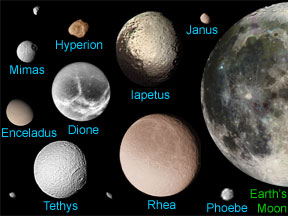
Medium-sized Moons of Saturn

Saturn has // Call the moon count function defined in the document head print_moon_count('saturn'); moons. Many of those are tiny chunks of rock or ice only a few kilometers (miles) across. One of Saturn's...more

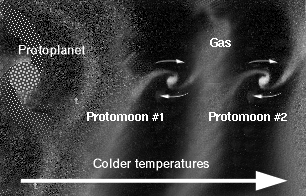
How Titan Formed

In many respects Titan is similar to the other icy moons, but Titan is the only icy moon to have an atmosphere that can be compared to other planets'. It is natural to ask how is this possible since Titan...more

The Environment of Titan, can there be Life?

Titan's atmosphere is a lot like the Earth's, except that it is very cold, from -330 degrees to -290 degrees! Like the Earth, there is a lot of Nitrogen and other complex molecules. There also may be an...more

Prometheus

Prometheus is a small moon of Saturn. It was discovered by S. Collins and others in 1980 from photos taken by the Voyager 1 spacecraft. This moon's name comes from Greek mythology. Prometheus was a Titan...more

Shop Windows to the Universe

Our Glaciers: Then and Now activity kit helps you see the changes taking place in glaciers around the world. See all our activity kits and classroom activities.

Windows to the Universe, a project of the National Earth Science Teachers Association, is sponsored in part by the National Science Foundation and NASA, our Founding Partners (the American Geophysical Union and American Geosciences Institute) as well as through Institutional, Contributing, and Affiliate Partners, individual memberships and generous donors. Thank you for your support! NASA AGU AGI NSF