Current Events

  • Atmospheric CO2 Level Tops 400 ppm
    During the week of May 13th, the CO2 level at the Mauna Loa Observatory in Hawaii topped 400 ppm rep...Read more

    x

    Atmospheric CO2 Level Tops 400 ppm

    During the week of May 13th, the CO2 level at the Mauna Loa Observatory in Hawaii topped 400 ppm repeatedly. Daily levels of CO2 can vary due to weather, and there are seasonal trends as well. The level of atmospheric greenhouse gases continues to increase, now over 120 ppm since the Industrial Revolution began. For more on the Keeling Curve, see http://keelingcurve.ucsd.edu/. Find out more about greenhouse gases and warming.
  • Massive Tornado Outbreak on Tornado Alley
    The week of May 19 brings dozens of tornadoes to Tornado Alley in the states of Oklahoma, Kansas, Io...Read more

    x

    Massive Tornado Outbreak on Tornado Alley

    The week of May 19 brings dozens of tornadoes to Tornado Alley in the states of Oklahoma, Kansas, Iowa, Illinois and Missouri. On May 20th, a massive tornado struck Moore, Oklahoma, devastating communities - destroying over 100 homes and hitting two elementary schools and a hospital - with many casualties and deaths. Our thoughts are with our friends and colleagues suffering from these storms. For more on the May 20th storms, see the NOAA Storm Prediction Center Storm Report.
  • Kansas Legislator Proposes Bill to Outlaw Sustainability Education
    A bill has been introduced in the Kansas legislature this week that would prohibit the promotion of ...Read more

    x

    Kansas Legislator Proposes Bill to Outlaw Sustainability Education

    A bill has been introduced in the Kansas legislature this week that would prohibit the promotion of sustainability. Here is a link to the one-page bill: http://www.kslegislature.org/li/b2013_14/measures/documents/hb2366_00_0000.pdf. See report on Bloomberg News.
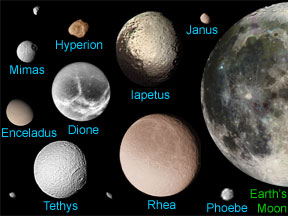
Medium-sized moons of Saturn shown alongside Earth's Moon.
Click on image for full size
Original Windows to the Universe artwork by Randy Russell using images courtesy NASA.

Medium-sized Moons of Saturn

Saturn has moons. Many of those are tiny chunks of rock or ice only a few kilometers (miles) across. One of Saturn's moons, Titan, is much larger than the rest and is amongst the largest moons in our entire Solar System.

Midway in size between Titan and the many tiny moonlets are several medium-sized moons. The image on this page shows the mid-sized moons of Saturn. They are, in order from largest to smallest: Rhea, Iapetus, Dione, Tethys, Enceladus, Mimas, Hyperion, Phoebe, Janus, Prometheus, Epimetheus and Pandora. The picture also shows Earth's Moon for size comparison.

Last modified June 7, 2004 by Randy Russell.

Shop Windows to the Universe Science Store!

Our online store includes books on science education, ranging from evolution, classroom research, and the need for science and math literacy!

Windows to the Universe Community

News

Opportunities

You might also be interested in:

Titan

Titan is the largest moon of Saturn, and the second largest moon in the entire Solar System (Jupiter's moon Ganymede is the largest). Titan's diameter is 5,150 km (3,200 miles), which is comparable to...more

A Comparison of Some Major Moons, and the Earth's Moon

This is an image of the Earth's moon, shown in the center, with several other moons for comparison. The image shows that the Earth's moon is a lot smaller than Ganymede, Callisto, and Titan. The Earth's...more

Rhea

Rhea was discovered by G. Cassini in 1672. Rhea is the 5th farthest moon from Saturn, with a standoff distance of 527,040 km. It is one of the icy moons, similar to the Galilean satellites. Rhea is about...more

Dione

Dione was discovered by G. Cassini in 1684. Dione is the 7th farthest moon from Saturn, with a standoff distance of 377,400 km. It is a small icy moon, lightly cratered, with wispy white streaks across...more

Tethys

Tethys was discovered by G. Cassini in 1684. Tethys is the 8th closest moon to Saturn, with a standoff distance of 294,660 km. It is one of the icy moons, similar to the Galilean satellites. Tethys is...more

Enceladus

Enceladus is the sixth largest moon of Saturn. It was discovered in 1789 by the British astronomer William Herschel (who also discovered the planet Uranus). Enceladus is a medium-sized moon made primarily...more

Hyperion

Hyperion was discovered by W. Bond in 1848. Hyperion is the 3rd farthest moon from Saturn, with a standoff distance of 1,481,000 km. Hyperion is 175 x 100 km (117 x 67 miles) in size. Its dimensions make...more

The South Pole of Enceladus

Enceladus is a medium-sized, icy moon of Saturn. The South Pole of Enceladus is one of the oddest places in the Solar System. Temperatures near the pole are far warmer than anywhere else on the moon, huge...more

Shop Windows to the Universe

Our Glaciers: Then and Now activity kit helps you see the changes taking place in glaciers around the world. See all our activity kits and classroom activities.

Windows to the Universe, a project of the National Earth Science Teachers Association, is sponsored in part by the National Science Foundation and NASA, our Founding Partners (the American Geophysical Union and American Geosciences Institute) as well as through Institutional, Contributing, and Affiliate Partners, individual memberships and generous donors. Thank you for your support! NASA AGU AGI NSF