Current Events

  • Irish Chronicles Document Links Between Volcanoes and Weather
    A study of over 40,000 written entries in Irish Annals and ice core measurements shows a strong corr...Read more

    x

    Irish Chronicles Document Links Between Volcanoes and Weather

    A study of over 40,000 written entries in Irish Annals and ice core measurements shows a strong correlation between the occurrence of volcanic eruptions and extreme cold weather in Ireland over a 1200 year period. Data analyzed in this study cover the period from 431 to 1649, during which time up to 48 volcanic eruptions are identified in Greenland ice core records through deposition of volcanic sulfate in annual layers of ice. You can find the study (open access), published on 6 June 2013 in IOP Publishing's journal Environmental Research Letters, at http://iopscience.iop.org/1748-9326/8/2/024035/article. Find out more about how volcanoes can influence climate.
  • EF-5 Tornado in El Reno, Oklahoma Widest Ever Recorded in US
    The EF-5 tornado that hit El Reno, Oklahoma on May 31st was the widest ever recorded in the US, acco...Read more

    x

    EF-5 Tornado in El Reno, Oklahoma Widest Ever Recorded in US

    The EF-5 tornado that hit El Reno, Oklahoma on May 31st was the widest ever recorded in the US, according to the National Weather Service in Norman Oklahoma. The tornado, which remained on the ground for 40 minutes and reached 2.6 miles across (4.2 km), took the lives of 18 people including storm chasers Tim Samaras, Paul Samaras and Carl Young. For more information on the tornado, visit http://ow.ly/i/2hfDG.
  • Atmospheric CO2 Level Tops 400 ppm
    During the week of May 13th, the CO2 level at the Mauna Loa Observatory in Hawaii topped 400 ppm rep...Read more

    x

    Atmospheric CO2 Level Tops 400 ppm

    During the week of May 13th, the CO2 level at the Mauna Loa Observatory in Hawaii topped 400 ppm repeatedly. Daily levels of CO2 can vary due to weather, and there are seasonal trends as well. The level of atmospheric greenhouse gases continues to increase, now over 120 ppm since the Industrial Revolution began. For more on the Keeling Curve, see http://keelingcurve.ucsd.edu/. Find out more about greenhouse gases and warming.
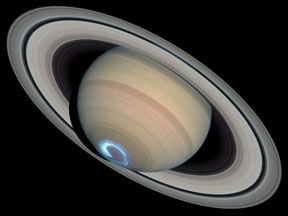
This picture shows the aurora (Southern Lights) of Saturn. The aurora looks like a blue ring of light over Saturn's South Pole in this picture. The Hubble Space Telescope took this picture in 2004.
Click on image for full size
Image courtesy of NASA, ESA, J. Clarke (Boston University), and Z. Levay (STScI).

Saturn's Aurora

Have you ever seen the Southern or Northern Lights? Earth isn't the only planet that puts on these beautiful light shows, which are also called the "aurora". Aurora have been seen at both poles of Saturn, too.

The solar wind is a flow of charged particles that stream outwards from the Sun. When they get to Saturn, some of those particles are trapped by Saturn's magnetic field. Fast-moving electrons bounce back and forth in Saturn's magnetic field, gaining more and more energy. Some of them blast into Saturn's atmosphere near the planet's poles. The electrons cause hydrogen gas in the atmosphere to glow. It is a lot like the glow that lights a fluorescent bulb when electricity flows through it.

Aurora on Earth usually shine for a few hours at most. Aurora on Saturn can last for days! These "curtains of light" sometimes rise 1,200 miles (2,000 km) above the cloud tops near Saturn's poles. If you were on Saturn, the aurora would look like a faint red glow. Most of the energy in Saturn's aurora is not in the form of visible light, though. Instead, they mostly glow in ultraviolet (UV) wavelengths.

Most UV "light" cannot get through Earth's atmosphere. That means telescopes on the ground cannot see Saturn's UV aurora. However, telescopes in Earth orbit can. Spacecraft that fly near Saturn can also "see" the ringed planet's aurora. The Hubble Space Telescope has taken some pictures of Saturn's aurora. The Pioneer 11, Voyager 1 & 2, and Cassini spacecraft have observed Saturn's aurora from closer range.

The aurora at Earth are mostly caused when high-energy particles collide with either nitrogen or oxygen in our atmosphere. Saturn's aurora are caused by electrons crashing into hydrogen molecules and atoms in Saturn's upper atmosphere. Scientists have also detected radio signals emitted by Saturn's aurora. It is a lot like the static you can sometimes hear on a radio when lightning strikes nearby.

Last modified January 29, 2009 by Randy Russell.

Shop Windows to the Universe Science Store!

Our online store includes books on science education, ranging from evolution, classroom research, and the need for science and math literacy!

Windows to the Universe Community

News

Opportunities

You might also be interested in:

Cool It! Game

Check out our online store - minerals, fossils, books, activities, jewelry, and household items!...more

The Poles of Saturn and Its Moons

There's a lot of strange and interesting stuff going on at both the North and South Poles of Saturn. Two of Saturn's moons also have interesting polar regions. Let's take a look! The atmosphere and clouds...more

Particle Radiation

One main type of radiation, particle radiation, is the result of subatomic particles hurtling at tremendous speeds. Protons, cosmic rays, and alpha and beta particles are some of the most common types...more

A Look at Saturn's Magnetosphere

Saturn's magnetosphere is not as big as Jupiter's, but it is still pretty big. It is big enough to hold all of Saturn's moons. It is probably made the same way as is Jupiter's, which affects its overall...more

The Magnetic Field

The force of magnetism causes material to point along the direction the magnetic force points. As shown in the diagram to the left, the force of magnetism is illustrated by lines, which represent the force....more

An Overview of Saturn's Atmosphere

The dramatic appearance of Saturn stems mainly from the spectacular rings. The atmosphere looks much less dramatic. The clouds of Saturn are much less colorful than those of Jupiter. This is because the...more

Hubble Space Telescope

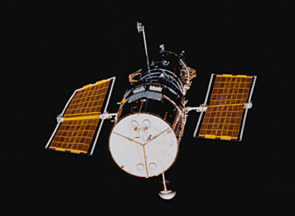
The Hubble Space Telescope (HST) was one of the most important exploration tools of the past two decades, and will continue to serve as a great resource well into the new millennium. The HST found numerous...more

Voyager

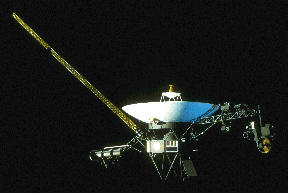
The rare arrangement of planets Jupiter, Saturn, Uranus, and Neptune in the 1980's made it possible for the Voyager spacecrafts to visit them over a 12 year span instead of the normal 30. They used gravity...more

Shop Windows to the Universe

Please help support Windows to the Universe, and our activities to help Earth and space science teachers, with a tax-exempt donation today!

Windows to the Universe, a project of the National Earth Science Teachers Association, is sponsored in part by the National Science Foundation and NASA, our Founding Partners (the American Geophysical Union and American Geosciences Institute) as well as through Institutional, Contributing, and Affiliate Partners, individual memberships and generous donors. Thank you for your support! NASA AGU AGI NSF