Current Events

  • Atmospheric CO2 Level Tops 400 ppm
    During the week of May 13th, the CO2 level at the Mauna Loa Observatory in Hawaii topped 400 ppm rep...Read more

    x

    Atmospheric CO2 Level Tops 400 ppm

    During the week of May 13th, the CO2 level at the Mauna Loa Observatory in Hawaii topped 400 ppm repeatedly. Daily levels of CO2 can vary due to weather, and there are seasonal trends as well. The level of atmospheric greenhouse gases continues to increase, now over 120 ppm since the Industrial Revolution began. For more on the Keeling Curve, see http://keelingcurve.ucsd.edu/. Find out more about greenhouse gases and warming.
  • Massive Tornado Outbreak on Tornado Alley
    The week of May 19 brings dozens of tornadoes to Tornado Alley in the states of Oklahoma, Kansas, Io...Read more

    x

    Massive Tornado Outbreak on Tornado Alley

    The week of May 19 brings dozens of tornadoes to Tornado Alley in the states of Oklahoma, Kansas, Iowa, Illinois and Missouri. On May 20th, a massive tornado struck Moore, Oklahoma, devastating communities - destroying over 100 homes and hitting two elementary schools and a hospital - with many casualties and deaths. Our thoughts are with our friends and colleagues suffering from these storms. For more on the May 20th storms, see the NOAA Storm Prediction Center Storm Report.
  • Kansas Legislator Proposes Bill to Outlaw Sustainability Education
    A bill has been introduced in the Kansas legislature this week that would prohibit the promotion of ...Read more

    x

    Kansas Legislator Proposes Bill to Outlaw Sustainability Education

    A bill has been introduced in the Kansas legislature this week that would prohibit the promotion of sustainability. Here is a link to the one-page bill: http://www.kslegislature.org/li/b2013_14/measures/documents/hb2366_00_0000.pdf. See report on Bloomberg News.
This is an infrared image of Jupiter showing regions which are hot.
Click on image for full size
NASA

The Source of Heat from Within Saturn

The energy that Jupiter and Saturn make has been found be very high.

There are several ways in which astronomical objects make energy from inside. The first is by thermonuclear fusion, the way a star makes energy. Another method is by radioactive material within the ground, the way a planet makes energy.

For the giant planets, the method which seems to be at work is the mere fact that energy is given off from when a planet is in the process of shrinking together, or collapsing on itself.

The fact that Saturn is still collapsing together indicates that the process of planet formation is still going on. This process is providing the heat from within which causes the unusual motions in the atmosphere.


Shop Windows to the Universe Science Store!

Our online store includes issues of NESTA's quarterly journal, The Earth Scientist, full of classroom activities on different topics in Earth and space science, ranging from seismology, rocks and minerals, oceanography, and Earth system science to astronomy!

Windows to the Universe Community

News

Opportunities

You might also be interested in:

Traveling Nitrogen Classroom Activity Kit

Check out our online store - minerals, fossils, books, activities, jewelry, and household items!...more

How Titan Formed

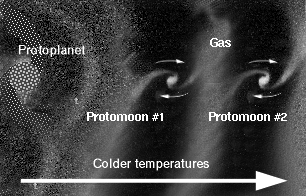
Titan is similar to the other icy moons, but Titan is the only icy moon to have a big atmosphere. It is natural to ask how is this possible? The nebula was colder near Saturn, than near Jupiter. The nebula...more

An Overview of Saturn's Interior

The Giant planets do not have the same layered structure that the terrestrial planets do. Their evolution was quite different than that of the terrestrial planets, and they have less solid material. Saturn's...more

Saturn's Strange Hexagon

Astronomers have discovered a strange shape in Saturn's atmosphere. The shape is a hexagon. The hexagon is near Saturn's North Pole. Scientists aren't quite sure why Saturn has the hexagon shape in its...more

The Liquid Hydrogen Layer

The first liquid layer inside Saturn, right under the atmosphere, is the liquid hydrogen layer. The hydrogen atmosphere becomes thicker and thicker, like a dense fog, with more and more liquid droplets,...more

The Structure of Saturn's Interior

There is no surface to the giant planets, only a gradual change from the atmosphere, as shown in this drawing. The gases which Saturn is mostly made of change to liquid inside Saturn, but the change is...more

An Overview of Motions in Saturn's Atmosphere

The most important motions in the atmosphere are winds. The major winds in Saturn's atmosphere are the zonal winds which are made of zones and belts. Zones are high pressure systems and belts are low pressure...more

Saturn's Belts and Zones

The striped cloud bands on Saturn, like Jupiter, are divided into belts and zones. In a belt, the wind flows very strongly in one direction only. In a zone, the wind flows very strongly in exactly the...more

Shop Windows to the Universe

The Spring 2011 issue of The Earth Scientist is focused on modernizing seismology education. Thanks to IRIS, you can download this issue for free as a pdf. Print copies are available in our online store.

Windows to the Universe, a project of the National Earth Science Teachers Association, is sponsored in part by the National Science Foundation and NASA, our Founding Partners (the American Geophysical Union and American Geosciences Institute) as well as through Institutional, Contributing, and Affiliate Partners, individual memberships and generous donors. Thank you for your support! NASA AGU AGI NSF