This is an image of Saturn in false color.
Click on image for full size
NASA
Saturn's Belts and Zones
The striped cloud bands on Saturn, like Jupiter, are divided into belts and zones.
In a belt, the wind flows very strongly in one direction only. In a zone, the wind flows very strongly in exactly the opposite direction. These kinds of winds are called "zonal winds".
Measurements show that the winds of Saturn, within a belt or a zone can reach 500 m/sec (1100 miles/hour), but are usually 100 m/sec (225 miles/hour). On Earth, the most powerful winds during a hurricane can blow 100 miles per hour. So these winds of Saturn provide for a pretty rough environment.
You might also be interested in:

The striped cloud bands on Jupiter are certainly not as straight as they appear to be in this picture! The picture shows that the striped pattern is divided into belts and zones. The belts and zones of
...more
The most important motions in the atmosphere are winds. The major winds in Saturn's atmosphere are the zonal winds which are made of zones and belts. Zones are high pressure systems and belts are low pressure
...more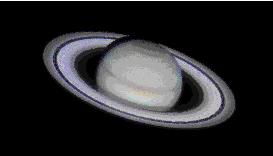
Saturn's atmospheric environment is one of strong gravity, high pressure, strong winds, from 225 miles per hour to 1000 miles per hour, and cold temperatures of -270 degrees to +80 degrees. With winds
...more
The striped cloud bands on Saturn, like Jupiter, are divided into belts and zones. In a belt, the wind flows very strongly in one direction only. In a zone, the wind flows very strongly in exactly the
...more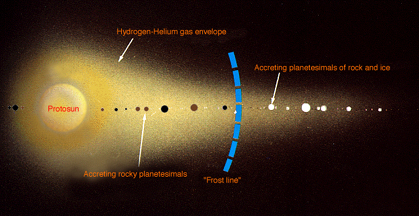
The position of the planets in the solar nebula greatly affected their 1. size and 2. composition. This is because of the effect of how cold it was in the nebula. 1. The nebula was a lot warmer close to
...more
As shown in this picture, while they were forming in the solar nebula, the nucleii of the planets-to-be (called protoplanets) drew material to themselves from the cloud of gas and dust around them. The
...more
Astronomers have discovered a strange shape in Saturn's atmosphere. The shape is a hexagon. The hexagon is near Saturn's North Pole. Scientists aren't quite sure why Saturn has the hexagon shape in its
...more