Orbit Shapes Interactive Animation
This animation explains about the shapes and sizes of orbits.
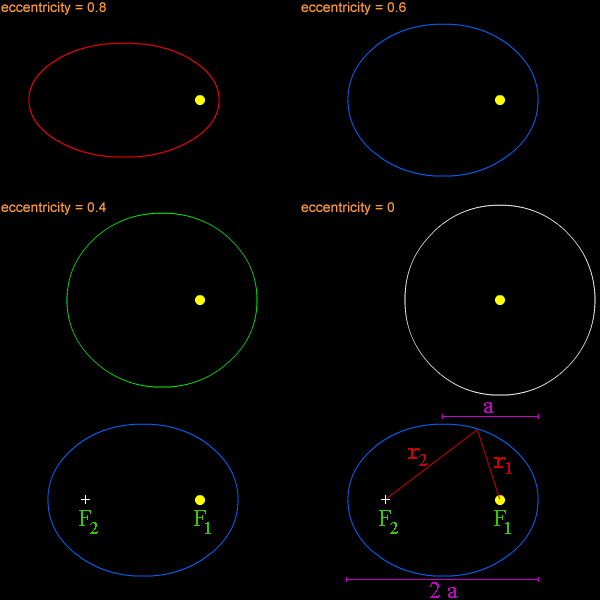
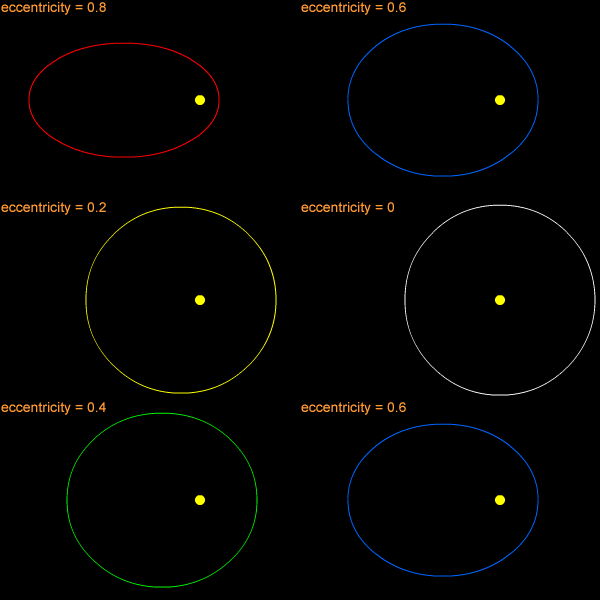
Orbits are ellipses. An ellipse is an oval, or a "stretched out" circle. An ellipse can be like a circle, or it can be long and skinny. Astronomers use a special word to describe the shape of an orbit. That word is "eccentricity". If an orbit is almost a circle, the eccentricity is small. If an orbit is a long, skinny ellipse, the eccentricity is bigger. A small eccentricity would be a number close to zero, like 0.1 or 0.2. A bigger eccentricity would be a number close to one, like 0.8 or 0.9. Eccentricity describes the shape of an orbit.
What about the size of an orbit? Think about a circle. The distance from the center of a circle to the edge is called the radius. The distance from the center of an ellipse to the edge is called the "semi-major axis". We measure the semi-major axis of an ellipse across the long direction of the ellipse.
Use the sliders in the animation (below) to change the shape and size of the orbit of "your planet". You can also see the orbit of Earth so you can compare your planet's orbit with Earth's orbit.
(Note: If you cannot see the animation below, or it is not working, you may need to download the latest Flash player.)
An astronomical unit (AU) is the length of the semi-major axis of Earth's orbit. AUs are used to measure distances in our Solar System.
Notice how a planet with an elliptical orbit moves closer to and further away from the Sun. The point of closest approach to the Sun is called perihelion. The furthest point is called aphelion.
An astronomer named Johannes Kepler figured out three important laws about the orbits of planets.