Current Events

  • Kansas Legislator Proposes Bill to Outlaw Sustainability Education
    A bill has been introduced in the Kansas legislature this week that would prohibit the promotion of ...Read more

    x

    Kansas Legislator Proposes Bill to Outlaw Sustainability Education

    A bill has been introduced in the Kansas legislature this week that would prohibit the promotion of sustainability. Here is a link to the one-page bill: http://www.kslegislature.org/li/b2013_14/measures/documents/hb2366_00_0000.pdf. See report on Bloomberg News.
  • Earth's Center Is 1,000 Degrees Hotter Than Previously Thought, Synchrotron X-Ray Experiment Shows
    Scientists have determined the temperature near the Earth’s center to be 6000 degrees Celsius, 1000 ...Read more

    x

    Earth's Center Is 1,000 Degrees Hotter Than Previously Thought, Synchrotron X-Ray Experiment Shows

    Scientists have determined the temperature near the Earth’s center to be 6000 degrees Celsius, 1000 degrees hotter than in a previous experiment run 20 years ago. These measurements confirm geophysical models that the temperature difference between the solid core and the mantle above, must be at least 1500 degrees to explain why the Earth has a magnetic field. For more information about this study, see the press release from the European Synchrotron Radiation Facility.
  • Ocean Volcanic Rocks Contain Samples of Recycled Crust
    Scientists have long believed that lava erupted from certain oceanic volcanoes contains materials fr...Read more

    x

    Ocean Volcanic Rocks Contain Samples of Recycled Crust

    Scientists have long believed that lava erupted from certain oceanic volcanoes contains materials from the early Earth’s crust. But decisive evidence for this phenomenon has proven elusive. New research from a team including Carnegie’s Erik Hauri demonstrates that oceanic volcanic rocks contain samples of recycled crust dating back to the Archean era 2.5 billion years ago. Their work is published in Nature. Oceanic crust sinks into the Earth’s mantle at so-called subduction zones, where two plates come together. Much of what happens to the crust during this journey is unknown. Model-dependent studies for how long subducted material can exist in the mantle are uncertain and evidence of very old crust returning to Earth’s surface via upwellings of magma has not been found until now. For more information about these results, see the press release from the Carnegie Institution.
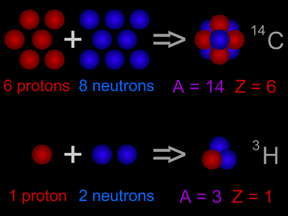
This picture explains the idea of "atomic mass". The carbon atom (14C) nucleus on the top has 6 protons plus 8 neutrons. It has an atomic mass of 14. Tritium (3H), an isotope of hydrogen, is shown on the bottom. It has 1 proton plus 2 neutrons in its nucleus. Tritium has an atomic mass of 3.
Click on image for full size
Original artwork by Windows to the Universe staff (Randy Russell).

Atomic Mass

One way scientists measure the size of something is by its mass. Scientists can even measure very, very tiny things like atoms. One measure of the size of an atom is its "atomic mass". Almost all of the mass of an atom (more than 99%) is in its nucleus, so "atomic mass" is pretty much a measure of the size of the nucleus of an atom.

The nucleus of an atom is made up of protons and neutrons. Protons and neutrons are almost exactly the same size. If you add up the number of protons and neutrons in the nucleus of an atom, you get that atom's atomic mass. A simple hydrogen atom has just one proton and zero neutrons. Its atomic mass is 1. The most common kind of carbon atom has 6 neutrons and 6 protons. It has an atomic mass of 12.

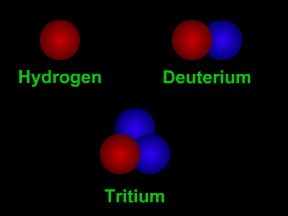
All atoms of a certain element have the same number of protons. Oxygen atoms always have 8 protons; carbon atoms all have 6 protons. Most atoms come in different types called isotopes. Isotopes have different numbers of neutrons. The most common isotope of carbon has 6 neutrons and 6 protons. Its atomic mass is 12. A rare, radioactive isotope of carbon has 8 neutrons. Its atomic mass is 14 ( = 6 protons + 8 neutrons).

In chemistry, the number of protons in an atom is more important than the number of neutrons. Scientists call the number of protons the "atomic number". Normal atoms have the same number of electrons as protons. The number of electrons is the main thing that controls how atoms behave in chemical reactions. Scientists use the letter "Z" to stand for atomic number and the letter "A" to stand for atomic mass.

Last modified August 26, 2009 by Randy Russell.

Shop Windows to the Universe Science Store!

Our online store includes issues of NESTA's quarterly journal, The Earth Scientist, full of classroom activities on different topics in Earth and space science, ranging from seismology, rocks and minerals, oceanography, and Earth system science to astronomy!

Windows to the Universe Community

News

Opportunities

You might also be interested in:

Cool It! Game

Check out our online store - minerals, fossils, books, activities, jewelry, and household items!...more

Element (Chemical Element)

An element (also called a "chemical element") is a substance made up entirely of atoms having the same atomic number; that is, all of the atoms have the same number of protons. Hydrogen, helium, oxygen,...more

Isotope

Isotopes are different "versions" of an element. All atoms of an element have the same number of protons. For example, all hydrogen atoms have one proton, all carbon atoms have 6 protons, and all uranium...more

Atomic Number

The nucleus of an atom has protons and neutrons in it. Each element (like carbon or oxygen or gold) has a different number of protons in its atoms. Scientists have a special name for the number of protons...more

Carbon-14

Carbon-14 is an isotope of the element carbon. All carbon atoms have 6 protons in their nucleus. Most carbon atoms also have 6 neutrons, giving them an atomic mass of 12 ( = 6 protons + 6 neutrons). Carbon-14...more

ExploraTour: A Peek into the Lives of the Stars

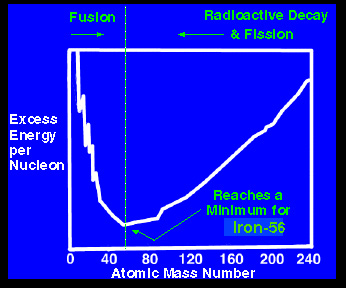
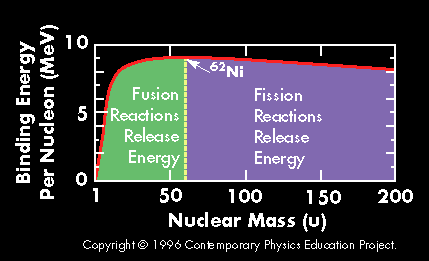
The diagram at the left gives the answer to that question. It shows the excess energy per nucleon plotted against the atomic mass number of an element. To illustrate what that means let's consider one...more

Binding Energy

A plot of the binding energy per nucleon vs. atomic mass shows a peak atomic number 56 (Iron). Elements with atomic mass less then 56 release energy if formed as a result of a fusion reaction. Above this...more

Atomic Physics & Particle Physics

Atoms and the tiny particles from which they are made strongly influence the world around us. The fields of atomic physics and particle physics help us understand the life cycles of stars, the forms of...more

Shop Windows to the Universe

Arches National Park Geology Tour provides an extensive, visually rich description of the geology of Arches, by Deborah Ragland, Ph.D. See our DVD collection.

Windows to the Universe, a project of the National Earth Science Teachers Association, is sponsored in part by the National Science Foundation and NASA, our Founding Partners (the American Geophysical Union and American Geosciences Institute) as well as through Institutional, Contributing, and Affiliate Partners, individual memberships and generous donors. Thank you for your support! NASA AGU AGI NSF