Current Events

  • Irish Chronicles Document Links Between Volcanoes and Weather
    A study of over 40,000 written entries in Irish Annals and ice core measurements shows a strong corr...Read more

    x

    Irish Chronicles Document Links Between Volcanoes and Weather

    A study of over 40,000 written entries in Irish Annals and ice core measurements shows a strong correlation between the occurrence of volcanic eruptions and extreme cold weather in Ireland over a 1200 year period. Data analyzed in this study cover the period from 431 to 1649, during which time up to 48 volcanic eruptions are identified in Greenland ice core records through deposition of volcanic sulfate in annual layers of ice. You can find the study (open access), published on 6 June 2013 in IOP Publishing's journal Environmental Research Letters, at http://iopscience.iop.org/1748-9326/8/2/024035/article. Find out more about how volcanoes can influence climate.
  • EF-5 Tornado in El Reno, Oklahoma Widest Ever Recorded in US
    The EF-5 tornado that hit El Reno, Oklahoma on May 31st was the widest ever recorded in the US, acco...Read more

    x

    EF-5 Tornado in El Reno, Oklahoma Widest Ever Recorded in US

    The EF-5 tornado that hit El Reno, Oklahoma on May 31st was the widest ever recorded in the US, according to the National Weather Service in Norman Oklahoma. The tornado, which remained on the ground for 40 minutes and reached 2.6 miles across (4.2 km), took the lives of 18 people including storm chasers Tim Samaras, Paul Samaras and Carl Young. For more information on the tornado, visit http://ow.ly/i/2hfDG.
  • Atmospheric CO2 Level Tops 400 ppm
    During the week of May 13th, the CO2 level at the Mauna Loa Observatory in Hawaii topped 400 ppm rep...Read more

    x

    Atmospheric CO2 Level Tops 400 ppm

    During the week of May 13th, the CO2 level at the Mauna Loa Observatory in Hawaii topped 400 ppm repeatedly. Daily levels of CO2 can vary due to weather, and there are seasonal trends as well. The level of atmospheric greenhouse gases continues to increase, now over 120 ppm since the Industrial Revolution began. For more on the Keeling Curve, see http://keelingcurve.ucsd.edu/. Find out more about greenhouse gases and warming.
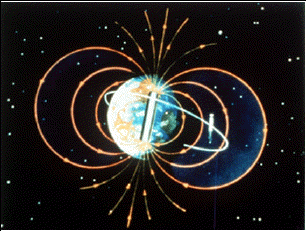
This is a drawing of Earth with its magnetic field.
Click on image for full size
NASA

Planetary Magnets

The Earth is a good example of a planetary dipole, where the lines of force point in a direction out of the South (magnetic) Pole and into the North (magnetic) Pole. Planets can also show evidence of quadrupoles (4 poles) and octupoles (8-poles). Jupiter and Saturn are good examples of multi-pole planetary magnetism.

Not every planet has a magnetic field. It takes special conditions to generate a magnetic field within a planet. Other planets known to have a magnetosphere include Mercury, Mars (perhaps), Jupiter, Saturn, Uranus, and Neptune. Venus is special case of a rocky planet with no magnetic field.

Last modified June 23, 2010 by Randy Russell.

Shop Windows to the Universe Science Store!

Our online store includes issues of NESTA's quarterly journal, The Earth Scientist, full of classroom activities on different topics in Earth and space science, as well as books on science education!

Windows to the Universe Community

News

Opportunities

You might also be interested in:

Cool It! Game

Check out our online store - minerals, fossils, books, activities, jewelry, and household items!...more

The Earth's Magnetosphere

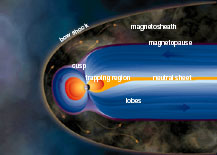
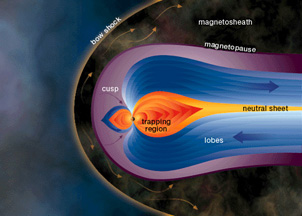
The Earth has a magnetic field with north and south poles. The magnetic field of the Earth is enclosed in a region surrounding the Earth called the magnetosphere. As the Earth rotates, its hot core generates...more

Detecting Planetary Magnetism

A magnetometer is an instrument for measuring magnetic fields. Many spacecraft carry magnetometers to measure the magnetic fields around planets they orbit or fly by. When a spacecraft takes such measurements,...more

Space Weather throughout the Solar System

The Sun is surrounded by a "bubble" in space called the heliosphere. In a sense, we Earthlings live within the outer atmosphere of our Sun. The solar wind fills the heliosphere with energetic...more

The Sun's Magnetic Field

The Sun has a very large and very complex magnetic field. The magnetic field at an average place on the Sun is around 1 Gauss, about twice as strong as the average field on the surface of Earth (around...more

Earth's Magnetic Poles

Earth has a magnetic field. If you imagine a gigantic bar magnet inside of Earth, you'll have a pretty good idea what Earth's magnetic field is shaped like. Of course, Earth DOESN'T have a giant bar magnet...more

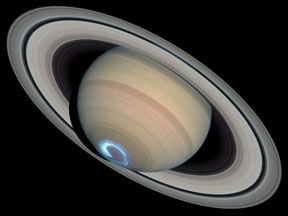
The Poles of Saturn and Its Moons

There's a lot of strange and interesting stuff going on at both the North and South Poles of Saturn. Features at the poles of two of Saturn's moons, Titan and Enceladus, have also grabbed the attention...more

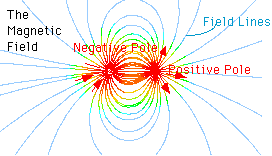
The Magnetic Field

The force of magnetism causes material to point along the direction the magnetic force points. This property implies that the force of magnetism has a direction. As shown in the diagram to the left, the...more

Shop Windows to the Universe

With Explore the Planets, investigate the planets, their moons, and understand the processes that shape them. By G. Jeffrey Taylor, Ph.D. See our DVD collection.

Windows to the Universe, a project of the National Earth Science Teachers Association, is sponsored in part by the National Science Foundation and NASA, our Founding Partners (the American Geophysical Union and American Geosciences Institute) as well as through Institutional, Contributing, and Affiliate Partners, individual memberships and generous donors. Thank you for your support! NASA AGU AGI NSF