Current Events

  • Atmospheric CO2 Level Tops 400 ppm
    During the week of May 13th, the CO2 level at the Mauna Loa Observatory in Hawaii topped 400 ppm rep...Read more

    x

    Atmospheric CO2 Level Tops 400 ppm

    During the week of May 13th, the CO2 level at the Mauna Loa Observatory in Hawaii topped 400 ppm repeatedly. Daily levels of CO2 can vary due to weather, and there are seasonal trends as well. The level of atmospheric greenhouse gases continues to increase, now over 120 ppm since the Industrial Revolution began. For more on the Keeling Curve, see http://keelingcurve.ucsd.edu/. Find out more about greenhouse gases and warming.
  • Massive Tornado Outbreak on Tornado Alley
    The week of May 19 brings dozens of tornadoes to Tornado Alley in the states of Oklahoma, Kansas, Io...Read more

    x

    Massive Tornado Outbreak on Tornado Alley

    The week of May 19 brings dozens of tornadoes to Tornado Alley in the states of Oklahoma, Kansas, Iowa, Illinois and Missouri. On May 20th, a massive tornado struck Moore, Oklahoma, devastating communities - destroying over 100 homes and hitting two elementary schools and a hospital - with many casualties and deaths. Our thoughts are with our friends and colleagues suffering from these storms. For more on the May 20th storms, see the NOAA Storm Prediction Center Storm Report.
  • Kansas Legislator Proposes Bill to Outlaw Sustainability Education
    A bill has been introduced in the Kansas legislature this week that would prohibit the promotion of ...Read more

    x

    Kansas Legislator Proposes Bill to Outlaw Sustainability Education

    A bill has been introduced in the Kansas legislature this week that would prohibit the promotion of sustainability. Here is a link to the one-page bill: http://www.kslegislature.org/li/b2013_14/measures/documents/hb2366_00_0000.pdf. See report on Bloomberg News.
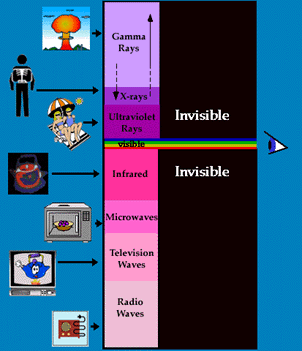
Visible light is just a small part of the entire electromagnetic spectrum.
Click on image for full size
Windows to the Universe original artwork.

The Electromagnetic Spectrum

Light is a form of electromagnetic radiation that is very familiar to us. However, there are several other forms of electromagnetic (EM) radiation, such as X-rays, radio waves, and ultraviolet and infrared "light". Together, these different types of EM radiation make up the electromagnetic spectrum.

Each section of the electromagnetic (EM) spectrum has characteristic energy levels, wavelengths, and frequencies associated with its photons. Gamma rays have the highest energies, the shortest wavelengths, and the highest frequencies. Radio waves, on the other hand, have the lowest energies, longest wavelengths, and lowest frequencies of any type of EM radiation. In order from highest to lowest energy, the sections of the EM spectrum are named: gamma rays, X-rays, ultraviolet radiation, visible light, infrared radiation, and radio waves. Microwaves (like the ones used in microwave ovens) are a subsection of the radio wave section of the EM spectrum.

Last modified June 23, 2005 by Randy Russell.

Shop Windows to the Universe Science Store!

Our online store includes issues of NESTA's quarterly journal, The Earth Scientist, full of classroom activities on different topics in Earth and space science, ranging from seismology, rocks and minerals, oceanography, and Earth system science to astronomy!

Windows to the Universe Community

News

Opportunities

You might also be interested in:

Cool It! Game

Check out our online store - minerals, fossils, books, activities, jewelry, and household items!...more

Electromagnetic Radiation

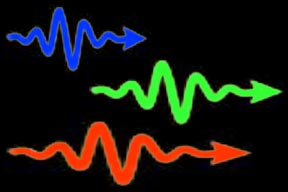
Electromagnetic radiation is the result of oscillating electric and magnetic fields. The wave of energy generated by such vibrations moves through space at the speed of light. And well it should... for...more

Photon

Light is very strange. Sometimes it is best to think of light as a series of waves. At other times, it is useful to think of light as a swarm of particles. When we think of light as particles, we call...more

Radio Waves

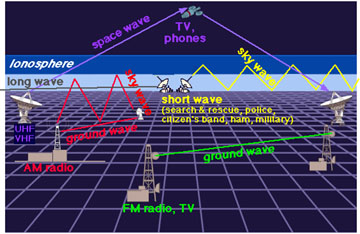
Radio waves are a type of electromagnetic radiation. A radio wave has a much longer wavelength than does visible light. We use radio waves extensively for communications. Radio waves have wavelengths as...more

Hubble Space Telescope

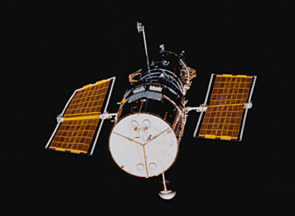
The Hubble Space Telescope (HST) was one of the most important exploration tools of the past two decades, and will continue to serve as a great resource well into the new millennium. The HST found numerous...more

Atomic Physics & Particle Physics

Atoms and the tiny particles from which they are made strongly influence the world around us. The fields of atomic physics and particle physics help us understand the life cycles of stars, the forms of...more

Radiation

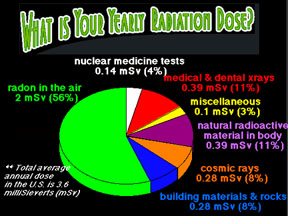
Radiation comes in two basic types: electromagnetic radiation transmitted by photons, and particle radiation consisting of electrons, protons, alpha particles, and so forth. Electromagnetic radiation,...more

The Magnetic Field

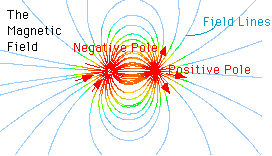
The force of magnetism causes material to point along the direction the magnetic force points. As shown in the diagram to the left, the force of magnetism is illustrated by lines, which represent the force....more

Shop Windows to the Universe

We now offer the Cool It! card game in our Science Store. Cool It! is the new card game from UCS that teaches kids about the choices we have when it comes to climate change.

Windows to the Universe, a project of the National Earth Science Teachers Association, is sponsored in part by the National Science Foundation and NASA, our Founding Partners (the American Geophysical Union and American Geosciences Institute) as well as through Institutional, Contributing, and Affiliate Partners, individual memberships and generous donors. Thank you for your support! NASA AGU AGI NSF