Current Events

  • Kansas Legislator Proposes Bill to Outlaw Sustainability Education
    A bill has been introduced in the Kansas legislature this week that would prohibit the promotion of ...Read more

    x

    Kansas Legislator Proposes Bill to Outlaw Sustainability Education

    A bill has been introduced in the Kansas legislature this week that would prohibit the promotion of sustainability. Here is a link to the one-page bill: http://www.kslegislature.org/li/b2013_14/measures/documents/hb2366_00_0000.pdf. See report on Bloomberg News.
  • Earth's Center Is 1,000 Degrees Hotter Than Previously Thought, Synchrotron X-Ray Experiment Shows
    Scientists have determined the temperature near the Earth’s center to be 6000 degrees Celsius, 1000 ...Read more

    x

    Earth's Center Is 1,000 Degrees Hotter Than Previously Thought, Synchrotron X-Ray Experiment Shows

    Scientists have determined the temperature near the Earth’s center to be 6000 degrees Celsius, 1000 degrees hotter than in a previous experiment run 20 years ago. These measurements confirm geophysical models that the temperature difference between the solid core and the mantle above, must be at least 1500 degrees to explain why the Earth has a magnetic field. For more information about this study, see the press release from the European Synchrotron Radiation Facility.
  • Ocean Volcanic Rocks Contain Samples of Recycled Crust
    Scientists have long believed that lava erupted from certain oceanic volcanoes contains materials fr...Read more

    x

    Ocean Volcanic Rocks Contain Samples of Recycled Crust

    Scientists have long believed that lava erupted from certain oceanic volcanoes contains materials from the early Earth’s crust. But decisive evidence for this phenomenon has proven elusive. New research from a team including Carnegie’s Erik Hauri demonstrates that oceanic volcanic rocks contain samples of recycled crust dating back to the Archean era 2.5 billion years ago. Their work is published in Nature. Oceanic crust sinks into the Earth’s mantle at so-called subduction zones, where two plates come together. Much of what happens to the crust during this journey is unknown. Model-dependent studies for how long subducted material can exist in the mantle are uncertain and evidence of very old crust returning to Earth’s surface via upwellings of magma has not been found until now. For more information about these results, see the press release from the Carnegie Institution.
This is a thermogram of a house, an IR view of a house. It shows variations in the amount of heat that escapes from a home. Greater heat loss appears in red. Blue indicates areas where little or no heat radiates from the building.
Click on image for full size
Daedalus Enterprises, Inc., Ann Arbor, MI

Infrared (IR) Radiation

Infrared (IR) radiation is a type of electromagnetic radiation. Infrared "light" has a longer wavelength than visible light. Red light has a longer wavelength than other colors of light, and infrared has even longer waves than red does; so infrared is sort of "redder-than-red" light or "beyond red" light. We cannot see infrared radiation, but we can sometimes feel it as heat.

Infrared radiation lies between visible light and radio waves on the electromagnetic spectrum. IR light has wavelengths between about 1 millimeter and 750 nanometers. The wavelength of red light is 700 nanometers (or 7,000 Å). Infrared radiation oscillates at rates between 300 gigahertz (GHz or 109 hertz) and 400 terahertz (THz or 1012 hertz).

The infrared spectrum is sometimes subdivided into the far infrared (1 mm to 10 µm wavelengths), mid infrared (10 to 2.5 µm wavelengths), and near infrared (2,500 to 750 nm wavelengths). A portion of the far IR, including wavelengths between 100 and 1,000 µm, is sometimes referred to as the extreme infrared. Boundaries aren't always distinct, and difference between extreme IR radiation and microwave radio frequencies is less than crystal clear.

We feel infrared radiation as heat. The heat our hand feels when placed above a burner on an electric stovetop after the burner has been turned off (and is no longer glowing red) but has not yet cooled is infrared radiation.

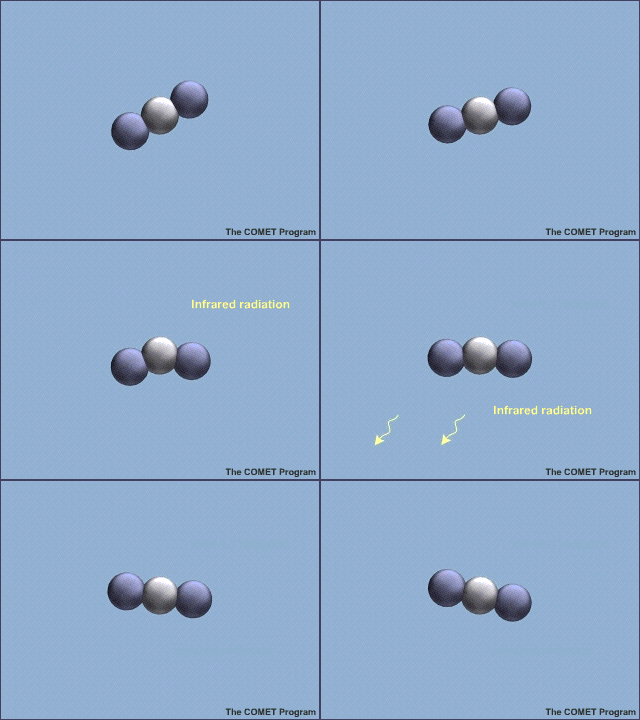
Earth's atmosphere is opaque to much of the infrared part of the spectrum. Water vapor, carbon dioxide, methane, and other greenhouse gases tend to absorb IR radiation, trapping extra heat in Earth's lower atmosphere.

Night vision goggles and TV remote controls both make use of infrared "light" to accomplish their tasks.

Last modified July 13, 2005 by Randy Russell.

Shop Windows to the Universe Science Store!

Our online store includes issues of NESTA's quarterly journal, The Earth Scientist, full of classroom activities on different topics in Earth and space science, ranging from seismology, rocks and minerals, oceanography, and Earth system science to astronomy!

Windows to the Universe Community

News

Opportunities

You might also be interested in:

Traveling Nitrogen Classroom Activity Kit

Check out our online store - minerals, fossils, books, activities, jewelry, and household items!...more

Electromagnetic Radiation

Electromagnetic radiation is the result of oscillating electric and magnetic fields. The wave of energy generated by such vibrations moves through space at the speed of light. And well it should... for...more

Radio Waves

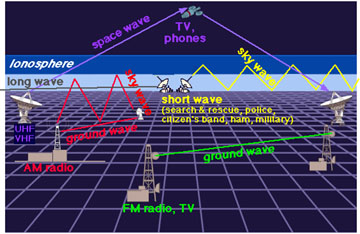
Radio waves are a type of electromagnetic radiation. A radio wave has a much longer wavelength than does visible light. We use radio waves extensively for communications. Radio waves have wavelengths as...more

Earth's Greenhouse Gases

Less than 1% of the gases in Earth's atmosphere are called greenhouse gases. Even though they are not very abundant, these greenhouse gases have a major effect. Carbon dioxide (CO2), water vapor (H2O),...more

Earth's Radiation Budget

Sunlight streams into Earth's atmosphere from space. Some is reflected away by clouds and snow-covered landscapes. Light that makes it to the ground is absorbed and heats Earth's surface and oceans. The...more

Hubble Space Telescope

The Hubble Space Telescope (HST) was one of the most important exploration tools of the past two decades, and will continue to serve as a great resource well into the new millennium. The HST is credited...more

Photon

Light is very strange. Sometimes it is best to think of light as a series of waves. At other times, it is useful to think of light as a swarm of particles. When we think of light as particles, we call...more

Electricity and Magnetism

Electricity and magnetism are two closely related and very important topics within the science of physics. We use electricity to power computers and to make motors go. Magnetism makes a compass point North...more

Shop Windows to the Universe

Hands On Mineral Identification helps you to identify over 14,500 minerals! By M. Darby Dyar, Ph.D. See our DVD collection.

Windows to the Universe, a project of the National Earth Science Teachers Association, is sponsored in part by the National Science Foundation and NASA, our Founding Partners (the American Geophysical Union and American Geosciences Institute) as well as through Institutional, Contributing, and Affiliate Partners, individual memberships and generous donors. Thank you for your support! NASA AGU AGI NSF