Current Events

  • Kansas Legislator Proposes Bill to Outlaw Sustainability Education
    A bill has been introduced in the Kansas legislature this week that would prohibit the promotion of ...Read more

    x

    Kansas Legislator Proposes Bill to Outlaw Sustainability Education

    A bill has been introduced in the Kansas legislature this week that would prohibit the promotion of sustainability. Here is a link to the one-page bill: http://www.kslegislature.org/li/b2013_14/measures/documents/hb2366_00_0000.pdf. See report on Bloomberg News.
  • Earth's Center Is 1,000 Degrees Hotter Than Previously Thought, Synchrotron X-Ray Experiment Shows
    Scientists have determined the temperature near the Earth’s center to be 6000 degrees Celsius, 1000 ...Read more

    x

    Earth's Center Is 1,000 Degrees Hotter Than Previously Thought, Synchrotron X-Ray Experiment Shows

    Scientists have determined the temperature near the Earth’s center to be 6000 degrees Celsius, 1000 degrees hotter than in a previous experiment run 20 years ago. These measurements confirm geophysical models that the temperature difference between the solid core and the mantle above, must be at least 1500 degrees to explain why the Earth has a magnetic field. For more information about this study, see the press release from the European Synchrotron Radiation Facility.
  • Ocean Volcanic Rocks Contain Samples of Recycled Crust
    Scientists have long believed that lava erupted from certain oceanic volcanoes contains materials fr...Read more

    x

    Ocean Volcanic Rocks Contain Samples of Recycled Crust

    Scientists have long believed that lava erupted from certain oceanic volcanoes contains materials from the early Earth’s crust. But decisive evidence for this phenomenon has proven elusive. New research from a team including Carnegie’s Erik Hauri demonstrates that oceanic volcanic rocks contain samples of recycled crust dating back to the Archean era 2.5 billion years ago. Their work is published in Nature. Oceanic crust sinks into the Earth’s mantle at so-called subduction zones, where two plates come together. Much of what happens to the crust during this journey is unknown. Model-dependent studies for how long subducted material can exist in the mantle are uncertain and evidence of very old crust returning to Earth’s surface via upwellings of magma has not been found until now. For more information about these results, see the press release from the Carnegie Institution.

Bar Magnet and Compass Interactive

The black rectangle represents a bar magnet. The magnet's North and South poles are labeled. The other item represents a compass; the red end of the needle is the end that would point towards Earth's North Magnetic Pole. Notice that the red end of the compass needle points toward the south pole of the magnet. For historical reasons, what we call "Earth's North Magnetic Pole" is actually the south pole of Earth's magnetic field! Yikes!

Drag either the compass or the magnet around to explore the magnetic field around the bar magnet. Can you determine the shape of the magnetic field?

(Note: If you cannot see the animation below, or it is not working properly, you may need to download the latest Flash player.)

This is an early draft version of this activity. We expect to replace it with a better version soon. Some things to be aware of:

  • If you drag either the compass or the magnet off screen and let go, you won't have any way to get them back. Reload/refresh the web page to start over.
  • The behavior of the compass might be a bit different in the real world when you place it on top of the magnet.
Last modified August 22, 2007 by Randy Russell.

Shop Windows to the Universe Science Store!

Our online store includes issues of NESTA's quarterly journal, The Earth Scientist, full of classroom activities on different topics in Earth and space science, ranging from seismology, rocks and minerals, oceanography, and Earth system science to astronomy!

Windows to the Universe Community

News

Opportunities

You might also be interested in:

Traveling Nitrogen Classroom Activity Kit

Check out our online store - minerals, fossils, books, activities, jewelry, and household items!...more

Earth's Magnetic Poles

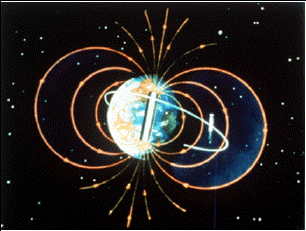
Earth has a magnetic field. If you imagine a gigantic bar magnet inside of Earth, you'll have a pretty good idea what Earth's magnetic field is shaped like. Of course, Earth DOESN'T have a giant bar magnet...more

The Magnetic Field

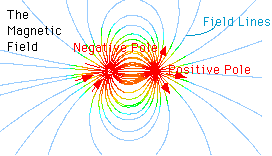
The force of magnetism causes material to point along the direction the magnetic force points. This property implies that the force of magnetism has a direction. As shown in the diagram to the left, the...more

The Sun's Magnetic Field

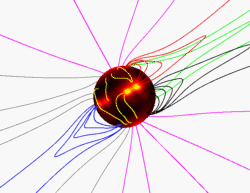
The Sun has a very large and very complex magnetic field. The magnetic field at an average place on the Sun is around 1 Gauss, about twice as strong as the average field on the surface of Earth (around...more

Earth's North Magnetic Pole

Earth has a global magnetic field that is approximately, though not exactly, a dipole field (like a bar magnet) with a north pole and a south pole. Earth's North Magnetic Pole (NMP) is not in the same...more

The Magnetic Poles of Uranus

The planet Uranus has an odd magnetic field. The planet's magnetic poles are nowhere near the geographic poles (as defined by the spin axis) of Uranus. A portion of the magnetic field of Uranus is a dipole...more

Planetary Magnets

The Earth is a good example of a planetary dipole, where the lines of force point in a direction out of the South (magnetic) Pole and into the North (magnetic) Pole. Planets can also show evidence of quadrupoles...more

Detecting Planetary Magnetism

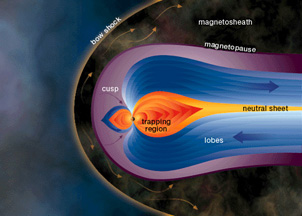
A magnetometer is an instrument for measuring magnetic fields. Many spacecraft carry magnetometers to measure the magnetic fields around planets they orbit or fly by. When a spacecraft takes such measurements,...more

Shop Windows to the Universe

The Winter 2010 issue of The Earth Scientist includes a variety of educational resources, ranging from astronomy to glaciers. Check out the other publications and classroom materials in our online store.

Windows to the Universe, a project of the National Earth Science Teachers Association, is sponsored in part by the National Science Foundation and NASA, our Founding Partners (the American Geophysical Union and American Geosciences Institute) as well as through Institutional, Contributing, and Affiliate Partners, individual memberships and generous donors. Thank you for your support! NASA AGU AGI NSF